Felix Laurent

Google released Gemini 4 Neon on November 18, 2026. It is the fourth Gemini 4 model in five weeks. Google describes Neon as a fast reasoning model with quality close to Gemini 4 Carbon at a lower price. It is generally available in the Gemini API at $3 per million input tokens and $15 per million output tokens. It is also rolling out in the Gemini app and in Antigravity, Google's coding agent platform.
Google launched it quietly. Neon appeared in the API docs, on Vertex AI and in app menus before Google's launch post. On X, Sundar Pichai only posted "Happy WedNEsday!", with Ne being the chemical symbol for neon.
What Gemini 4 Neon is
Google places Neon between its two most recent models. Hydrogen is the everyday model for coding and agent work, and Carbon is the most capable one. The Vertex AI listing says Neon "builds on Gemini 4 Hydrogen with deeper reasoning" and reaches quality close to Carbon "at Flash-tier speed and cost".
The Gemini API guide recommends each model for different work:
- Hydrogen: the default for everyday coding and agent workflows.
- Neon: complex software engineering, knowledge work and science tasks that need fast results.
- Carbon: the hardest architecture, debugging, science and security problems.
Google lists several improvements for Neon. It fixes bugs across a repository and refactors many files in fewer steps. In long sessions with many tool calls it reads fewer files twice and handles context compaction reliably. Google also says it makes up fewer claims, writes code with fewer security holes and takes fewer shortcuts on tasks.
The technical specs match the rest of the family:
| Spec | Gemini 4 Neon |
|---|---|
| Model ID | gemini-4-neon |
| Context window | 1,048,576 tokens, shared by input, thinking and output |
| Max output | 65,536 tokens, up to 1M with long decode |
| Input | Text, image, video, audio, PDF |
| Output | Text |
| Thinking levels | low, medium, high (default), xhigh |
| Tools | Function calling, code execution, computer use, Search and Maps grounding, file search |
Neon cannot generate images or audio and does not work with the Live API. In Gemini Managed Agents, the Antigravity agent can run Neon alone or pair it with Hydrogen.
Google's own test results show how Neon compares with rival models.
Gemini 4 Neon benchmarks
Google published Neon's results with its launch post and an evaluation report from DeepMind. Its comparison is with models of a similar class: Claude Opus 5.5 and GPT-6.2 Sol. Most rival numbers come from the providers' own reports, and Google ran several tests itself.
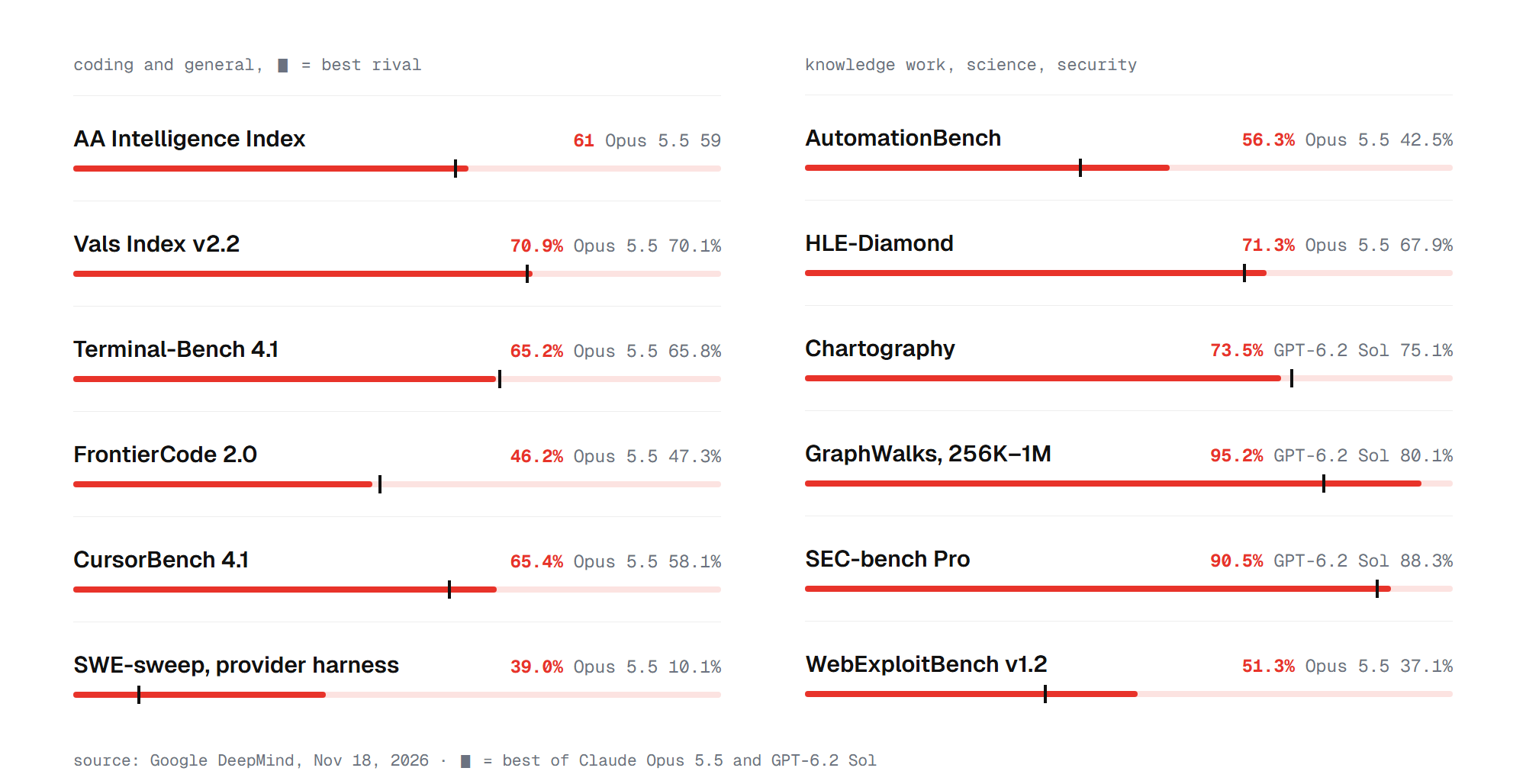
Neon leads on most of Google's list. It loses narrowly to Opus 5.5 on Terminal-Bench 4.1 and FrontierCode 2.0, and to GPT-6.2 Sol on chart reading. The widest gaps are on AutomationBench, Zapier's test of business automation, and on SWE-sweep. On that bug-hunting test Neon scores 39.0% in Google's Antigravity harness against 10.1% for Opus 5.5 in Claude Code. In a neutral harness the gap shrinks to 12.8% against 3.6%.
The Artificial Analysis score puts Neon third overall. Google says it lands "just behind larger, slower models". On that index, those are Claude Fable 5.2 at 65 and GPT-6.2 Astra at 62. Carbon scores 60, one point below Neon. On Artificial Analysis' Coding Agent Index, Neon is first with 58.6.
Real-world rankings point the same way. Neon debuted second on Arena's Agent Arena Index with 1,336 points across more than 4,200 sessions, behind Claude Fable 5.2. It is also second there on steerability.
Google adds cost to the case. At the default high level, Neon costs 32% less per task than Carbon on the Artificial Analysis tests. Against top rival models, Google puts the savings at 50% to 80% per task.
What Gemini 4 Neon can do in Antigravity and the Gemini app
Google showed Neon on long projects in Antigravity. There it can work alone or act as an Orchestrator that hands parts of a task to parallel Hydrogen subagents. Four of Google's demos show the scale:
- A ski simulator from scratch. Neon wrote a first-person freeride skiing game in WebGL2 on real Mont Blanc and Chamonix terrain. It has 10,200 lines of custom shaders, six alpine runs, carved tracks, slab avalanches and spatial sound, with no ready-made assets.
- Alan Turing's study in 3D. Using the /swarm command, Neon pulled archival photos and rebuilt Turing's 1936 room at King's College, Cambridge. A working Universal Turing Machine sits on the desk.
- An image inside a spreadsheet. A swarm of Neon agents turned one image into a Google Sheet of 100,000 cells. More than 500,000 formulas run edge detection, depth mapping and relighting, with no embedded images or Apps Script.
- A 3D lab bench in Blender. Through Blender MCP, Neon built a photorealistic bench where Bunsen flames stand for Carbon and Hydrogen, and glowing gas tubes stand for Argon and Neon.
In the Gemini app, Neon appears as the model for deeper analysis. It reads spreadsheets, PDFs and photos and pulls details from Gmail and Docs. Tasks in Gemini, the app's multi-step jobs, can now run on Neon. Google's examples include finding out why a utility bill spiked or cross-checking receipts to ask for a refund.
Google also stresses reliability. Neon took shortcuts on 2.45% of tasks in Google's coding cheating test, the lowest rate of any Gemini 4 model. It passed 99.2% of Google's agent honesty checks. At its highest thinking level with real-time safeguards, it resisted every indirect prompt injection attack in Gray Swan's benchmark. A separate Neon for cyber version goes to vetted security teams through Google's Fairwind Program in the coming days.
The price shows where Neon sits in the family.
Gemini 4 Neon price compared with Carbon and Hydrogen
In the Gemini API, the new model costs exactly twice as much as Gemini 4 Hydrogen and is not on the free tier. Its place against Carbon depends on the date.
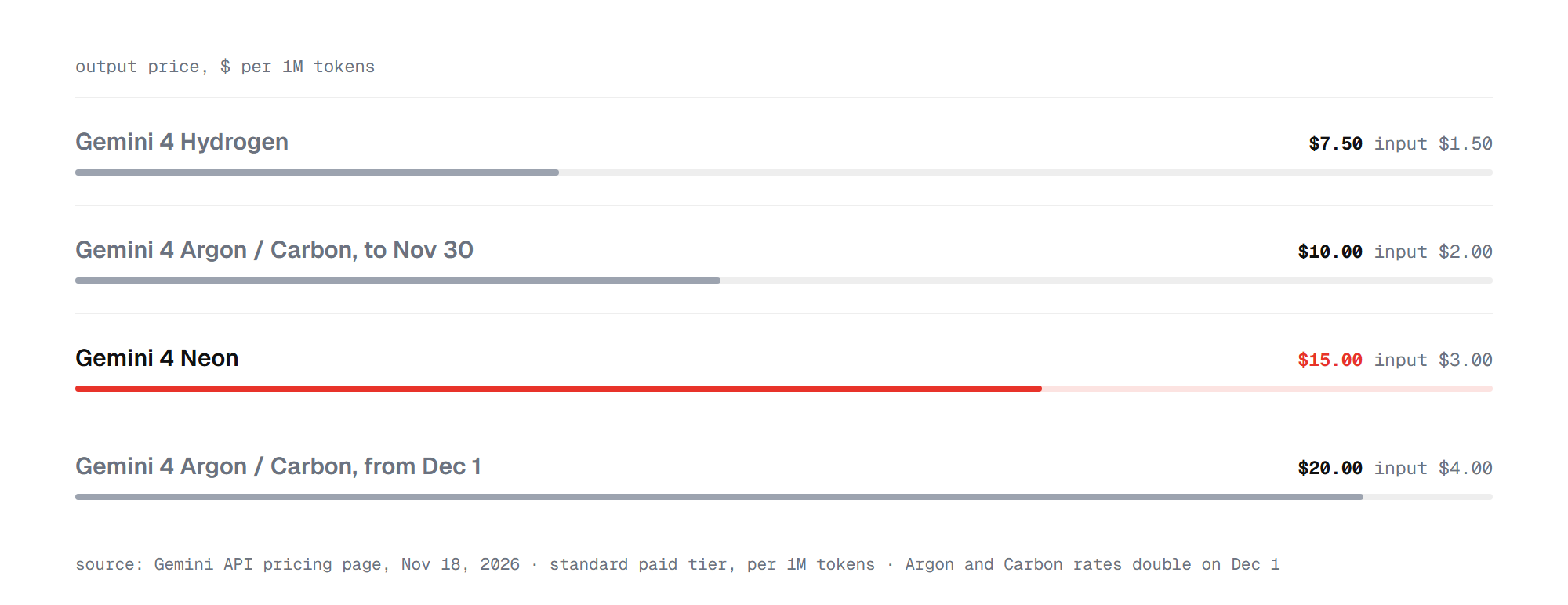
Until November 30, Neon is 50% more expensive than Carbon. On December 1, Carbon's price doubles to $4 and $20, and Neon becomes 25% cheaper than Carbon. Batch and Flex requests for Neon cost half, at $1.50 and $7.50. Priority requests cost $5.40 and $27.
Where to use Gemini 4 Neon
The model is available in four places:
- Gemini API and Google AI Studio. The model is listed as stable. In AI Studio it is open to Google AI Pro and Ultra subscribers.
- Vertex AI. The Model Garden page went live on November 18, with Provisioned Throughput available.
- Gemini app. Neon is rolling out gradually as "Deeper analysis" in the model menu. It sits between Hydrogen for "Everyday help" and Carbon for "Code & complex work".
- Antigravity. Users reported Neon in the model list on November 18. Some said it showed up and then disappeared during the rollout. Google says it is open to paid Google AI Pro and Ultra subscribers.
Before the release, Neon had leaked in several places over three days. On November 16, TestingCatalog found it in the Gemini web app's code. Two days later it showed up on Google Cloud's quotas page and in the billing catalog. A new Antigravity CLI build also listed a "gemini-pro-orchestrator-neon" option. The quick path from first leak to release fits a wider pattern.
Is Google speeding up Gemini 4 releases?
The pace is unusual. Google released Gemini 4 Argon on October 13, Carbon on November 10, Hydrogen on November 12 and Neon on November 18. Genie 4 launched in Project Genie on the same day as Neon. That makes four language models with element names in five weeks, each filling a different price point.
LuminaBench joked that Google is "just having fun with RSI". RSI stands for recursive self-improvement: AI that speeds up the building of the next AI. Google has said nothing like that. The quick releases look more like a product lineup being filled in than one model training the next. Another user replied that Google will run out of periodic table before OpenAI runs out of decimals.
For developers, the pace means more options to test. Neon fills the gap between the everyday Hydrogen and the top Carbon. From December 1 it becomes the cheaper way to get close to Carbon-level results. Google's benchmarks put it ahead of Opus 5.5 and GPT-6.2 Sol on most tests, though most of those numbers come from the companies themselves.
FAQ
A few quick answers about the new model.
How much does Gemini 4 Neon cost?
$3 per million input tokens and $15 per million output tokens on the standard paid tier of the Gemini API. Batch and Flex requests cost half. Neon is not available on the free tier.
What is the difference between Gemini 4 Neon and Carbon?
Carbon is Google's most capable Gemini 4 model for the hardest tasks. Neon is a faster reasoning model that Google says comes close to Carbon in quality at a lower cost and higher speed.
Is Gemini 4 Neon available in the Gemini app?
Yes, it is rolling out gradually as the "Deeper analysis" option in the model menu. It is also in Google AI Studio for Google AI Pro and Ultra subscribers.
Has Google published Gemini 4 Neon benchmarks?
Yes. Google DeepMind published results on launch day. Neon scores 61 on the Artificial Analysis Intelligence Index, against 59 for Claude Opus 5.5 and 57 for GPT-6.2 Sol, and leads on most of Google's tests.
Sources
- Introducing Gemini 4 Neon, Google – November 18, 2026
- Gemini 4 Neon model evaluation, Google DeepMind – November 2026
- What's new in Gemini 4 Neon, Gemini API docs – November 18, 2026
- Gemini 4 Neon model page, Gemini API docs
- Gemini API pricing
- Gemini API changelog – November 18, 2026
- Gemini 4 Neon is now out in Antigravity, LuminaBench on X – November 18, 2026
- Gemini 4 Neon listed on Vertex AI, TestingCatalog on X – November 18, 2026
- Gemini 4 Neon rolling out on Gemini and Antigravity, TestingCatalog on X – November 18, 2026
- Google prepares new Gemini 4 Neon model for release, TestingCatalog – November 18, 2026
- Sundar Pichai on X – November 18, 2026