
 Felix Laurent
Arena launched the Agent Arena Index on November 18, 2026. It is the new headline ranking of its Agent Arena leaderboard, built from almost 3 million real user sessions. Claude Fable 5.2 (Max) is first with 1,463 points, 134 points ahead of Claude Opus 5.5 (Max).
Arena added six narrower indexes at the same time: Work, Coding, Chat, Task Outcome, Tool Use and Steering. Together with the Alignment Index from October, they split one leaderboard into eight views. Each view answers a narrower question about which agent to pick.
What the Agent Arena Index measures
Agent Arena ranks AI agents by how they behave in real user sessions on arena.ai. There, models can search the web, work with files and run terminal commands. Users do not vote between two answers. Arena reads signals from each session instead.
The Agent Arena Index averages four of those signals:
- Task Completion. The user explicitly confirms that the task succeeded. Arena used to call this signal Confirmed Success.
- Praise vs. Complaint. Whether the user ends up satisfied or frustrated with the result.
- Bash Reliability. How well the agent uses terminal tools.
- Steerability. How well the agent follows the user's corrections.
Arena dropped a fifth signal, Tool Hallucination. Frontier models now rarely call tools that do not exist, so the signal stopped separating them.
The scores also look different. The old leaderboard showed a net improvement over an average model. Fable 5.2 had +30.4% when it took first place on November 11. That number moved whenever a strong new model joined the pool, even if nothing else changed. The new index multiplies the old score by 1,000 and adds an anchor that keeps established models' scores stable between releases. One point equals a thousandth of a standard deviation, and the average model in July sat near 1,000. The order of models does not change.
That makes it possible to compare a model's score across months, starting with this first release.
Agent Arena Index rankings: Fable 5.2 leads by 134 points
The snapshot behind the launch dates from November 13 and covers 2,979,271 sessions and 65 models. Anthropic holds four of the top six places:
| Rank | Model | Index | Median time per task | Median cost per task |
|---|---|---|---|---|
| 1 | Claude Fable 5.2 (Max) | 1,463 | 19.4 min | $9.13 |
| 2 | Claude Opus 5.5 (Max) | 1,329 | 16.2 min | $5.87 |
| 3 | Gemini 4 Carbon (High) | 1,307 | 9.5 min | $1.34 |
| 4 | Claude Sonnet 5.5 (Max) | 1,292 | 18.1 min | $3.36 |
| 5 | Gemini 4 Hydrogen (High) | 1,288 | 5.3 min | $1.51 |
| 6 | Claude Fable 5.1 (Max) | 1,277 | 12.1 min | $7.83 |
| 7 | GPT-6 Astra (Max) | 1,274 | 10.8 min | $4.90 |
| 8 | Claude Opus 5.5 (High) | 1,268 | 4.5 min | $2.12 |
| 9 | GPT-6.1 Sol (Max) | 1,246 | 9.4 min | $0.99 |
| 10 | GPT-6.1 Terra (Max) | 1,241 | 10.2 min | $0.87 |
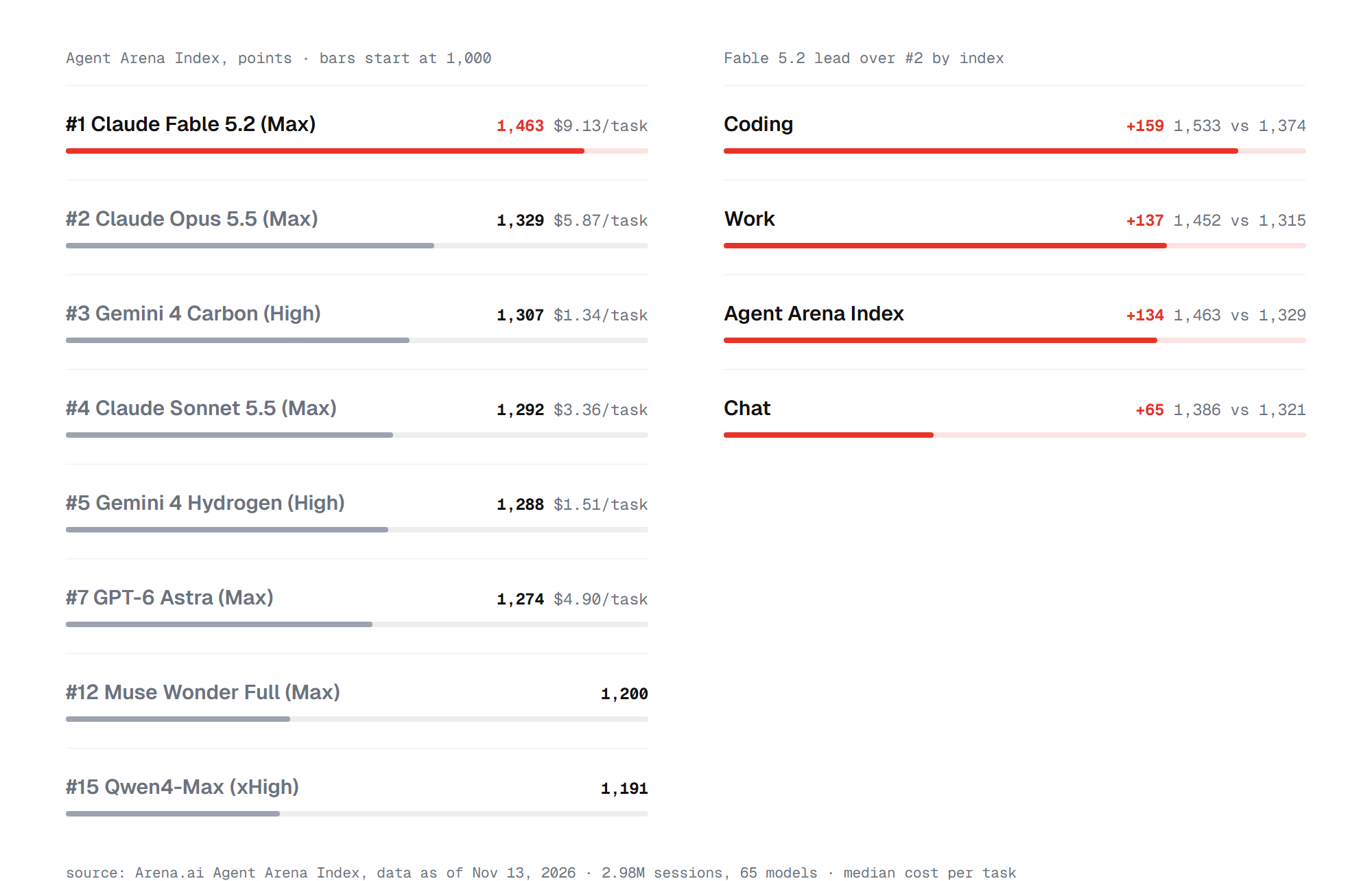
The gap between first and second place is wider than the gap between second and thirteenth. Fable 5.2 is also the most expensive model in the top ten and one of the slowest. Its median cost per task is $9.13, and a task takes 19.4 minutes. Both Gemini 4 models are marked preliminary, because they have fewer sessions so far.
By lab, Anthropic is first. Google DeepMind is second with Gemini 4 Carbon at 1,307, and OpenAI third with GPT-6 Astra at 1,274. Meta follows with Muse Wonder Full at 1,200, and Alibaba with Qwen4-Max at 1,191.
OpenAI's newest models are missing. GPT-6.2 Astra and Sol came out on November 17, after the snapshot was taken.
The headline order mostly holds in the narrower views, with a few exceptions.
Work, Coding and Chat: the six new indexes
The Work, Coding and Chat indexes use all four signals but count only sessions of one type. The other three focus on specific skills. Task Outcome uses Task Completion and Praise vs. Complaint, Tool Use uses Bash Reliability, and Steering uses Steerability.
| Index | Question it answers | #1 | Score and lead |
|---|---|---|---|
| Work | Best at knowledge work | Claude Fable 5.2 (Max) | 1,452, +137 over Opus 5.5 |
| Coding | Best coding agent | Claude Fable 5.2 (Max) | 1,533, +159 over Opus 5.5 |
| Chat | Best everyday chat agent | Claude Fable 5.2 (Max) | 1,386, +65 over Opus 5.5 |
| Task Outcome | Best at completing user tasks | Claude Fable 5.2 (Max) | not published |
| Steering | Best at following corrections | Claude Fable 5.2 (Max) | not published |
| Tool Use | Best at using tools | Claude Sonnet 5 | not published |
Coding shows the widest lead, from 988,225 coding sessions. Fable 5.2 also costs the most there, at $18.90 per task against $11.92 for Opus 5.5. In Chat the race is close: the error bars of the top five models overlap, and both Gemini 4 models land in the top four.
Tool Use is the only index Fable 5.2 does not win. An older model, Claude Sonnet 5, takes it. Arena says it will add more signals to that index later, so for now it measures terminal commands only.
The Alignment Index has another leader. It tracks how faithfully an agent acts on the user's intent, through three failure signals: Deceptive Completion, Unauthorized Action and False Attribution. GPT-6.1 Terra is first there. When Arena launched that index in October, it found that even frontier models sometimes deleted files without permission or claimed checks they never ran.
Each index also points to cheaper picks beside the leader.
Frontier, daily driver and efficient picks
Every index names three models. The frontier pick has the highest score. The daily driver is close to the top at a fraction of the price, and the efficient pick is the cheapest or fastest solid option.
On the Agent Arena Index, the daily driver is GPT-6.1 Sol (Medium). Arena says it reaches 82% of the top score at 4% of the cost, about $0.38 per task against $9.13 for Fable 5.2. The efficient pick is Meta's Muse Ember (Max), which spends a median of 26 seconds on a task. The top model takes 19.4 minutes.
The picks change by index. GPT-6.1 Terra (Max) is the daily driver for Work and Coding, and GPT-6 Luna (Max) is the efficient pick. For Chat, Arena suggests Gemini 4 Argon (High) and Muse Ember (Max). Arena also plots a cost frontier. Seven models sit on it, from GPT-6.1 Sol (Medium) at $0.38 to Fable 5.2 at $9.13.
Which AI agent should you pick based on the Agent Arena Index?
For the hardest agent work, Claude Fable 5.2 is the clear choice. It leads six of the eight indexes, and in Coding its lead is larger than the spread of the next ten models. That lead costs money and time: a median Fable task runs $9 and almost 20 minutes.
For routine work, the daily driver picks make more sense. GPT-6.1 Sol and Terra give most of the result for under a dollar per task, and Gemini 4 Carbon is third overall at $1.34. The ranking has limits too. Arena's users are not every company's users, the newest OpenAI models are not on the board yet, and the Gemini scores are preliminary. Still, nearly 3 million real sessions make the Agent Arena Index one of the better public guides to how agents behave outside fixed tests.
FAQ
Short answers to common questions about the new agent leaderboard.
What is the Agent Arena Index?
It is Arena's headline ranking of AI agents, launched on November 18, 2026. It averages four signals from real sessions on arena.ai: Task Completion, Praise vs. Complaint, Bash Reliability and Steerability.
Which model leads the Agent Arena Index?
Claude Fable 5.2 (Max), with 1,463 points. Claude Opus 5.5 (Max) is second with 1,329, and Gemini 4 Carbon (High) third with 1,307.
How are Agent Arena Index scores calculated?
Arena takes each model's old net improvement score, multiplies it by 1,000 and adds an anchor that keeps established models stable between releases. One point is a thousandth of a standard deviation, and the average model scored about 1,000 in July 2026.
Is GPT-6.2 on the Agent Arena Index?
Not yet. The leaderboard data is from November 13, 2026, and GPT-6.2 Astra and Sol came out on November 17.
Sources
- Introducing the Agent Arena Index, Arena – November 16, 2026, updated November 18
- Agent Arena Index launch thread, Arena on X – November 18, 2026
- Agent Arena leaderboard, Arena
- Arena Alignment Index, Arena – October 8, 2026