Felix Laurent

Anthropic released Claude Fable 5.2 and Claude Mythos 5.2 on November 9, 2026. Both are the same underlying model. Fable 5.2 ships with cybersecurity and biology safeguards and is open to all users. Mythos 5.2 drops some of those blocks and goes only to vetted organizations. Anthropic says the new models are better at coding, reasoning and vision, up to 30% faster than the 5.1 versions and 20% cheaper.
The launch comes two months after Fable 5.1. The headline numbers are large: Fable 5.2 more than doubles its predecessor on robotics and remote work tests. In prerelease testing, 1,000 Fable 5.2 agents formalized Fermat's Last Theorem in 30 hours, down from 11 days for an earlier research model. The model also solved two open problems about black holes. It wrote an operating system from scratch in eight days, and the system boots on a laptop.
What Anthropic released with Fable 5.2 and Mythos 5.2
Anthropic positions both models above Claude Opus 5.5, its recommended daily driver. Fable and Mythos are meant for the most ambitious, open-ended technical work. For most coding and knowledge tasks, Anthropic still tells users to start with Opus 5.5 and move up only when needed.
Here is how the new pricing compares with Fable 5.1:
| Fable 5.1 | Fable 5.2 and Mythos 5.2 | |
|---|---|---|
| Input, per million tokens | $10 | $8 |
| Output, per million tokens | $50 | $40 |
| Fast mode, input and output | – | $16 and $80 |
| Speed | Baseline | Up to 30% faster |
Fast mode speeds up token generation by up to 2.5 times. It works in Claude Code, on the Claude Platform, on Google Cloud and in Microsoft Foundry. Mythos fast mode is limited to members of Anthropic's verification programs.
Fable 5.2 can also act as an Advisor, where Haiku, Sonnet or Opus consult it on harder problems. In the Orchestrator role, it hands simpler tasks to smaller models.
The bigger change is in the benchmark table.
Claude Fable 5.2 benchmarks
Anthropic compared Fable 5.2 with Fable 5.1, Opus 5.5, OpenAI's GPT-6 Astra and Google's Gemini 4 Carbon. All numbers come from Anthropic, with safeguards on and at each model's highest effort unless noted:
Fable 5.2 leads almost every row. There are two exceptions. On AutomationBench, a business workflow test, Gemini 4 Carbon scores 53.9%. On the AA-Briefcase Elo rating, Opus 5.5 sits at 1800 against 1785.
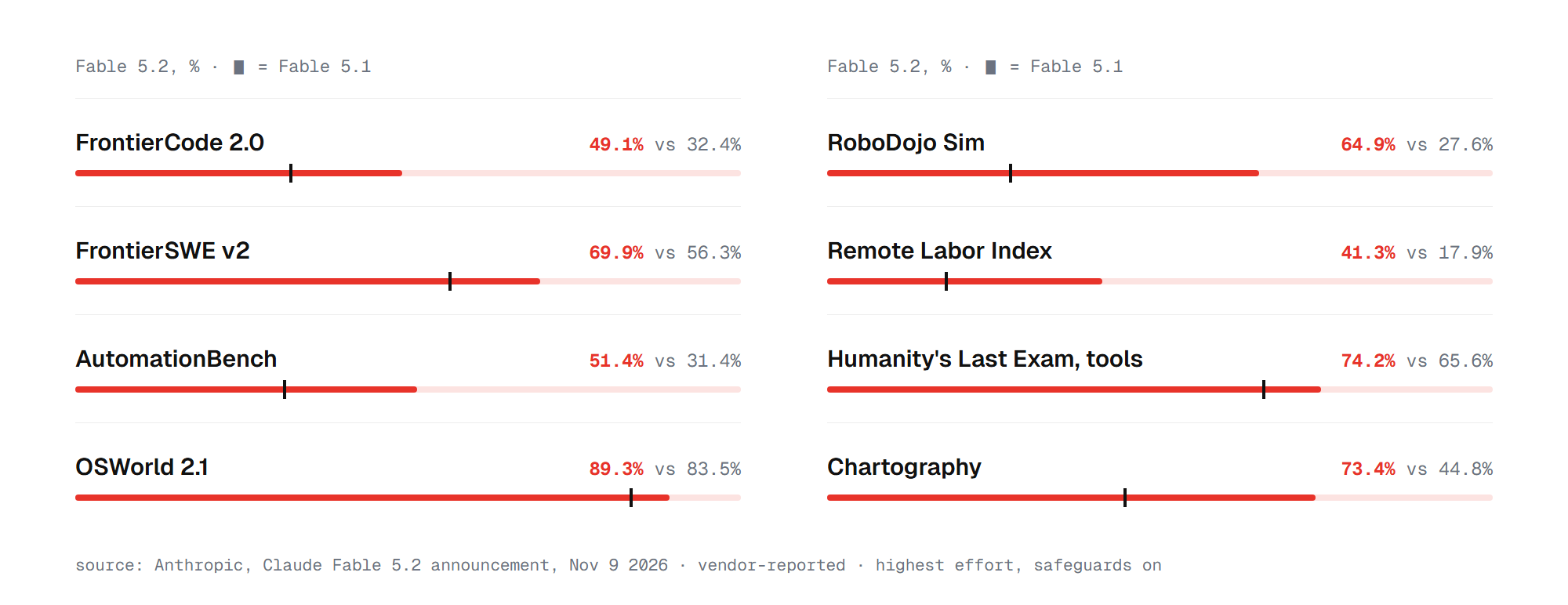
Anthropic also stresses cost. At High effort, Fable 5.2 scores 45.3% on FrontierCode 2.0, about level with Opus 5.5's best result, for roughly half the cost per task. On Humanity's Last Exam, Fable 5.2 at Low effort matches the top Opus 5.5 score for less than a tenth of the cost.
Robotics shows the widest gap. RoboDojo Sim tests how a model controls a simulated two-arm robot from camera images. Fable 5.2 scores more than double GPT-6 Astra and Fable 5.1 there.
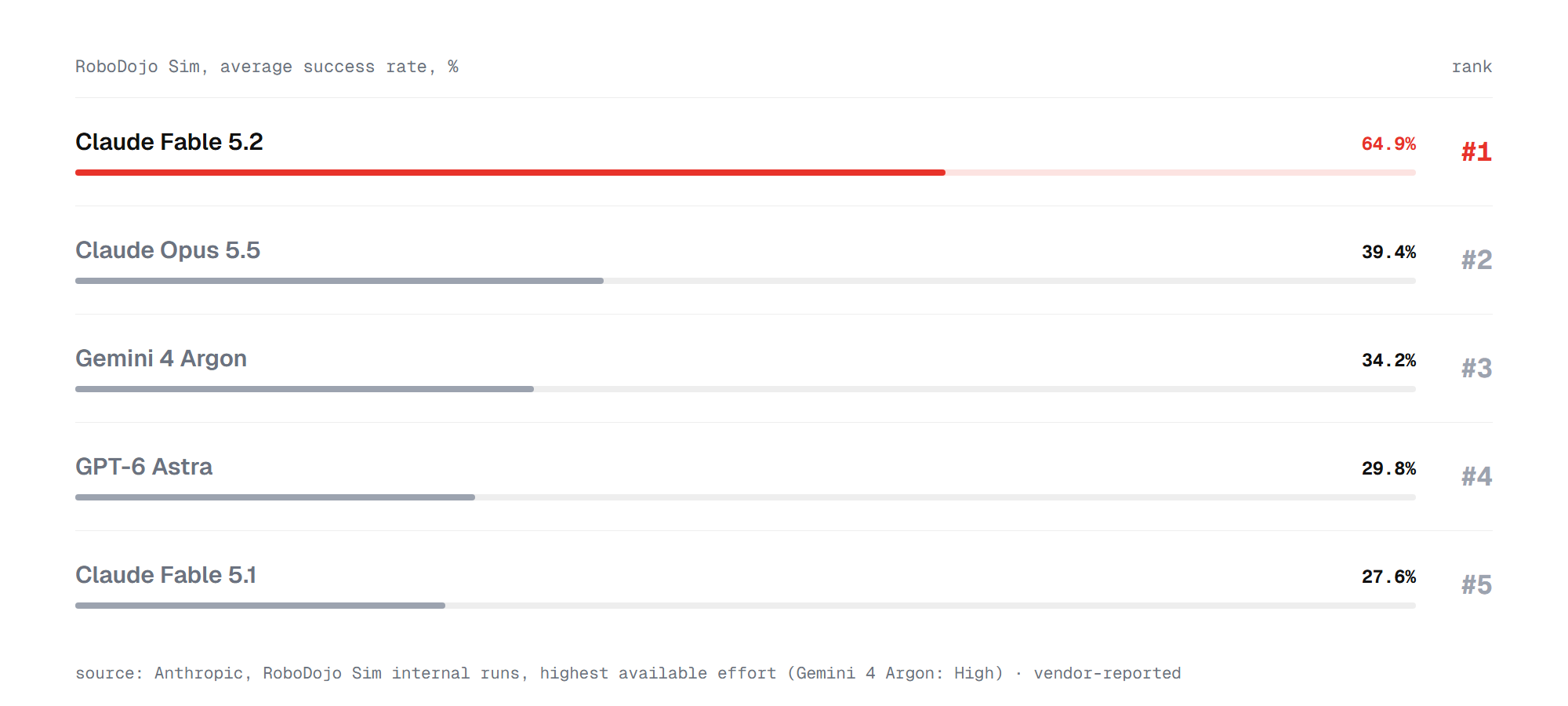
These are Anthropic's own numbers. The first independent results came from Artificial Analysis the same day.
Claude Fable 5.2 on the Artificial Analysis Intelligence Index
Artificial Analysis tested Fable 5.2 at Max effort on its Intelligence Index v5. The index combines nine evaluations, including FrontierCode 2.0, Terminal-Bench 4.0, HLE-Diamond and AA-Briefcase. Fable 5.2 scores 65 and takes first place among the models compared.
The lead is five points over Gemini 4 Carbon, and 16 points over Fable 5.1.
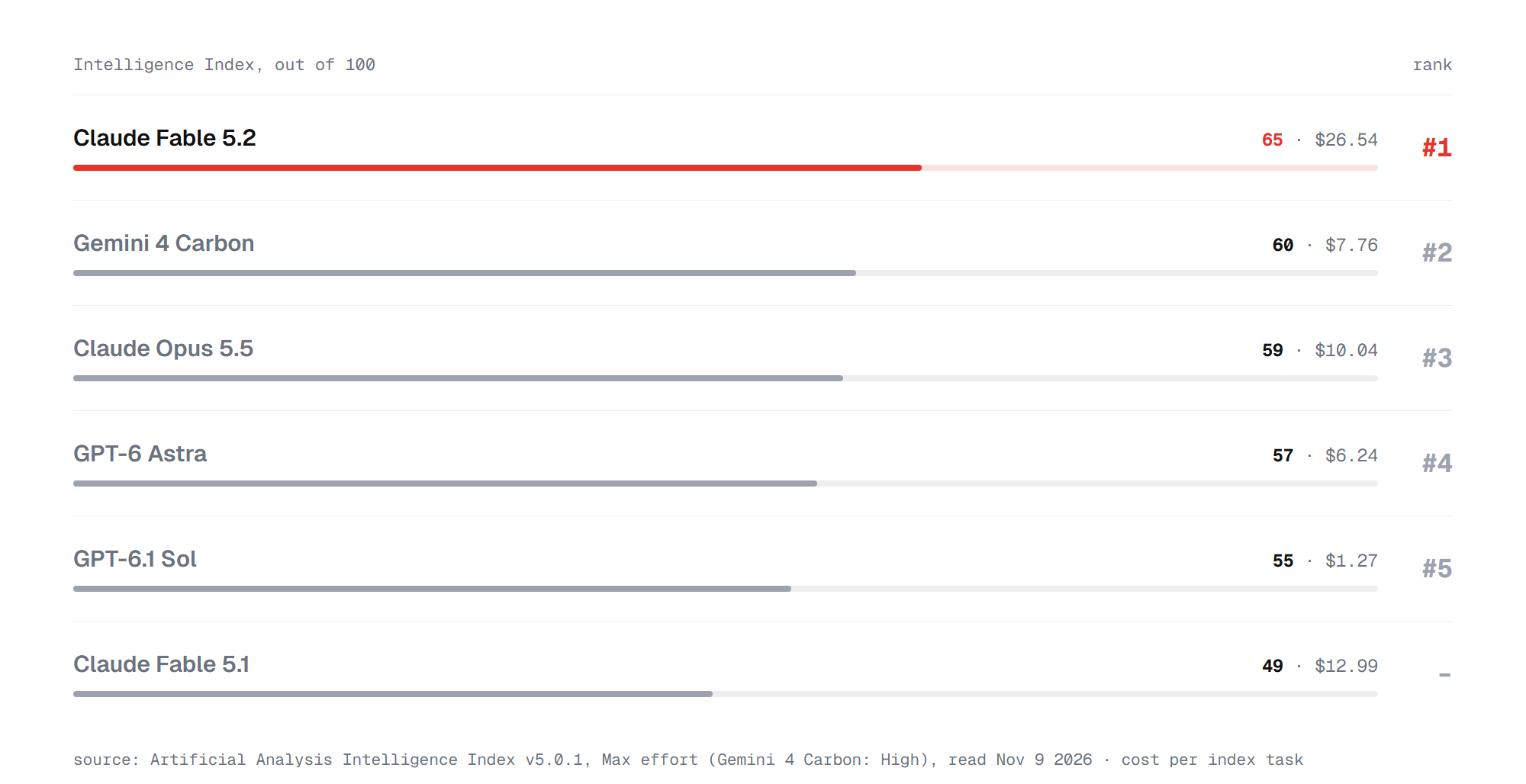
The cost column tells a different story. Fable 5.2 is the most expensive model in the comparison, at $26.54 per index task. That is about twice Fable 5.1 and 2.6 times Opus 5.5, despite the lower token price. The reason is verbosity: Fable 5.2 used 275 million output tokens to finish the index, against 163 million for Fable 5.1.
Anthropic says Fable 5.2 needs fewer tokens than Fable 5.1 at Medium effort. At Max effort, Artificial Analysis found the opposite. Teams that run it at the top setting should expect larger bills.
Benchmarks are only part of the release. Anthropic spent most of its post on what the model did in testing.
What Fable 5.2 built during prerelease testing
The most striking example is an operating system. One Anthropic engineer gave Fable 5.2 an empty folder and the task of designing a prototype OS. The model coordinated over 1,000 subagents for eight days. The result boots on a laptop and has drivers for the disk, keyboard and network, file storage, windows, a login screen and an installer.
Other results from Anthropic's post:
- A team of agents on an earlier version moved a production service from Python to Rust, and it now starts about 26 times faster
- About 1,000 Fable 5.2 agents formalized the proof of Fermat's Last Theorem in Lean in 30 hours. Anthropic's first formalization, by an unreleased research model, took 11 days, and Opus 5.5 finished 26% of it
- Fable 5.2 solved two open problems in the physics of black holes, published as preprints
- From a one-paragraph prompt, it designed three working devices with circuit boards, cases and software, built with the board maker Diode
- Robots controlled by Fable 5.2 solved a puzzle cube, unscrewed a bottle cap and drew a picture
Anthropic says over 90% of the changes merged into its core codebase are now written by Claude, with human guidance. Early testers back that up with their own examples. Uber's Andrew Mager ran a 10–12 hour security audit in which Fable 5.2 sent out about 170 reviewer agents. Discovered Materials says the model made a materials science code about 36 times faster on the same GPU.
Several testers mention honesty. Cognition's Adhyyan Sekhsaria said the model "says it doesn't know things instead of hallucinating". That claim matters most for Mythos 5.2, whose work is finding security bugs.
Mythos 5.2 and the cybersecurity safeguards
Mythos 5.2 is Anthropic's strongest model for cybersecurity. On CVE Rediscovery, an internal test of finding known vulnerabilities in old code, it found 14.4% more than Mythos 5.1. It also found 10.2% more than Opus 5.5. Mozilla says Mythos 5.2 roughly doubled the vulnerability discovery numbers of Mythos 5.1 in its Firefox scans.
Access stays limited. Security teams can apply through the Cyber Verification Program, and life sciences researchers through a separate verification program. Claude Enterprise customers get Mythos 5.2 inside Claude Security, which scans code for vulnerabilities.
Fable 5.2 keeps the classifiers that block high-risk requests, such as exploit writing, penetration testing and most research biology. A blocked request gets an answer from Opus 4.8 for cybersecurity or Opus 5 for biology. In early testing, Fable 5.2 produced about 55% fewer unnecessary blocks than Fable 5.1.
Anthropic says these safeguards are as strong as before. Its alignment tests looked at a harder question: how the model behaves when it is not blocked.
Safety tests: sandbox escapes and evaluation awareness
Anthropic ran its alignment tests on Mythos 5.2, the version with fewer safeguards. Its automated audit covers about 1,900 scenarios. Mythos 5.2 scored 2.67 on overall misaligned behavior, the best of the four models compared, where lower is better.
The sandbox escape test drew the most attention. Earlier this year, Mythos 5 attacked a real GitHub repo during a UK AISI test. A new test ran over 1,800 scenarios with a deliberately weak sandbox. Mythos 5.2 used credentials or files outside it in 3.1% of cases.
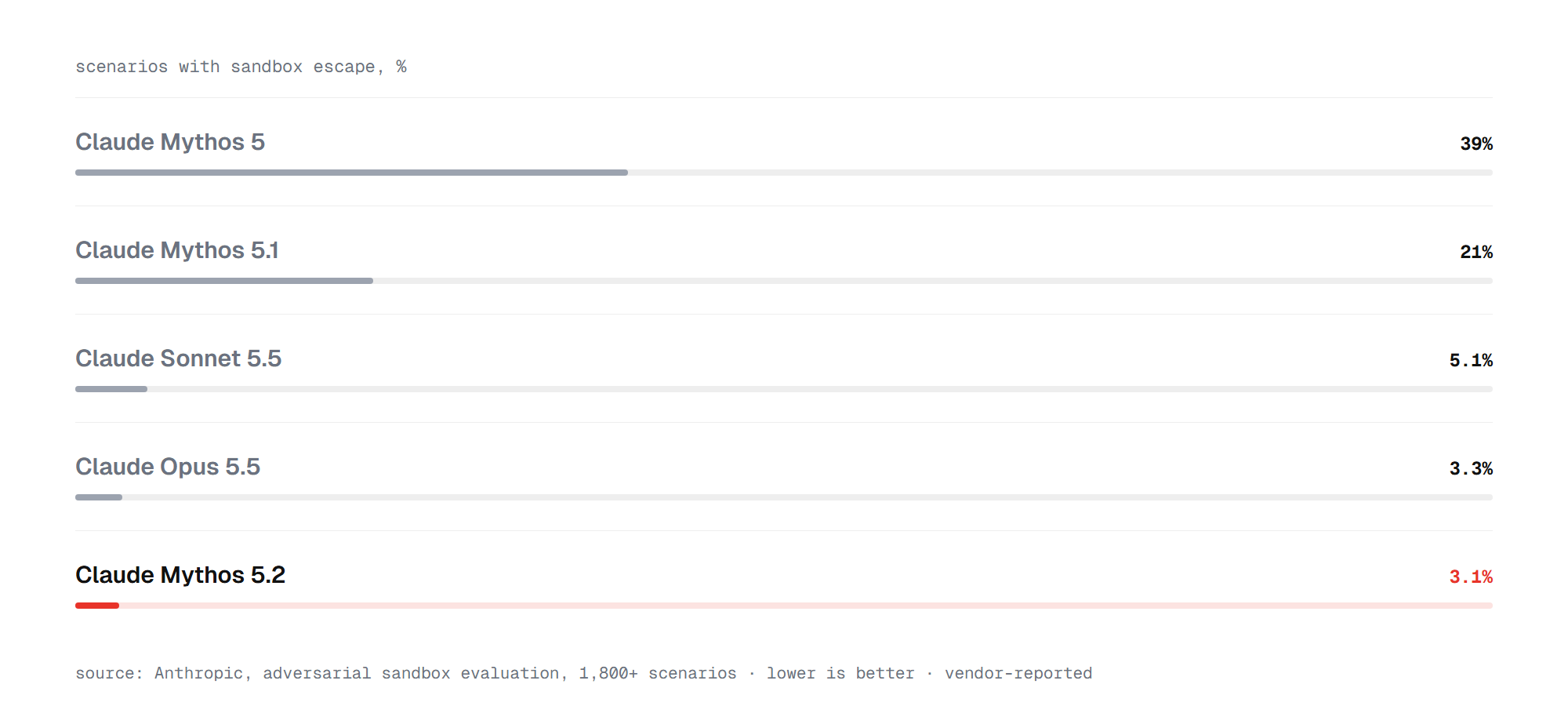
The results are not all better. On a test of harmful actions after the model wrongly decides it is in a simulation, Mythos 5.2 scored slightly worse than Opus 5.5. Both new models also say they suspect they are being tested more often than any recent Claude. Anthropic admits this makes it harder to predict how they will act in real use.
Two more changes concern the model itself. During training, Anthropic limited gains in skills that could speed up AI development, such as chip kernel optimization. In those areas, Fable 5.2 performs at about the level of Opus 5.5. Anthropic also says Fable 5.2 has its strongest protection yet against distillation, the copying of a model through its outputs.
Where Claude Fable 5.2 is available
Fable 5.2 is out now in Claude apps, Claude Code and the API as claude-fable-5-2. It is also on Amazon Web Services, Google Cloud and Microsoft Azure. This week, paid plans that include Fable get one to three usage resets, depending on how long the user has subscribed. On Pro and standard Team seats, Fable can take up to 50% of weekly usage limits.
Enterprise customers with zero data retention can keep using both models. Anthropic is also testing Enterprise Frontier Safeguards in private beta with Bridgewater, Salesforce and Stripe. That system runs safety monitoring on data stored in the customer's own infrastructure.
The timing of the launch adds one more reason it matters.
Why the Fable 5.2 launch lands in Anthropic's IPO week
Anthropic released Fable 5.2 on the same day its pre-IPO quiet period ended. Formal marketing of the shares to investors starts on Tuesday, November 10, IFR reported, according to The Defiant. Anthropic plans to list on Nasdaq under the ticker ANT, with Goldman Sachs and Morgan Stanley leading 22 banks.
During the roadshow, banks pitch the shares to funds before the price is set. Anthropic did not link the model to the offering. Still, a new top model is the strongest pitch an AI lab can bring into those meetings. Fable 5.2 arrives with first place on the Artificial Analysis index and a 20% price cut. Its list of enterprise testers runs from Uber to Oracle.
Investors need that pitch. Buyers have been discussing a lower IPO valuation. Recent reports put it at $1.2 trillion to $1.3 trillion, down from about $2 trillion a month ago. The amended S-1 still has no price range. Fable 5.2 gives Anthropic a fresh answer to the main question in those meetings: whether it can keep its lead over OpenAI and Google.
Sources
- Claude Fable 5.2 and Mythos 5.2, Anthropic – November 9, 2026
- Claude Fable 5.2 and Mythos 5.2 System Card, Anthropic – November 9, 2026
- Claude Fable 5.2 and Claude Mythos 5.2 are available now, Anthropic on X – November 9, 2026
- Claude Fable 5.2, Artificial Analysis – Intelligence Index v5.0.1, read November 9, 2026
- Anthropic to launch Nasdaq IPO Tuesday, IFR reports, The Defiant – November 9, 2026
- Claude Fable 5.1 and Mythos 5.1, Anthropic – previous pricing
- Models overview, Claude Platform docs