Felix Laurent

OpenAI released GPT-6.2 Astra and GPT-6.2 Sol in its API on November 17, 2026. The new models appeared in the API changelog and on new model pages in OpenAI's developer docs. GPT-6.2 Astra is the frontier model for the hardest reasoning and coding tasks. GPT-6.2 Sol is the cheaper option for everyday coding and agent work.
The release ends two weeks of leaks. Users reported both names on a Google Cloud quotas page around November 5, and later in Codex usage data. OpenAI followed up with benchmark charts on X, claiming new highs at less than a third of GPT-6 Astra's cost per task.
What OpenAI released with GPT-6.2
OpenAI calls GPT-6.2 Astra "a frontier reasoning model for coding and professional work" on its model page. It can build and revise software, use a computer and work with documents. GPT-6.2 Sol is "a reasoning model for text, images, and tool use," aimed at complex work at a lower cost.
Both models take text and images as input and answer in text. They work with the Responses API and Chat Completions, and tool calling requires the Responses API. Developers can also use them with OpenAI's multi-agent beta, which lets a model hand work to subagents.
The two models share most of their specs:
| GPT-6.2 Astra | GPT-6.2 Sol | |
|---|---|---|
| Role | demanding reasoning and coding | everyday coding and agents |
| Context window | 1,050,000 tokens | 1,050,000 tokens |
| Max input | 922,000 tokens | 922,000 tokens |
| Max output | 128,000 tokens | 128,000 tokens |
| Knowledge cutoff | May 18, 2026 | June 1, 2026 |
| Input, per million tokens | $8 | $2 |
| Output, per million tokens | $40 | $10 |
Both support web search, file search, code interpreter, a hosted shell, computer use, MCP and skills through the Responses API. Neither supports fine-tuning yet. The API also rejects requests that switch reasoning off completely.
The price is where the Astra update stands out.
GPT-6.2 pricing and how it compares
GPT-6.2 Astra costs $8 per million input tokens and $40 per million output tokens. That is 20% cheaper than GPT-6 Astra at $10 and $50. Cached input drops to $0.40 per million tokens, from $1 for GPT-6 Astra.
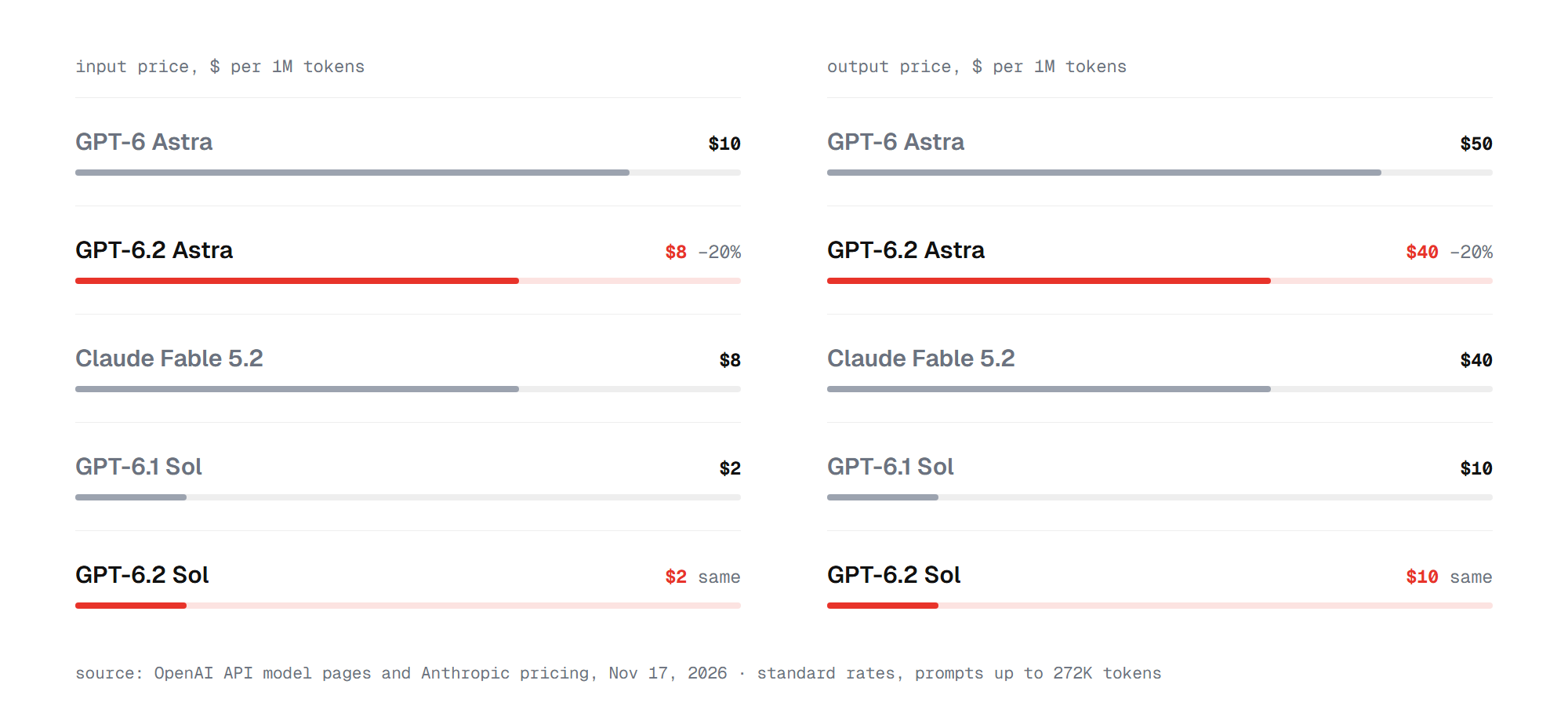
GPT-6.2 Sol keeps the price of GPT-6.1 Sol at $2 per million input tokens and $10 per million output tokens. Its knowledge cutoff moves forward by a month to June 1.
Astra now matches the list price of Claude Fable 5.2, Anthropic's top model, which also costs $8 and $40. That puts the two most expensive frontier models at exactly the same rate per token. The real cost per task will depend on how many tokens each model uses.
Long requests cost more. Above 272,000 input tokens, input and cache rates double and output costs 1.5 times as much for the whole request. Batch jobs cost half the standard rate, and fast mode costs twice as much.
OpenAI also added cheaper background windows on the same day. In a public beta of the Responses API, developers can let a request finish within two or eight hours. Token rates drop 30% for the two-hour window and 40% for the eight-hour one. The fastest tier, Ultrafast, costs three times the standard rate until February 28, 2027, then six times.
Beyond price, OpenAI's migration guide shows how the models behave differently.
What changes for developers in GPT-6.2
The biggest technical change concerns reasoning. Starting with GPT-6.2, the API drops the model's earlier reasoning when it detects edits to the conversation history mid-session. The same happens after a switch to a weaker model or a change of user or organization. OpenAI warns that answer quality can decline and token use can rise when that happens.
The guide also lists new default behavior for GPT-6.2 Astra:
- writing is more concise and direct, so old "be concise" instructions may now be too much;
- when the user's intent is unclear, the model may propose a next step and wait for confirmation;
- it tends to write more efficient, higher-quality code than its predecessors;
- for front-end work, developers should name the imagery and typography they want.
OpenAI's sample prompts push the model to act more independently on long tasks. They tell it to keep working until the job is done and to stop only when it is truly blocked or before irreversible actions. With an asynchronous question tool, GPT-6.2 can ask the user something and keep working on parts that do not depend on the answer.
OpenAI's own benchmarks show what those changes add up to.
GPT-6.2 Astra benchmarks
OpenAI published three charts that plot each model's score against its cost per task. It says GPT-6.2 Astra sets new highs on evaluations for professional work and scientific research. It also claims Astra reaches them at less than a third of GPT-6 Astra's cost per task. The values below are our approximate readings of those charts, using each model's best result.
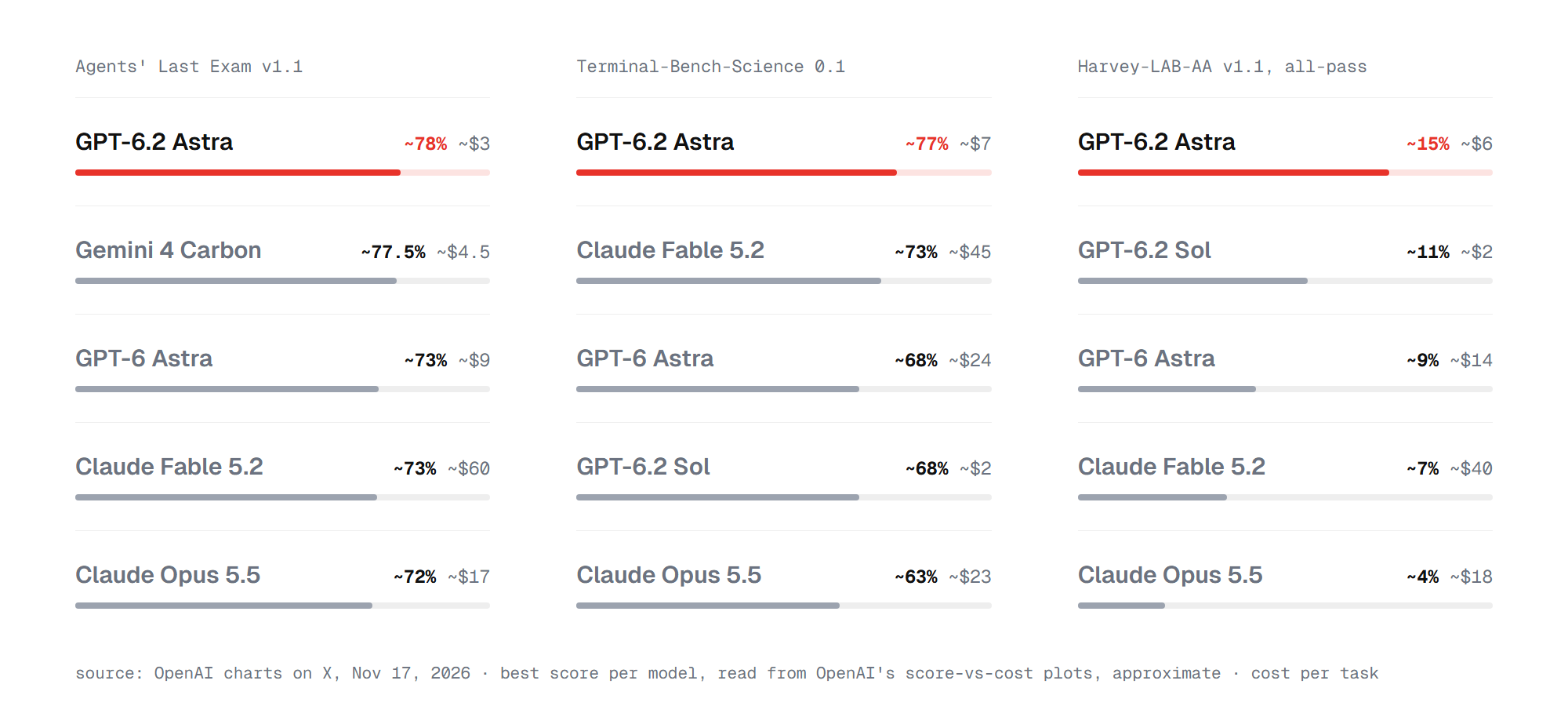
On Agents' Last Exam v1.1, a test of agentic work, GPT-6.2 Astra peaks at about 78% for around $3 a task. Gemini 4 Carbon comes close at about 77.5%. Claude Fable 5.2 scores about 73% and costs roughly $60 a task in OpenAI's chart.
Terminal-Bench-Science 0.1 tests scientific work in a terminal. GPT-6.2 Astra reaches about 77% for roughly $7 a task, against about 73% for Fable 5.2 at around $45. OpenAI notes that it ran Fable 5.2 in the mini-swe-agent harness on this test. GPT-6.2 Sol matches the old GPT-6 Astra at about 68%, for under a tenth of the cost.
Harvey-LAB-AA v1.1 measures legal work and counts a task as passed only when the answer contains no hallucinations. Scores are low across the board. GPT-6.2 Astra passes about 15% of tasks, roughly double Fable 5.2's 7%.
These are OpenAI's own numbers on tests it chose, and the cost comparisons depend on how each rival model was run. Independent results from Artificial Analysis and Arena have not arrived yet.
Is GPT-6.2 Astra better than Claude Fable 5.2
On OpenAI's numbers, yes, and much cheaper per task. Astra leads Fable 5.2 on all three charts while costing a fraction as much per task. Independent leaderboards still need to confirm it. In Arena's agent rankings from last week, the previous GPT-6 Astra placed sixth, far behind Claude Fable 5.2 in first. Our own Fable 5.2 vs GPT-6 Astra test is a useful baseline for the new model.
What is clear is the pricing move. GPT-6.2 Astra is 20% cheaper than its predecessor and costs the same as Fable 5.2 per token. GPT-6.2 Sol keeps the low price of GPT-6.1 Sol with fresher knowledge. If independent tests confirm OpenAI's charts, GPT-6.2 Astra will beat Anthropic's top model on quality and on cost per task at the same list price.
FAQ
Here are short answers to common questions about the release.
When was GPT-6.2 released?
OpenAI added GPT-6.2 Astra and GPT-6.2 Sol to its API on November 17, 2026, according to its developer changelog.
How much does GPT-6.2 Astra cost?
GPT-6.2 Astra costs $8 per million input tokens and $40 per million output tokens. GPT-6.2 Sol costs $2 and $10.
What is the difference between GPT-6.2 Astra and Sol?
Astra is OpenAI's frontier model for the hardest reasoning and coding tasks. Sol is cheaper and built for everyday coding and agent workflows. Both have a context window of about one million tokens.
Sources
- OpenAI API changelog – November 17, 2026
- GPT-6.2 Astra model page, OpenAI API
- GPT-6.2 Sol model page, OpenAI API
- Using GPT-6.2, OpenAI API guide
- GPT-6 Astra model page, OpenAI API
- GPT-6.1 Sol model page, OpenAI API
- OpenAI on X: GPT-6.2 Astra benchmarks – November 17, 2026
- Lumina on X – November 17, 2026