Felix Laurent

The Gemini 4 Carbon API price is $2 per million input tokens and $10 per million output tokens until November 30. On December 1, both rates double. Google made its strongest reasoning model generally available to paid developers in the Gemini API and Google AI Studio on November 10.
Google AI Studio announced the launch on X and said Google AI Ultra subscribers get access too. The company calls Carbon its best model for cybersecurity and long agentic work in software engineering, knowledge work and science.
Who can use Gemini 4 Carbon now
When Google announced Gemini 4 Carbon on October 28, only a small group of cyber defenders could use it. They came through Fairwind, Google's program for trusted security partners. Gemini 4 Argon followed the same path before its public release.
Now the model ID gemini-4-carbon works for anyone on the paid tier of the Gemini API. It is also in Google AI Studio and in Gemini Managed Agents, where the Antigravity agent supports it. There is no free tier.
The Gemini app is a different story for now. As of November 10, its release notes still list Argon as the newest model for Pro and Ultra subscribers. So most people will meet Carbon through the API and AI Studio first.
How much the Gemini 4 Carbon API costs
Carbon has the same per-token prices as Argon. Its introductory period ends on November 30.
| Token type | Through November 30 | From December 1 |
|---|---|---|
| Input | $2.00 per 1M | $4.00 per 1M |
| Cached input | $0.10 per 1M | $0.20 per 1M |
| Output, including thinking | $10.00 per 1M | $20.00 per 1M |
The per-token price is only part of the bill. Carbon is built to think longer than Argon, and every thinking token is billed as output. Google also charges for internal tool instructions and function declarations when grounding is on. Search grounding is still billed per query.
Caching works differently too. Explicit context caching is not supported on Carbon. Implicit caching turns on for prompts of at least 4,096 tokens and cuts the price of cached input by 95%.
Those costs make more sense next to independent test results.
Where Gemini 4 Carbon ranks now
At launch, Carbon took first place on the Artificial Analysis Intelligence Index. Two weeks later it has slipped to fourth of 74 entries. Anthropic's Claude Fable 5.2 now holds the top three spots with its max, xhigh and high settings.
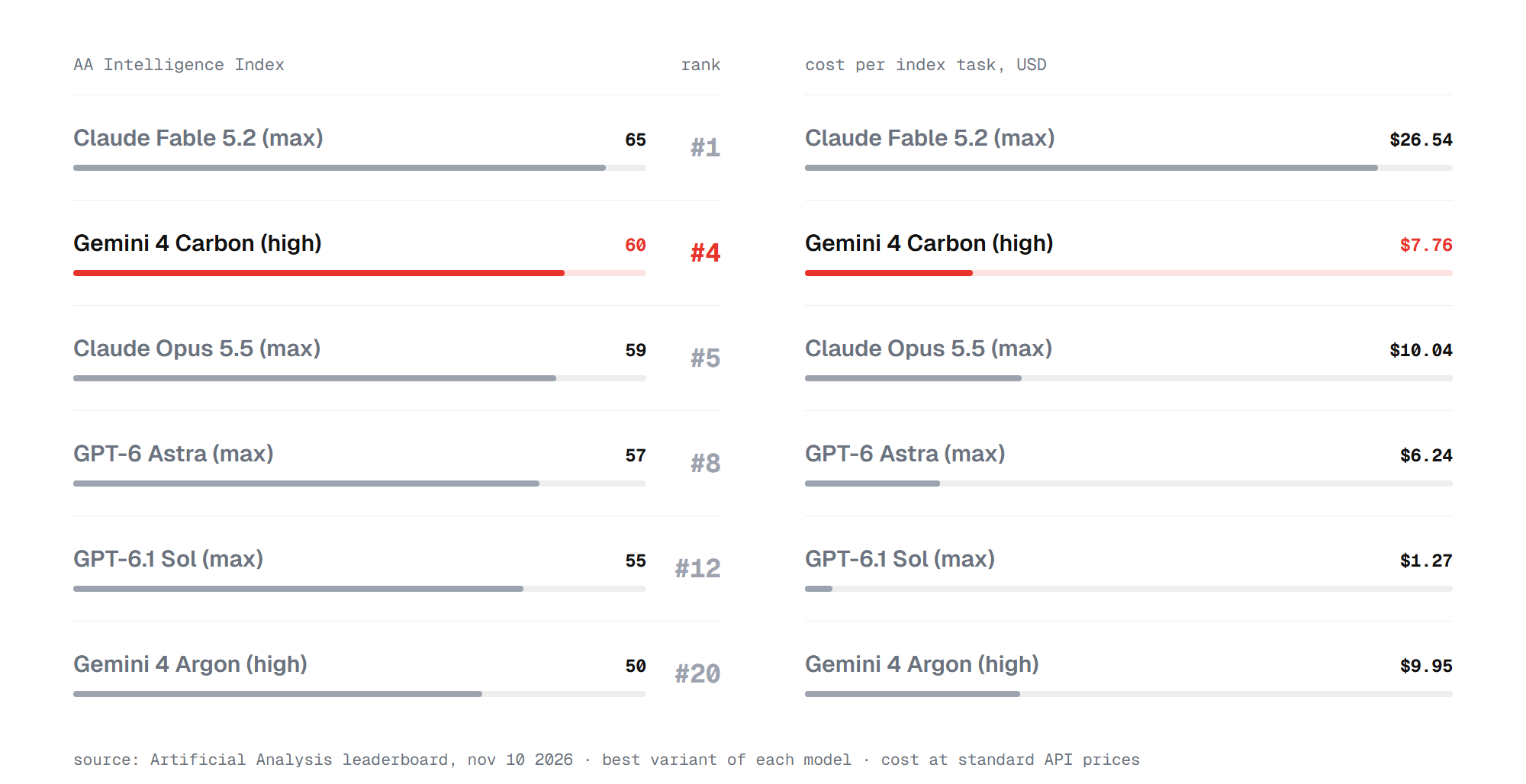
Carbon at its high thinking level scores 60. That is one point above Claude Opus 5.5 at max and three above GPT-6 Astra. Fable 5.2 at max costs $26.54 per task for its five-point lead.
Artificial Analysis already counts Carbon's cost at the full $4 and $20 rates. So $7.76 per index task is what Carbon will cost from December 1. Until November 30, the same task costs about $3.90. When the title says the price doubles, this is the jump: from about $3.90 to $7.76 per task.
The thinking level changes the score a lot. Medium, the default, scores 58. Low drops to 54. Carbon is also slow: Artificial Analysis measured about 67 seconds to the first answer token and an output speed of about 80 tokens per second.
The overall index hides big differences between tasks, though.
How Gemini 4 Carbon does on individual benchmarks
Artificial Analysis also runs each model through separate tests. Its latest results show where Carbon is strong and where it falls behind.
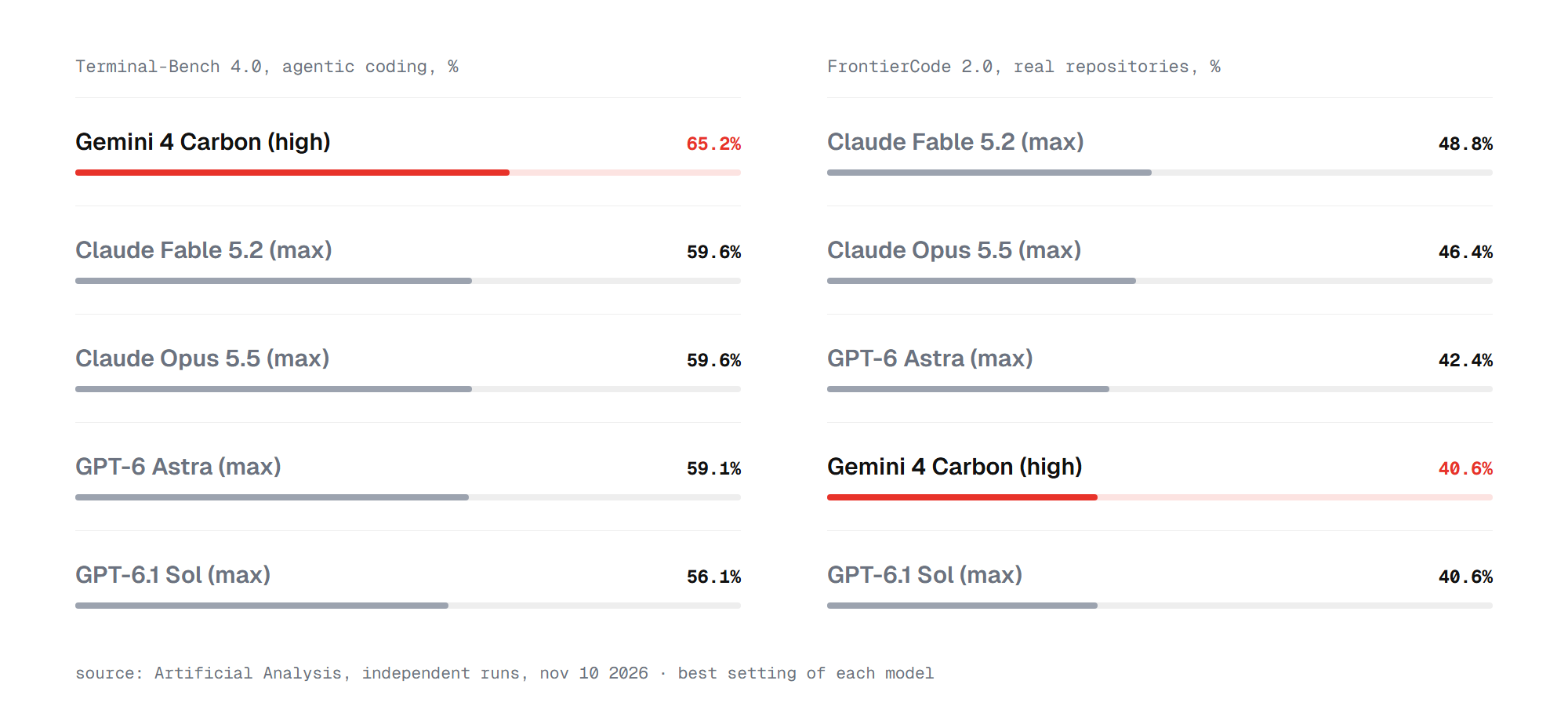
Carbon is strongest in the terminal. It scores 65.2% on Terminal-Bench 4.0, ahead of every model from Anthropic and OpenAI. Only Kimi K3.1 Pro scores higher, at 67.2%. On FrontierCode 2.0, which tests work in real open-source repositories, Carbon drops to 40.6%. That puts it behind Fable 5.2, Opus 5.5 and GPT-6 Astra.
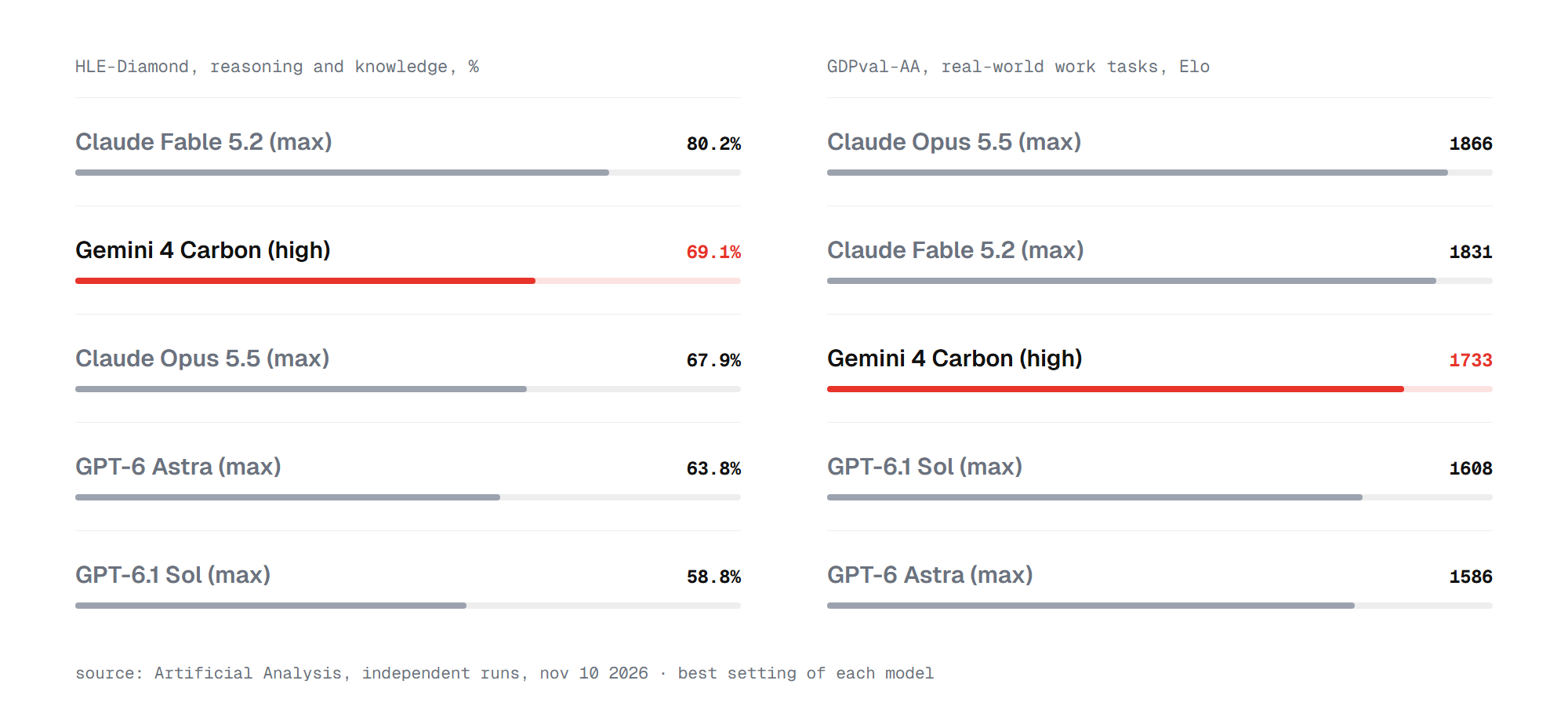
On hard reasoning and knowledge questions, Carbon is second. It scores 69.1% on HLE-Diamond, ahead of Opus 5.5 but 11 points behind Fable 5.2. On GDPval-AA, which rates real-world work tasks, both Anthropic models lead Carbon by about 100 Elo points.
AA-Omniscience rewards correct answers and penalizes made-up ones. Carbon scores 53.5 there, against 42.4 for GPT-6 Astra. Fable 5.2 still leads at 66.8.
So Carbon is not the best pick for every job, and Google says as much in its own guide.
Gemini 4 Carbon or Gemini 4 Argon
Both models share the same 1 million token context window, built-in tools and prices. The difference is how much each one thinks per turn, Google says.
Google suggests Carbon for complex root-cause debugging, architecture design, dense documents, scientific proofs and security audits. Argon stays the better choice for interactive coding, everyday feature work and fast production loops. It answers faster and spends fewer tokens per turn.
Switching from Argon needs no schema changes beyond the model ID. Older Gemini apps need more work.
What developers need to change
Google's migration guide lists several breaking points for apps that moved from Gemini 3 or earlier:
- Sampling: temperature, top_p and top_k are ignored.
- Output limit: max_output_tokens now covers thinking and the answer together, so Google recommends at least 32,768.
- Long answers: a synchronous response stops at 65,536 tokens. With background execution, one response can run up to the full 1M-token window minus the input.
- Timeouts: hard prompts can take several minutes, so clients should wait at least 15 minutes.
- Caching: calls that create explicit caches must be removed.
Google recommends starting at the medium thinking level and testing all three. The lowest level that meets the quality bar is the cheapest.
Is the Gemini 4 Carbon API worth it
For hard tasks, yes, especially before December 1. Carbon is the strongest Google model on independent tests and sits within a point of Opus 5.5. It costs less per index task than Opus 5.5 at max, and the introductory price halves that again. Teams doing security work, long debugging runs or document-heavy research get the most from it.
It is no longer the best model overall, though. Fable 5.2 leads by five points, and Carbon's long thinking makes it slow for interactive work. Most teams will keep Argon or a cheaper model as the default and route only the hardest jobs to Carbon. After the price doubles, that routing will matter even more.
Update: Gemini 4 Carbon is now in Cursor
Cursor added Gemini 4 Carbon to its code editor on November 10. At high effort, Carbon is the top model on CursorBench 4.0 with 60.4%, the company said on X.
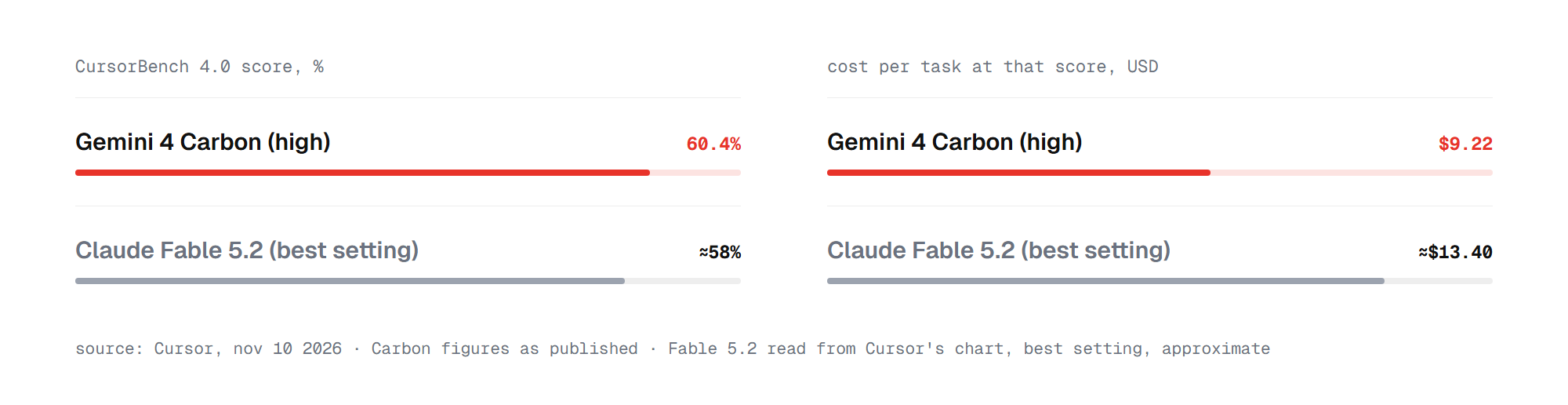
CursorBench is Cursor's own test, built from real coding tasks in its editor. Carbon at high effort costs $9.22 per task on Cursor's chart. The best Claude Fable 5.2 setting reaches about 58% at about $13.40 per task. Cursor did not publish exact scores for the other models.
That result is Cursor's own measurement, so it is not directly comparable with the independent tests above. Access through Cursor is one more route besides the Gemini API.
Sources
- Gemini 4 Carbon is here, Google AI Studio on X – November 10, 2026
- Gemini 4 Carbon is now available in Cursor, Cursor on X – November 10, 2026
- Gemini API release notes, Google AI Studio – November 10, 2026
- What's new in Gemini 4 Carbon, Google AI Studio docs – November 10, 2026
- Gemini 4 Carbon (high) intelligence, performance and price analysis, Artificial Analysis
- Gemini Apps release notes, Google