Felix Laurent
Google has released Gemini 4 Hydrogen, a fast model for coding, agents and everyday work. Google DeepMind announced it on November 12, 2026. Google says Hydrogen finishes tasks 2.5 times faster than Gemini 3.8 Flash and scores higher than Gemini 4 Argon on the Artificial Analysis Intelligence Index.
Hydrogen is the first Gemini 4 model for everyone. It is rolling out in the Gemini app, Google Search, the Gemini API and Google AI Studio. Most of these need no paid plan. The API price is $1.50 per million input tokens and $7.50 per million output tokens.
What Gemini 4 Hydrogen is
Hydrogen takes the place of the Flash line in Google's lineup. Google dropped the "Flash" name and kept the chemistry theme of its Gemini 4 family. Carbon and Argon are the large reasoning models for hard, long problems. Hydrogen is the quick workhorse for writing code, running tests and handling daily requests.
"Hydrogen brings cutting-edge intelligence to everyone," wrote Koray Kavukcuoglu, Google's chief AI architect, in the launch post. The model reads up to 1 million tokens of input and can write up to 1 million tokens of output. It works with text, PDFs, spreadsheets, charts, audio and video.
There are four thinking levels: low, medium, high and a new xhigh tier. High is the default. Google says each step up trades speed and cost for deeper reasoning in a smooth progression.
Compared with Gemini 3.8 Flash, Hydrogen is a big jump. Google says it more than triples the Terminal-Bench 4.1 score, from 18.2% to 57%, and cuts fabricated claims by more than five times. Partners testing it on data-heavy workflows saw it run 2 to 2.8 times faster than 3.8 Flash while using 12% to 23% fewer tokens. Those gains come from a long list of new abilities.
Gemini 4 Hydrogen features
Google's launch post groups Hydrogen's upgrades around four kinds of work: coding, office tasks, multimodal analysis and everyday help.
Coding and agents
For developers, Hydrogen focuses on careful, fast execution:
- Surgical edits: it fixes bugs and answers questions about a codebase without rewriting unrelated files
- Parallel exploration: it batches file reads and searches at once instead of opening files one by one
- Recovery: it adapts when a tool call fails or a search comes back empty
- Front-end design: paired with a new Gemini front end design skill in Antigravity, it builds polished web layouts in fewer prompts
Google's demos show what that looks like. In one, Hydrogen built a full e-commerce storefront in a single shot, with a WebGL2 shader, scroll animations and a live product configurator.
In another, called Geminisland, anyone can add a building to a shared voxel island with one prompt. Hydrogen generates each structure live, and players can walk around it in first person.
Google AI also showed 3D Medic, a Managed Agent app built in Google AI Studio. It uses Hydrogen to inspect a 3D model, flag problems such as a misaligned ground plane or missing UV data, and patch them before export. Each issue comes with the rule it broke, the measured offset and the exact fix in Blender.
Office work in Sheets and Slides
Hydrogen also powers Gemini inside Google Workspace. In Google Sheets, Google says it builds outputs over 30% faster than previous models in the Sheets canvas. It can turn financial data into interactive models that update with different forecasting scenarios.
The more playful demos push the same tools further. Hydrogen turned a spreadsheet into an animated pixel canvas, using Python, formulas and conditional formatting to paint moving scenes across thousands of cells.
In Antigravity, it built a Google Slides deck from a YouTube keynote and a design template. It then checked its own slides and fixed overlapping text without help.
Multimodal analysis
Hydrogen reads up to 1 million tokens of input and can write up to 1 million tokens of output. It works across PDFs, spreadsheets, charts, audio and recorded video, and turns them into cited reports. Google says it leads the new Multimodal Knowledge Agent benchmark with 53.4%.
Everyday help in the Gemini app and Search
In the Gemini app, Google says Hydrogen follows tone, format and rules more closely, so drafts need fewer rewrites. It calls the right tools more often and pulls context from uploads, Gmail, Google Drive and connected apps such as Airtable and Dropbox. It also builds small interactive projects from a single request, like a 3D globe that turns real-time lightning strikes into music.
Another demo shows a water and glass visualizer built from pure math, with light refraction and dispersion. With a custom video assembly skill, Hydrogen even cut a short archival film about the element hydrogen from public-domain footage.
In Google Search, Hydrogen handles long, messy questions with typos and gives more visual answers. Google also upgraded its query fan-out, so results link to a wider range of sites.
Safety
Google says Hydrogen reduces overreach in agent tasks by up to 81% and cuts misaligned actions by 12 times compared with 3.8 Flash. It scored 96.7% on Google's internal agent honesty test and is 2.3 times more resilient to indirect prompt injection. False refusals on medical questions stay under 0.4% on HealthBench Pro. The benchmark numbers show how all of this compares with rivals.
Gemini 4 Hydrogen benchmarks
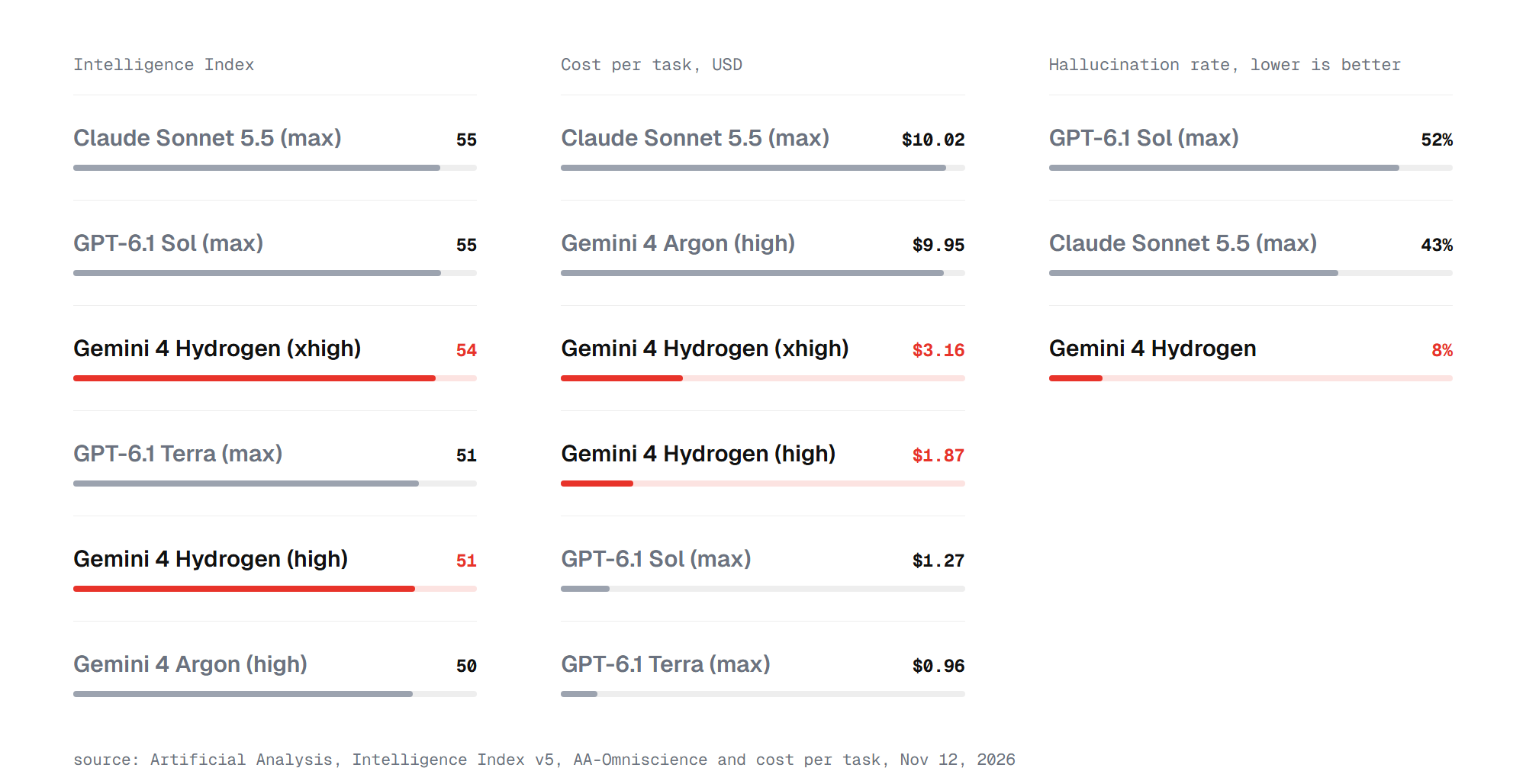
Artificial Analysis has now published its own results, and they back Google's main claim. On its Intelligence Index, an independent average of nine hard tests, Hydrogen scores 54 at xhigh. That is one point behind Claude Sonnet 5.5 and GPT-6.1 Sol at their max settings. At the default high level it scores 51, level with GPT-6.1 Terra and just above Argon's 50.
The independent tests found clear strengths:
- Low hallucination: on AA-Omniscience, Hydrogen guesses wrongly when it does not know the answer only 8% of the time, against 43% for Sonnet 5.5 and 52% for GPT-6.1 Sol
- Visual reasoning: on GDP.pdf, which tests reasoning over long, complex documents, it ties for first place with a 33% all-pass score at medium
- Presentation: on AA-Briefcase, graders rated its work above other Gemini models, including Carbon
- Speed: it outputs about 200 tokens per second and sits on the frontier of time per task versus intelligence at high, medium and low
The weak spot is terminal work. Artificial Analysis measured 54% on Terminal-Bench 4.0 and 50% on Terminal-Bench-Science. Sonnet 5.5 scored 64% and 53%, and GPT-6.1 Sol 56% and 58%. The xhigh level lifted the science score from 41% to 50% but did not help on Terminal-Bench 4.0.
Google's own table tells a similar story. Hydrogen leads Sonnet 5.5 and Terra on several of Google's tests:
- SWE-sweep, finding and fixing bugs without breaking code: 13.5% against 3.1% for Sonnet and 5.8% for Terra
- HLE-Diamond, hard reasoning: 58.8% against 53.3% and 47.3%
- Agents' Last Exam v1.1, professional workflows: 71.6% against 60.4% and 69.8%
- Vending-Bench 2, running a simulated business: a $14,549 balance against $11,165 and $9,107
Sonnet 5.5 stays ahead in Google's table on Terminal-Bench 4.1, with 63.9% to Hydrogen's 57%, and on OSWorld-2.1 computer use. Google also says Hydrogen ranks fifth on Agent Arena and leads the Vals Tax Agent Bench at 52.3%. LMArena had not published a Hydrogen ranking yet. The independent numbers also show the real cost of each answer.
How much Gemini 4 Hydrogen costs
In the API, Hydrogen costs $1.50 per million input tokens and $7.50 per million output tokens, flat across the full 1 million-token context. Cached input gets a 95% discount, at $0.075. That is twice Gemini 3.8 Flash's $0.75 and $3.75 rates. Google's Carbon costs $4 and $20 from December 1.
Cost per task depends heavily on the thinking level, according to Artificial Analysis:
| Thinking level | Intelligence Index | Cost per task |
|---|---|---|
| xhigh | 54 | $3.16 |
| high (default) | 51 | $1.87 |
| medium | 41 | $0.80 |
| low | 27 | $0.29 |
The xhigh level nearly doubles output tokens for a three-point gain. At xhigh, Hydrogen costs about 32% as much per task as Sonnet 5.5 for near-equal intelligence. It costs about 2.5 times as much as GPT-6.1 Sol, which scores one point higher. At high, it matches Argon's score for about 19% of Argon's cost per task. GPT-6.1 Terra reaches the same 51 for about $0.96.
For consumers, much of it is free. Hydrogen is labeled "Everyday help" in the Gemini app's model picker. Free users get it through automatic model selection when Gemini decides it fits the prompt. It also now powers answers in Google Search for all users.
Where you can use Gemini 4 Hydrogen
Google is rolling out the model globally on several surfaces:
- Developers: Gemini API and Google AI Studio on all tiers, plus Android Studio on the paid tier
- Antigravity: for paid Google AI Pro and Ultra subscribers, with an extra thinking tier, plus Orchestrator for Ultra
- Enterprises: Gemini for business through the API and model picker, plus Gemini in Google Sheets
- Everyone: the Gemini app model menu and Google Search
That makes Hydrogen the first Gemini 4 model for free users, since Carbon and Argon are available only on paid plans.
How Hydrogen works with Carbon in Antigravity
Hydrogen arrived in Antigravity together with a new feature called Orchestrator. Both launched on November 12, two days after Google added /swarm agent teams alongside Carbon. Orchestrator shows up as its own option in the model menu.
Instead of using one model for a whole session, Orchestrator hands work back and forth between Carbon and Hydrogen. Carbon can start by exploring the code and writing a plan. Hydrogen then makes the edits, updates packages and runs tests. If Hydrogen gets stuck, it hands control back to Carbon to repair the plan.
Google says this beats static routers that pick one cheap model from the first prompt. On Terminal-Bench, Orchestrator came close to Carbon's success rate while using 24% less quota and finishing 19% faster. Developers who want manual control can wire the two models together with the Antigravity SDK, giving Hydrogen agents triage and Carbon the bigger refactors.
There is a limit on access. Hydrogen itself is available to paid Google AI Pro and Ultra subscribers in Antigravity, but Orchestrator is rolling out only to Ultra for now. Google says more plans will follow. That pairing is also the strongest argument for switching.
Should you switch to Gemini 4 Hydrogen
For anyone on Gemini 3.8 Flash, the upgrade is clear. Hydrogen is much smarter, much better at agentic coding and faster to finish real tasks, even at twice the token price. For Ultra subscribers in Antigravity, pairing it with Carbon through Orchestrator is the most practical way to cut quota use on long sessions.
Against other labs, the choice depends on what you pay for. GPT-6.1 Sol and Terra deliver similar index scores for less money per task, while Sonnet 5.5 still leads on terminal and computer-use work. Gemini 4 Hydrogen wins on speed and reliability, with one of the lowest hallucination rates Artificial Analysis has measured. For research, documents and everyday agents, that makes it the safest fast model to start with.
Sources
- Introducing Gemini 4 Hydrogen, Google – November 12, 2026
- Gemini 4 Hydrogen announcement, Google DeepMind on X – November 12, 2026
- Gemini 4 Hydrogen availability, Google DeepMind on X – November 12, 2026
- Gemini 4 Hydrogen and 3D Medic, Google AI on X – November 12, 2026
- Gemini 4 Hydrogen and Orchestrator, Google Antigravity blog – November 12, 2026
- Gemini 4 Hydrogen evaluation methodology, Google DeepMind
- Google announces Gemini 4 Hydrogen, rolling out to Gemini app, 9to5Google – November 12, 2026
- Gemini 4 Hydrogen results, Artificial Analysis on X – November 12, 2026
- Artificial Analysis leaderboard – accessed November 12, 2026
- Gemini 4 Hydrogen's $3 workload costs 1.5x GPT-6.1 Terra, FourWeekMBA – November 12, 2026