Felix Laurent

Meta released Muse Ember on November 9, 2026, its smallest and cheapest model so far. Muse Ember scores 36 on the Artificial Analysis Intelligence Index, the same as Claude Haiku 5.5 at max reasoning. It gets there at about a third of the cost per task. It costs $0.10 per million input tokens and $0.50 per million output tokens on the Meta Model API.
Meta built Muse Ember for the work AI agents repeat all day: tool calls, coding subtasks, routing, data extraction and long documents. It is also the first model Meta trained with Muse Wonder Full, its largest model.
What Muse Ember is built for
Muse Ember is the small, high-volume tier of Meta's Muse family. Meta's own pitch splits the work between models. In Meta's words, Muse Wonder plans and Muse Ember "handles the volume" of the job. The bigger model breaks down a hard problem, and the small one runs the many steps that follow.
The specs fit that role:
- 1M-token context window, enough for a full codebase or document set in one call;
- up to 512K output tokens, four times the 128K limit of Claude Haiku 5.5 and GPT-6 Luna;
- native multimodal input: text, images, audio and video, so an agent can read screenshots, charts and scanned documents;
- computer use directly from screenshots;
- Responses API support, the format OpenAI uses for agents.
Meta says Ember received the same core safety training and testing as its larger models. Under its Superintelligence Scaling Framework, it stayed below the high-risk thresholds for chemical, biological, cyber and loss-of-control risks. The company also tested how the model resists instructions hidden in web pages and tool outputs, and whether it asks a person before high-impact actions.
The main claim is about price, and Artificial Analysis has already checked it.
How Muse Ember compares on price and intelligence
Muse Ember, Claude Haiku 5.5 and GPT-6 Luna all list at the same token prices. Each costs $0.10 per million input tokens and $0.50 per million output tokens. The difference shows up in the full cost of a task.
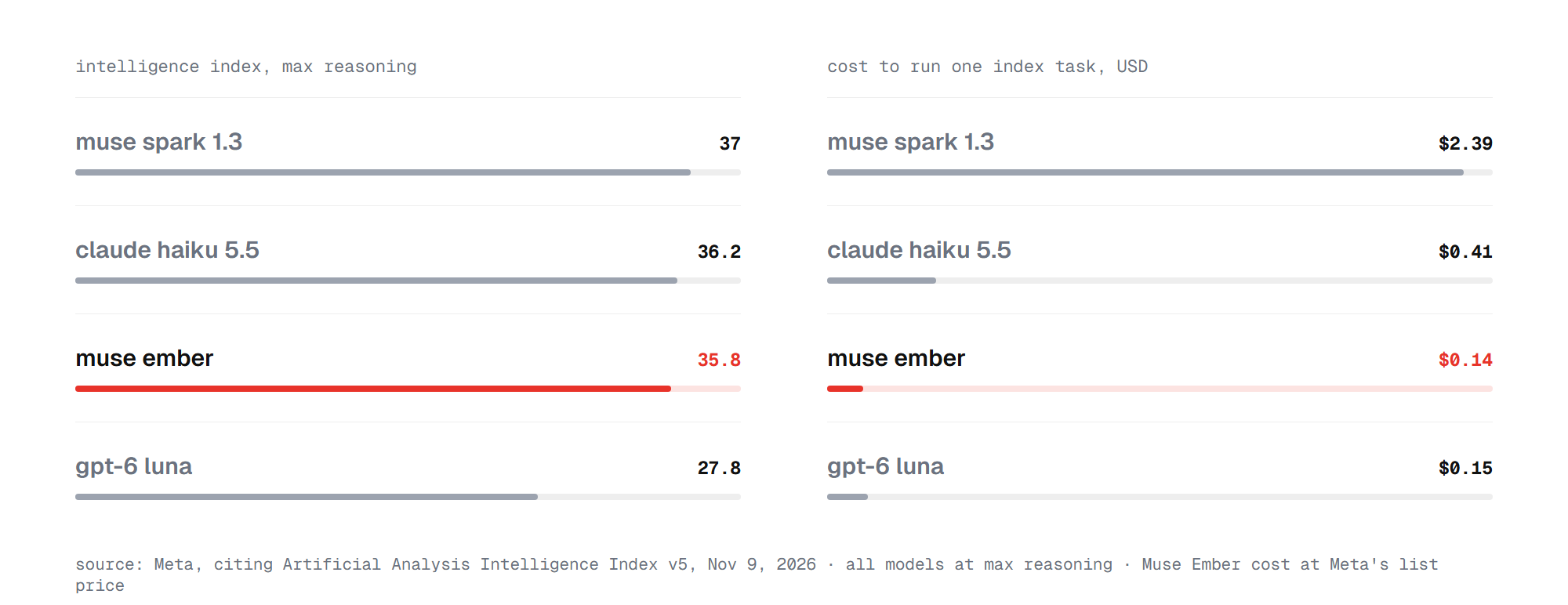
Artificial Analysis confirmed the headline in its own post the same day. Muse Ember at max reasoning scores 36 and costs $0.14 per index task. Claude Haiku 5.5 gets the same score for $0.41, almost three times more. GPT-6 Luna costs about the same as Ember per task, $0.15, but scores only 28.
Artificial Analysis names two reasons for the gap. Cached input makes up most of the cost in agent tasks, and on Ember it is 60% cheaper: $0.004 per million tokens against $0.01. Ember also uses roughly a third as many output tokens as Haiku 5.5.
Ember is also about four times cheaper per task than DeepSeek V4.1 Flash, which scores 33 at $0.60, and GLM-5.3-Flash, which scores 28 at $0.58. Within Meta's own lineup, Ember scores one point below Muse Spark 1.3 for about a seventeenth of the price. It is eight points below Muse Wonder for about a fiftieth.
A single index hides where a small model is strong and where it is weak. The benchmarks split that out.
Muse Ember benchmarks against Claude Haiku 5.5 and GPT-6 Luna
Meta published eight benchmark results against Claude Haiku 5.5 and GPT-6 Luna, all at max reasoning. Some come from Artificial Analysis, marked AA, and the rest are Meta's own tests.
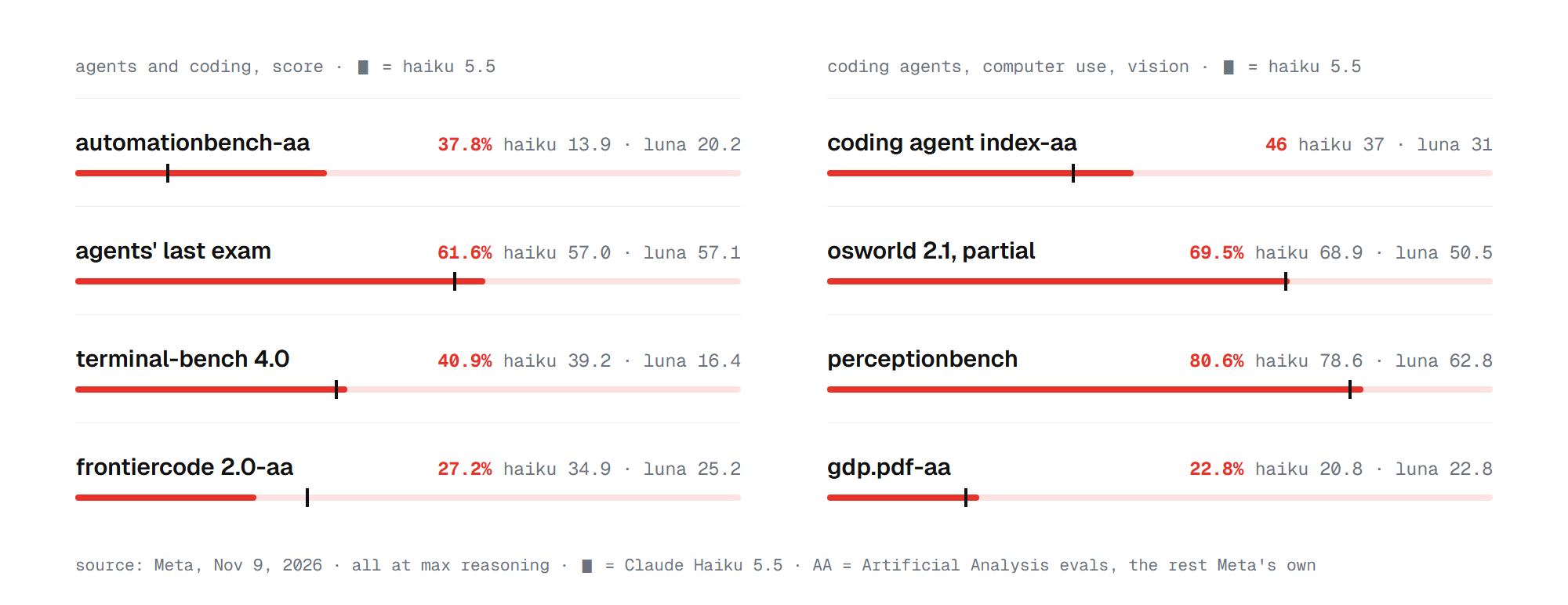
Ember leads or ties on seven of the eight. Its clearest win is in business automation, where AutomationBench-AA tests end-to-end workflows across apps. As a coding agent in Muse Code, it scores 46 on the Coding Agent Index-AA. Haiku gets 37 in Claude Code and Luna 31 in Codex.
The one loss is FrontierCode 2.0-AA, which judges real engineering tasks by whether the code could be merged. There Haiku 5.5 scores 34.9% and Ember 27.2%. On computer use and visual perception, Ember and Haiku are within two points of each other, with Luna well behind.
Meta's chart mixes its own tests with numbers it attributes to Artificial Analysis. The independent results look different in places.
What Artificial Analysis measured
Artificial Analysis published its full Muse Ember results on November 10. Its Intelligence Index v5.0.1 combines nine evaluations, all run at max reasoning. Ember ranks second of 32 models in its comparison group, with a score of 36.
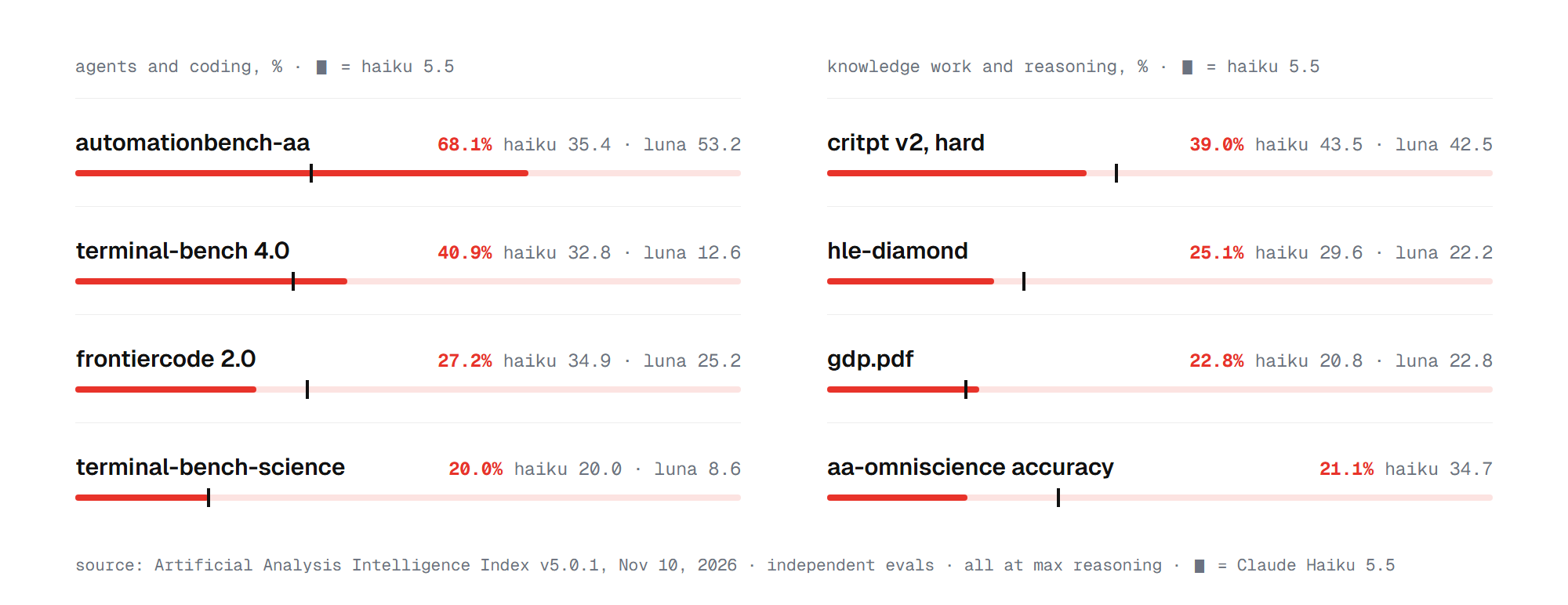
Ember's lead is in agent work. On AutomationBench-AA, which tests business workflows across SaaS apps, it scores 68.1%, against 35.4% for Haiku 5.5 and 53.2% for Luna. On Terminal-Bench 4.0 it scores 40.9%, against 32.8% and 12.6%. On GDP.pdf, a test of professional work over long documents, it ties Luna at 22.8% and edges past Haiku.
Haiku 5.5 wins the reasoning and knowledge tests. It leads on FrontierCode 2.0, HLE-Diamond and the CritPt physics test, where Ember is last of the three at 39%. Haiku also leads on AA-Briefcase, a test of agentic knowledge work, at 1574 Elo against 1521. The two models tie on Terminal-Bench-Science at 20%.
These numbers do not match Meta's chart everywhere. Meta shows AutomationBench-AA scores of 37.8% for Ember, 13.9% for Haiku and 20.2% for Luna under strict pass@1. Artificial Analysis reports all three far higher, and Ember's lead over Haiku shrinks from almost three times to about two. On Terminal-Bench 4.0, Meta ran Haiku in Claude Code and got 39.2%, while Artificial Analysis measured 32.8% in its own harness.
The cost gap holds up in the independent data. Ember used 84,500 output tokens per task, against 226,000 for Haiku 5.5. Running the full index cost $117 on Ember and $339 on Haiku. Artificial Analysis has not measured Ember's output speed yet.
The same evaluations also show where Ember is weakest.
Where Muse Ember falls short
Knowledge is Ember's main weakness, according to Artificial Analysis. On its AA-Omniscience test of factual knowledge, Ember answered 21.1% correctly. That is the lowest result among models of similar intelligence. Claude Haiku 5.5 scored 34.7% and Gemini 3.8 Flash 50.5%.
The low score comes mostly from caution. Ember declined to answer 64% of the questions. That keeps its hallucination rate at 17.4%, half of Haiku 5.5's. For an agent that pulls facts from tools and documents, refusing to guess is often the right behavior. For a chat assistant that must answer from memory, it is a limit.
Ember is also a closed model. Artificial Analysis lists it as proprietary, with no public weights, like every Muse model except the open Muse Glimmer.
These limits matter less for the work Meta's partners have already tested.
Who is using Muse Ember
Meta named five early partners: Box, Cline, Oracle, Cloudflare and You.com. Box says Ember can score a contract against a negotiation playbook clause by clause and screen job candidates against a brief. Cline, the open-source coding agent, says the model "excels at" subagent work like coding and document analysis. Its pitch is cost: teams can run Ember as the subagent in their own harness.
Mark Zuckerberg called Ember a model that "delivers higher intelligence per dollar than others in its class" in his launch post. TechCrunch noted that Ember is the fourth model under the Muse brand, after Spark, Glimmer and Wonder.
How to start using Muse Ember
Muse Ember is available now in two places:
- Meta Model API, with the model ID
muse-ember-1.0, at $0.10 per million input tokens, $0.004 per million cached input tokens and $0.50 per million output tokens; - Muse Code, Meta's coding agent for the terminal, where Artificial Analysis measured its best coding results.
Meta has not announced Ember for the Meta AI app or for third-party platforms such as OpenRouter. The Meta Model API opened worldwide in September, when Meta also cut prices for developers by up to 80% on a new tier.
Muse Ember and Meta's model lineup
Ember completes a four-tier lineup that Meta has built in seven months. Muse Spark launched in April as the first model from Meta Superintelligence Labs. Spark 1.3, released in September, is the model for coding and agent workflows at $1.25 and $4.25 per million tokens. Muse Wonder arrived in October for the hardest problems, at $4 and $20. Muse Glimmer is a free open model for local use.
| Model | Role | Price per 1M input / output tokens |
|---|---|---|
| Muse Wonder | hardest problems, planning | $4.00 / $20.00 |
| Muse Spark 1.3 | coding and agent workflows | $1.25 / $4.25 |
| Muse Ember | repeated agent tasks at scale | $0.10 / $0.50 |
| Muse Glimmer | open model for local use | free, open weights |
When Meta launched Wonder, it said it would use the big models to train smaller ones for everyone. Ember is the first result of that plan. Meta says it has "even more efficient models in training."
Is Muse Ember worth using
For agent pipelines, yes. Muse Ember matches Claude Haiku 5.5 on the Artificial Analysis index at a third of the cost per task. An independent evaluator confirmed it on day one. Cheap cached input and short answers make the savings largest exactly where agents spend most tokens: long contexts reused across many calls.
For tasks that need broad knowledge or code that has to be merged as written, Haiku 5.5 is still stronger. The best fit is the one Meta describes: a bigger model plans, and Ember runs the hundreds of small steps that follow.
Sources
- Introducing our smallest, most efficient model: Muse Ember, Meta – November 9, 2026
- Artificial Analysis on Muse Ember, X – November 9, 2026
- Mark Zuckerberg on Muse Ember, X – November 9, 2026
- Meta releases Muse Ember, a new lightweight model for agent execution, TechCrunch – November 9, 2026
- Muse Ember vs Claude Haiku 5.5, Artificial Analysis – accessed November 10, 2026
- Muse Ember vs GPT-6 Luna, Artificial Analysis – accessed November 10, 2026
- Claude Haiku 5.5 on Artificial Analysis
- GPT-6 Luna on Artificial Analysis
- Pricing, Claude Platform docs
- GPT-6 Luna model page, OpenAI