 Felix Laurent
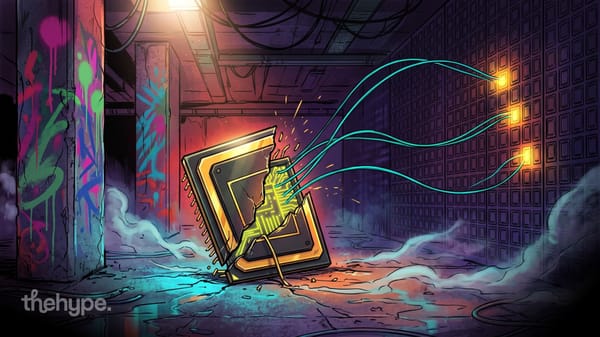
Tencent's Hunyuan team has open-sourced DFly2, the draft model that speeds up text generation in its Hy4 flash model. Tencent says it delivers up to a 4.2x speedup in token output, with the biggest gains on long-context and agentic workloads. The weights, training code and a technical report went public on November 26, 2026.
DFly2 also works with two other open models, DeepSeek-V4.1-Flash and GLM-5.3-Flash. Tencent released separate drafters for all three on Hugging Face.
What DFly2 does
DFly2 is a drafter for speculative decoding, built for Tencent's Hy4 family and similar models. In this method, a small, fast model guesses several next tokens at once, and the large model checks them in a single pass. Every accepted guess saves the large model a step, so the answer arrives faster without changing what the model writes.
Drafters have a cost of their own. Most keep a separate memory of the conversation, called a KV cache. On long prompts, that extra cache eats GPU memory, slows down the initial prompt processing and leaves room for fewer users per server. Some drafters avoid this by reading only the most recent part of the context, but then they miss earlier details.
DFly2 solves both problems by borrowing from the main model. Hy4, DeepSeek-V4.1 and GLM-5.3 use sparse attention, where an indexer picks the few positions in the context that matter for each new token. DFly2 reads the main model's own KV cache at exactly those positions. Each draft token looks at about 2,000 keys at most, however long the context is.
That design brings three advantages. Drafting cost stays flat at any context length. The drafter needs no extra KV memory. And it is not involved in prompt processing at all, which makes it easier to run in setups that split prefill and decoding across machines.
Those design choices show up most clearly in the benchmark numbers.
DFly2 benchmarks against DFlash and DSpark
Tencent compared DFly2 with two other drafter designs, DFlash and DSpark, trained on the same recipe. The tests covered three long-context sets of up to 128K tokens and four agentic sets, including BFCL-v3 and a SWE task at 64K.
On Hy4 flash, DFly2 sped up decoding of agentic tasks by 3.41 times on average, compared with 2.63 times for DSpark. That is the roughly 30% gain Tencent highlights. On DeepSeek-V4.1-Flash, the agentic average was 3.10 times against 2.61 times, and on GLM-5.3-Flash it was 2.61 times against 2.14 times. The best single result was 4.55 times on one agentic set with Hy4 flash.
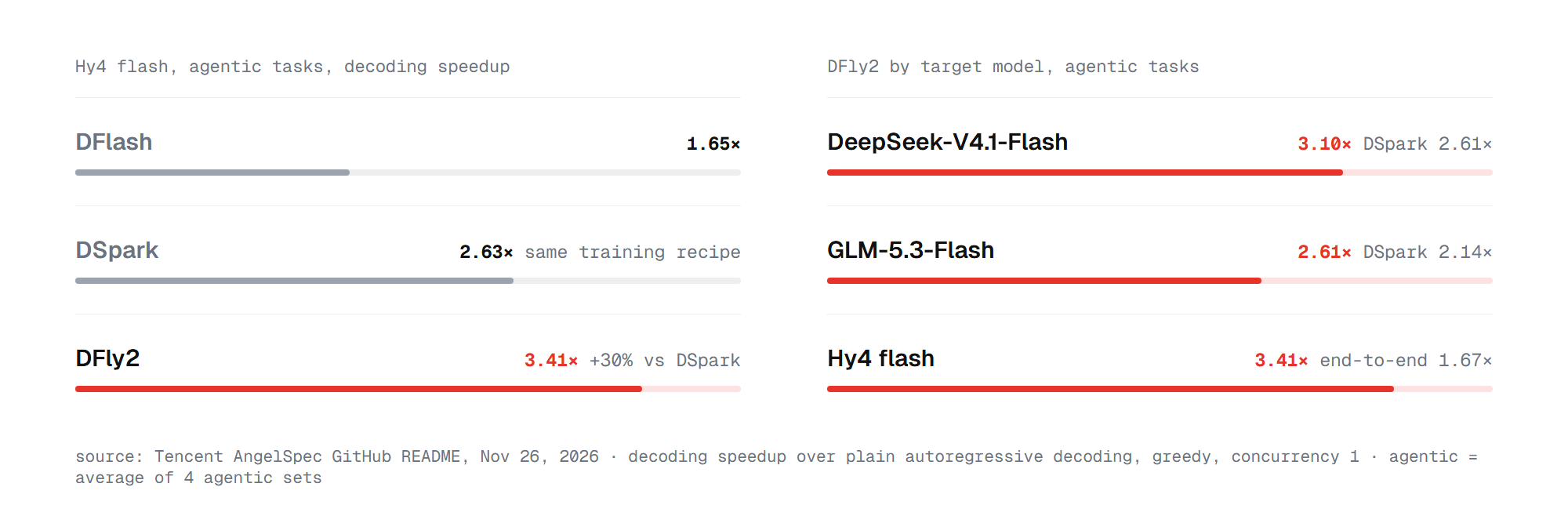
DFly2 also accepted more draft tokens per step than both rivals on every target and benchmark. According to the paper, its lead over the stronger rival is 3.9% to 10.5% on general tasks. On long-context and agentic work, it widens to 10% to 31.5%.
The end-to-end numbers are more modest. Counting prompt processing, DFly2 sped up Hy4 flash agentic runs by 1.67 times on average. On DeepSeek-V4.1-Flash at high load and 64K context, the paper reports 62% to 81% higher server throughput than the stronger baseline.
Getting those gains takes some work, though.
How to use DFly2
The drafter for Hy4 flash already ships inside the model. Tencent also released three MoE drafters on Hugging Face, for Hy4 flash, DeepSeek-V4.1-Flash and GLM-5.3-Flash. Teams that already run DeepSeek-V4.1-Flash can add the matching drafter to their serving stack.
Training a drafter for another model takes AngelSpec, Tencent's open framework for speculative decoding. It supports seven drafter designs, including Eagle3, DSpark and MTP, and uses vLLM or SGLang for inference. The single-node quickstart needs eight GPUs. The project uses its own AngelSpec license, so check its terms before commercial use.
Does DFly2 matter for open models
Yes, mainly for teams that serve open models to many users. Agents send long prompts with full histories, tool results and code, and that is where ordinary drafters lose speed and memory. DFly2 keeps drafting cost flat and frees memory, so a server can handle more requests at once.
The limits are clear too. DFly2 only works with models that use sparse attention with an indexer, so dense models like Qwen3 need other drafters. The headline 4.2x figure is a best case for decoding speed, while full requests gain less. Still, a free drafter with training code for three popular open models is a practical upgrade for anyone running agents on their own hardware.
Sources
- AngelSpec, Tencent on GitHub – November 26, 2026
- DFly2: Turbocharging long-context speculative decoding by sharing the target's sparsity, arXiv – November 25, 2026
- AngelSlim models, Hugging Face – November 2026
- Tencent Hunyuan on X – November 26, 2026