Felix Laurent

Alibaba's Qwen team has expanded the languages and Chinese dialects in Qwen-Audio-3.1, its family of speech models. The update, announced on November 26, 2026, covers all three models: speech recognition, text-to-speech and real-time voice conversation. The biggest jump is in recognition, which now handles 59 languages, up from 30.
The update is live in the API on Qwen Cloud, Alibaba's model platform. Qwen says the focus is on Chinese dialects, which most speech models still handle poorly.
What changed in Qwen-Audio-3.1
Qwen released the Qwen-Audio-3.1 series earlier this autumn. Its technical reports came out in September for the real-time model and in October for speech recognition. This week's update widens language coverage across the family:
- Qwen-Audio-3.1-ASR turns speech into text in 59 languages and 8 Chinese dialects.
- Qwen-Audio-3.1-TTS turns text into speech in 65 languages and 6 Chinese dialects.
- Qwen-Audio-3.1-Realtime holds spoken conversations in 53 languages and 6 Chinese dialects.
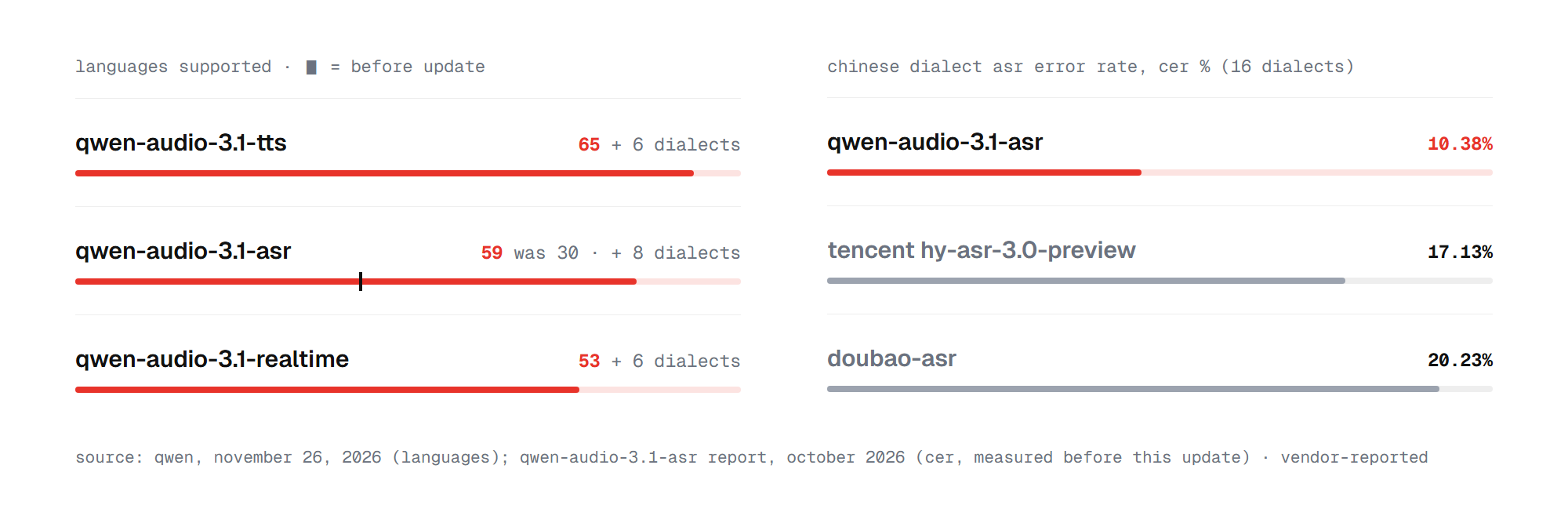
Qwen has not published the full list of languages or named the dialects in its announcement. Its counting has also changed. Earlier, Qwen described the recognition model as supporting 30 languages and 16 Chinese dialects. The new post lists 8 dialects for the same model and does not explain the difference. The October technical report grouped its dialect tests into eight regions, which may account for the lower number.
How well Qwen-Audio-3.1 handles Chinese dialects
The dialect focus builds on results Qwen reported in October. On an internal test set of 16 Chinese dialects, Qwen-Audio-3.1-ASR got 10.38% of characters wrong on average. ByteDance's Doubao-ASR got 20.23% wrong and Tencent's Hy-ASR-3.0-preview 17.13%. The test included Cantonese, Shanghainese, Sichuanese, Hakka and city dialects such as Wenzhou, Hangzhou and Suzhou.
The gap is widest on the hardest dialects. Wenzhou speech is notoriously hard to understand, even for other Chinese speakers. There, Qwen's error rate was 19.21%, against 68.22% for Doubao and 64.74% for Tencent. On public dialect benchmarks the race was closer: Qwen scored 4.55%, Tencent 4.61% and Doubao 7.15%.
These are Qwen's own tests, run before this week's update. Qwen has not published new scores for the added languages.
The recognition model also does more than plain transcription. It can translate dialect speech into standard Mandarin text and label who is speaking in a recording. It also boosts names or terms that a developer passes in advance. The other two models in the family have their own strengths.
Qwen-Audio-3.1 TTS and Realtime
Qwen-Audio-3.1-TTS is built for real-time apps. Developers can steer emotion, tone, persona, speaking rate and volume with plain-text instructions or tags, and the model supports voice cloning.
Qwen-Audio-3.1-Realtime is a full-duplex voice model, meaning it listens and speaks at the same time. It is designed to handle interruptions, wait for users to finish and call tools during a conversation. In Qwen's September report, it completed 82.0% of tasks on a speech-to-text adaptation of the τ-Voice agent benchmark, up from 78.4% for the previous version. It also learned to ignore background talk: it responded to background speech in 13% of test cases, down from 73%.
All three models are available only through the API, and Qwen has not released weights.
| Model | Input price | Output price |
|---|---|---|
| Qwen-Audio-3.1-ASR-Flash | $0.15 per 1M tokens | $0.47 per 1M tokens |
| Qwen-Audio-3.1-TTS-Flash | $0.23 per 1M tokens | $1.87 per 1M tokens |
| Qwen-Audio-3.1-Realtime-Flash | $0.93 per 1M audio tokens | $1.87 per 1M tokens |
Prices come from the Qwen Cloud model pages. The Realtime model charges $0.23 per million tokens for text input.
Qwen's open-weight Qwen3 TTS is a different option for developers. It is available on OpenRouter and covers 10 languages.
What the update means for voice apps
For developers building voice apps for Chinese users, Qwen-Audio-3.1 now looks like one of the strongest options. It beat ByteDance's and Tencent's recognition models on Qwen's own dialect tests, by a wide margin on the hardest dialects. The update also brings more languages to all three models at low token prices. The doubled language count also makes it more useful outside China, though Qwen has not shown how well it handles the new languages. Until independent tests and a full language list appear, teams should check it on their own recordings, especially for dialects and smaller languages.
Sources
- Qwen-Audio-3.1 multilingual update, Qwen on X – November 26, 2026
- Qwen-Audio-3.1-ASR technical report, arXiv – October 20, 2026
- Qwen-Audio-3.1-Realtime: towards reliable agentic voice interaction, arXiv – September 24, 2026
- Qwen-Audio-3.1-ASR-Flash, Qwen Cloud
- Qwen-Audio-3.1-TTS-Flash, Qwen Cloud
- Qwen-Audio-3.1-Realtime-Flash, Qwen Cloud
- Qwen Audio project page