 Felix Laurent
Tencent released the open weights of Hy4 flash on November 18, two days after the model launched as an API. Three versions are on Hugging Face: the instruct model, an FP8 build and the pre-trained Hy4 flash-Base. A few hours later, Tencent's AngelSlim team added GGUF files for local tools.
Hy4 flash is a mixture-of-experts (MoE) model with about 220 billion parameters, of which 12 billion are active per token. It reads text and images and holds up to 1 million tokens of context. The weights ship under the new Tencent Hy License, which is free for most users but adds terms for large API providers.
When we covered the Hy4 flash launch on November 16, open weights were the open question. Here is what Tencent has now released and what you need to run it.
What Tencent released
The release has three model repositories and a set of quantized files:
| Version | What it is | Size on disk |
|---|---|---|
| Hy4 flash | Instruct model in BF16 | 440 GB |
| Hy4 flash-FP8 | FP8 quantized instruct model | 287 GB |
| Hy4 flash-Base | Pre-trained base model for fine-tuning | 439 GB |
| Hy4 flash GGUF | 2-bit to 4-bit builds for llama.cpp-style tools | 135 to 168 GB |
The models are also on ModelScope and GitCode, and the code is on GitHub. Tencent added a fine-tuning guide to the repository. The base model is not tuned for chat, so the usual prompts only work with the instruct and FP8 versions.
The instruct model has two reasoning modes. The default "high" mode thinks before it answers, and "no_think" replies directly. Tencent recommends a temperature of 0.9.
Those file sizes come from an unusual design.
Hy4 flash architecture: 220B parameters, 12B active
Tencent's launch post put the total at 224 billion parameters. The model card puts it at about 220 billion. The main network has 155.5 billion, Engram tables 63.5 billion, the vision encoder 0.43 billion and the drafter 0.85 billion. Each token uses about 11.3 billion text parameters plus the vision encoder.
Three parts set it apart from Tencent Hy4, the larger model it was distilled from:
- Hybrid attention. Sparse attention and sliding-window attention alternate at a 1 to 3 ratio. Tencent says this cuts the memory for long context to a sixth of Hy4's and 1/24 of Hy3's.
- LatentMoE. Each token picks 16 of 512 experts, plus one shared expert, and the experts work in a smaller latent space.
- Engram. Learned tables of two- and three-word phrases sit beside the network. They account for the 63.5 billion extra parameters but cost little compute.
A built-in drafter called DFly2 speeds up generation by guessing several tokens ahead. Tencent says it reuses the main model's memory, so it adds no extra cache. With 4-bit weights, Tencent claims more than 150 tokens per second.
That speed claim assumes serious hardware.
How to run Hy4 flash locally
Tencent's own recipes target data-center GPUs. The official vLLM and SGLang Docker images serve the FP8 model across 8 GPUs with tensor parallelism. Native support in Hugging Face Transformers is not merged yet, so for now you need to install it from a pull request.
The GGUF files lower the bar but not by much:
- IQ2_AH, the smallest 2-bit build, takes 135 GB.
- Q3_K takes 155 GB.
- Q4_K_M takes 168 GB.
- SPARK 4-bit builds come as single files of about 160 GB.
Even the 2-bit version needs more memory than any single consumer GPU has. It fits on workstations with 192 GB or more of unified memory, or on multi-GPU rigs with CPU offload. Tencent describes the GGUF files as meant "for end-to-end testing", so quality at 2 and 3 bits is unverified. A smaller model like DeepSeek V4.1 Flash is still the easier local option.
Where Hy4 flash runs matters less than what you are allowed to do with it.
Tencent Hy License: what is allowed
The Hy4 preview came out under Apache 2.0 in August. Hy4 flash does not. Tencent wrote a new Tencent Hy License 1.0, based on Apache 2.0 with one extra section for model-as-a-service businesses.
For most people the terms work like Apache 2.0. You can use, modify, fine-tune, quantize and redistribute the model, including for commercial products, with no fee. The license has no regional exclusions.
The catch is in Section 10. A company that gives others general access to the model, for example through an API, needs a separate written license from Tencent in two cases:
- its worldwide revenue is above $50 million in any 12-month period, even if the money has nothing to do with the model;
- the product built on the model has more than 100 million monthly active users.
Apps that use the model only inside fixed features, such as a summarize button, do not count as model-as-a-service. Neither does purely internal use. Fine-tuned and quantized versions inherit the same terms, so community GGUFs and fine-tunes carry the license too.
The license matters most for the companies that would host the model at scale. For everyone else, the question is whether it is good enough to bother.
Hy4 flash benchmarks against other open models
Tencent's model card compares Hy4 flash with three other open "flash" models and OpenAI's GPT-6 Luna on agent tasks. All scores come from Tencent's own runs at the highest reasoning setting, with costs per task in yuan.
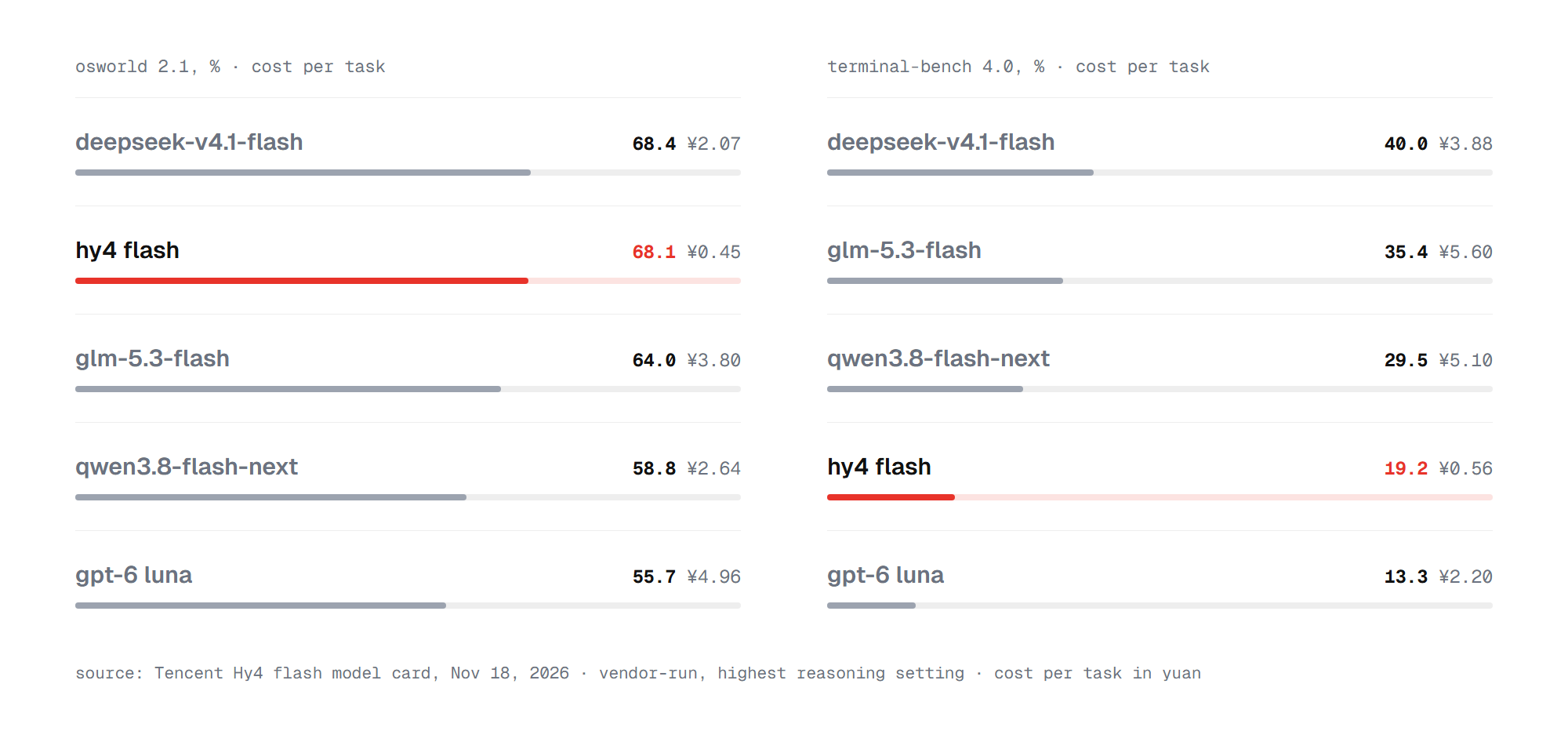
On OSWorld 2.1, a computer-use test, Hy4 flash scores 68.1%. That is level with DeepSeek-V4.1-Flash at 68.4%, at less than a quarter of the cost per task. It also scores 63.1% on APEX-Agents, behind DeepSeek's 72.9% but ahead of GLM-5.3-Flash and Qwen3.8-Flash-Next.
Coding is the weak spot. Hy4 flash completes 19.2% of Terminal-Bench 4.0 tasks, about half of DeepSeek's 40.0%. On DeepSWE v1.1 it scores 64.6% against 73.8% for DeepSeek. Tencent itself recommends the full Hy4 for long software projects and Hy4 flash for search, documents, slides and computer use.
Those trade-offs shape who should download it.
Should you use the Hy4 flash open weights
Yes, if you build office agents or computer-use tools and want a cheap model you can host and fine-tune yourself. Its OSWorld score matches DeepSeek's flash model, its running cost is far lower, and the license is free unless you are a large API provider. Skip it for coding agents, where DeepSeek-V4.1-Flash and GLM-5.3-Flash score much higher. Skip it too if you only have a gaming PC: even the 2-bit file needs 135 GB of memory.
FAQ
Is Hy4 flash open source?
The weights are open under the Tencent Hy License 1.0, which is based on Apache 2.0. It is free for commercial use. API providers with more than $50 million in revenue, or products with over 100 million monthly users, need a separate license.
Where can I download Hy4 flash?
On Hugging Face, ModelScope and GitCode. Tencent released Hy4 flash, Hy4 flash-FP8 and Hy4 flash-Base, plus GGUF builds in the AngelSlim repository.
How much memory does Hy4 flash need?
The BF16 weights take 440 GB and the FP8 version 287 GB. The smallest GGUF build is 135 GB. You need a workstation with about 150 GB of RAM or unified memory, or several GPUs.
How many parameters does Hy4 flash have?
About 220 billion in total, including 63.5 billion Engram parameters, with roughly 12 billion active per token. Tencent's announcement rounds the total to 224 billion.
Can I fine-tune Hy4 flash?
Yes. Tencent released the pre-trained Hy4 flash-Base model and a fine-tuning guide in the repository. Fine-tuned versions fall under the same license.