Felix Laurent

CoreWeave's banks are preparing a $4.5 billion loan backed by graphics processing units for Meta, Bloomberg reported on November 25, 2026. Morgan Stanley and Mitsubishi UFJ Financial Group could bring the deal to investors as soon as next week. The money will buy GPUs for a data center in Dalton, Georgia.
The timing is awkward. On the same day, CoreWeave's 2031 bonds fell to a record low. The cost of insuring its debt against default jumped by the most ever. The new loan shows how differently investors treat CoreWeave and its biggest customers.
How the Meta-backed loan works
The deal is a delayed draw term loan, a structure CoreWeave has used before. Proceeds go into an escrow account. CoreWeave draws on it only to pay for GPUs at the Dalton site. It pays the debt down gradually over the life of the loan.
The key is the collateral. The loan is secured by the GPUs and tied to CoreWeave's contract with Meta, which pays to use the computing power. In practice, lenders rely on Meta's credit more than CoreWeave's.
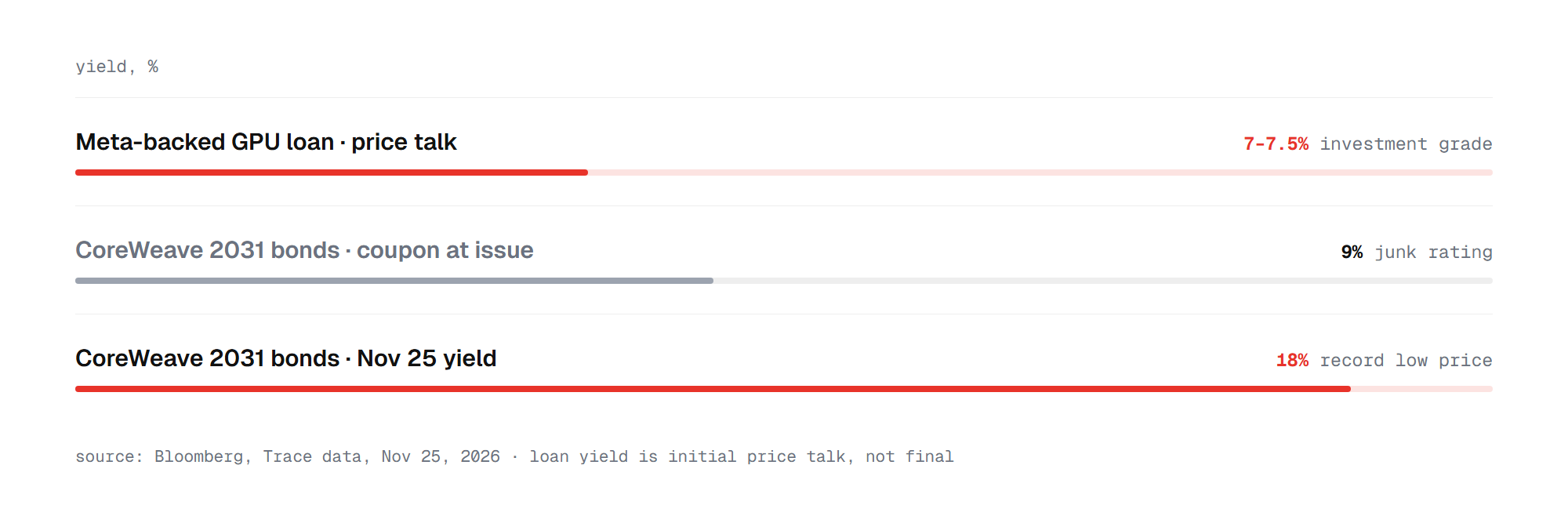
That is why the loan is expected to get an investment-grade rating, even though CoreWeave itself has a junk rating. Early talk puts the yield at 7% to 7.5%, according to people familiar with the deal. Potential buyers have already signaled interest roughly equal to the full $4.5 billion. CoreWeave's own bonds tell a very different story.
Why CoreWeave's own debt looks distressed
CoreWeave's 9% bonds due in 2031 traded at record lows on November 25, yielding 18%, according to Trace data. That is more than double the yield discussed for the Meta-backed loan.
Credit default swaps, which pay out if a company defaults, sent an even louder signal. The cost of five-year protection on CoreWeave's debt rose by the largest margin on record. At those prices, the market sees more than a 70% chance of default within five years, according to Bloomberg data.
The stock has been volatile too. CoreWeave shares closed at $42.57 on November 25, after swinging from $39.51 to $48.33 over the past week. This is the third debt scare in about six weeks.
How CoreWeave got here
In October, CoreWeave's bond yields topped 15% as investors questioned how a company carrying about $72 billion in liabilities would keep borrowing. Then, after the US midterms, its bonds hit new lows when candidates who want to slow data center construction won several governor races.
One of those races matters directly for this loan. Georgia's governor-elect, Keisha Lance Bottoms, campaigned on slowing data center construction, and the new GPUs are headed to Dalton, Georgia. CoreWeave runs computing there through Core Scientific. Core Scientific is building data centers in five states, fully leased to CoreWeave under a 12-year contract worth about $10 billion.
New US chip restrictions have added to the pressure on AI debt in general. Billions of dollars in loans tied to Chinese firms are now on hold, Bloomberg reported. CoreWeave's spending keeps rising regardless.
What CoreWeave is spending
CoreWeave's capital expenditure reached $14.5 billion in the third quarter. That brought spending for the first nine months of 2026 to $30.65 billion. On its earnings call in November, executives said the next delayed draw term loan would come "in the coming weeks," with investment-grade ratings.
The company did give investors some good news. Its full-year revenue came in above both its own forecast and Wall Street's average estimate. Meta is a large part of that revenue. In April, CoreWeave disclosed an expanded agreement with Meta worth about $21 billion, on top of a $14.2 billion deal from September 2025.
This structure lets CoreWeave keep building while its own credit weakens. Lenders get paid from Meta's contract, and CoreWeave gets cheaper money than its bonds would allow. CoreWeave's existing delayed draw loans trade around par, a sign that buyers trust the structure.
What the CoreWeave loan means for AI debt
The loan will likely sell, and at a much lower cost than CoreWeave's bonds. Investors are happy to lend against Meta's contract and the chips themselves. They are far less willing to lend to CoreWeave on its own.
That gap is the real story. It suggests the market sees big tech as the safe end of the AI buildout and companies like CoreWeave as the risky middle. If CoreWeave struggles, lenders backed by Meta's contract are protected, while bondholders and shareholders take the losses. The Dalton loan will show how long that split can keep financing new GPUs.
Sources
- CoreWeave's banks to sell $4.5 billion Meta-tied loan next week, Bloomberg – November 25, 2026
- Bloomberg post on X – November 25, 2026
- CoreWeave's banks to sell US$4.5 billion Meta-tied loan next week, Bloomberg via Longbridge – November 25, 2026
- CoreWeave's bankers reportedly ready $4.5B GPU-backed loan tied to Meta deal, Stocktwits – November 25, 2026