Felix Laurent
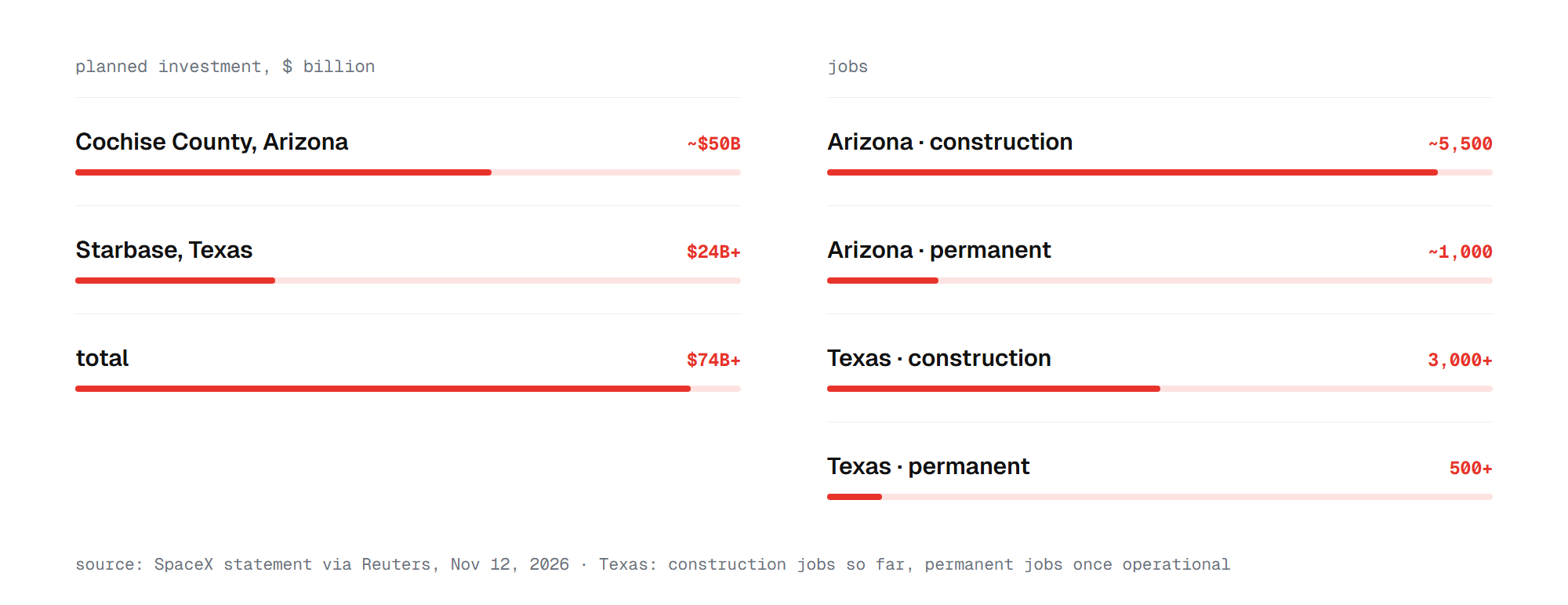
SpaceX plans to invest more than $74 billion in two AI data center campuses, the company said on November 12, 2026. About $24 billion will go to a site at Starbase in Texas and roughly $50 billion to a campus in Cochise County, Arizona.
The plan shows how far SpaceX has moved beyond rockets. Its AI segment generated more than half of the company's revenue in the third quarter, Reuters reported. Both projects still need local approvals, and the Arizona campus already faces opposition.
What SpaceX plans in Texas and Arizona
The two campuses differ in size, power source and status.
| Starbase, Texas | Cochise County, Arizona | |
|---|---|---|
| Investment | more than $24 billion | about $50 billion |
| Power | own gas-fired plant, off the public grid | local electric cooperatives, plus batteries |
| Construction jobs | more than 3,000 so far | about 5,500 |
| Permanent jobs | more than 500 | about 1,000 |
| Next step | tax abatement vote on December 9 | county permit hearing in December |
Starbase is the company's rocket base on the Gulf Coast. A city notice this week showed plans there for a gas-fired power plant and a supercomputing facility on about 444 acres. The site will make its own electricity instead of drawing from the public grid. The Starbase City Commission will consider a property tax abatement for the project on December 9.
The Arizona campus is the larger bet. Local reports describe a site of about 747 acres near Willcox, with up to nine computing buildings. Peak capacity is planned at 6 gigawatts, built in four phases of about 1.5 gigawatts each, with a 24-gigawatt-hour battery system. The plan also includes about $3.6 billion in grid upgrades. If approved, construction could start as early as March 2027.
SpaceX is pitching the Arizona project to residents with promises about power bills and water.
How SpaceX is selling the Arizona campus
SpaceX said it is working with local electric cooperatives and that the project could cut bills for co-op members by up to 20%. The campus would use dry cooling, with no planned industrial groundwater use. Water is a sensitive issue in southeastern Arizona, where farms and towns rely on shrinking aquifers.
Residents are not convinced. A petition with 2,400 signatures asks officials to deny the permit, and the county will hold a public hearing in December. The filing was made by Tombstone Resources LLC, a Wyoming company formed in July. SpaceX's name does not appear on the permit, according to local reporting. SpaceX hosted a town hall on November 4, which the county described as privately organized by the company.
The pushback fits a wider trend. Data centers became a political issue in the November midterms, and projects worth about $68 billion have stalled amid local resistance. Building its own gas plant in Texas lets SpaceX sidestep one common complaint, higher power prices for nearby homes. The White House has pushed the same model. We checked whether data centers really build their own power.
The scale of the spending reflects what AI now means for SpaceX.
Why SpaceX is spending $74 billion on AI compute
SpaceX now combines rockets, Starlink and AI under one listed company. It went public in June in a record IPO and agreed to buy Cursor, the AI coding company. Its AI business, which develops Grok and Grok Bot, now brings in more than half of its revenue.
Training and serving those models takes huge amounts of compute. xAI's Colossus supercomputer in Memphis drew criticism for running gas turbines without full permits. The new campuses move SpaceX's next round of compute to land it controls, at Starbase, and to a rural county with room to grow.
Rivals are spending on a similar scale. OpenAI, Google, Meta and Microsoft have all announced multi-gigawatt campuses. Anthropic also reports about $900 billion in compute commitments in its IPO filing. A 6-gigawatt site in Arizona would put SpaceX among the largest single AI campuses announced in the US.
The size of the plan also adds risk for investors.
What it means for SpaceX shareholders
Investors reacted to both sides of the news. Shares rose about 3% after the announcement, according to GuruFocus. A week earlier, reports of the 6-gigawatt plan and its backlash had weighed on the stock. A $74 billion build-out is a large commitment even for a company of SpaceX's size. Most of it depends on permits that are not yet granted.
The two sites carry different risks. Starbase sits on SpaceX's own land in a city built around the company, so approval there looks likely. Arizona depends on a county vote, a skeptical public and a power deal with local co-ops.
Will SpaceX build its Arizona AI campus
The Texas site looks set to move ahead. SpaceX owns the land, the city grew around its base, and it plans to make its own power. The tax abatement vote on December 9 is the next formal step.
Arizona is less certain. The promise of lower power bills, dry cooling and 1,000 permanent jobs is designed to win over a rural county. The petition and the shell company behind the permit show how much trust SpaceX still has to build. The December hearing will show whether a 6-gigawatt AI campus can win local approval in the current climate.
Sources
- SpaceX to invest over $74 billion in supercompute facilities in Texas, Arizona, Reuters via The Star – November 12, 2026
- SpaceX plans more than $74B in Texas, Arizona data-center investments, MarketWatch – November 12, 2026
- SpaceX announces $74B AI data center investment, GuruFocus – November 12, 2026
- SpaceX planning 747-acre data center campus in Cochise County, AZBEX
- SpaceX pitched a 6-gigawatt AI campus in Cochise County, Three Sonorans