Felix Laurent
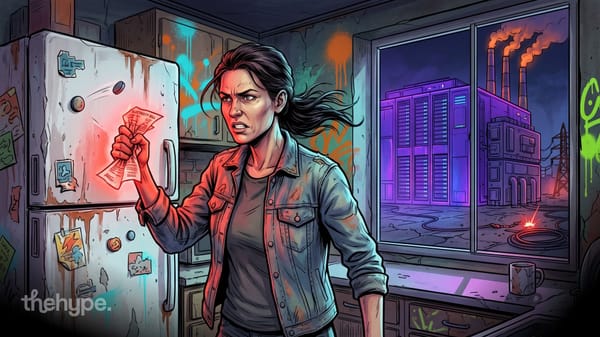
President Donald Trump says new AI data centers build their own power plants and send extra electricity to the grid. He made the claim in a CBS "60 Minutes" interview with Ross Douthat that aired on November 8. The record shows a slower and messier picture: no formal rule, few plants feeding the grid and power prices that are still rising.
Douthat asked what ordinary Americans get out of AI, since polls show they dislike data centers. Trump answered by pointing to China and to power supply.
"China has no problem with electricity. And, by the way, we don't either because I'm letting-- I'm demanding that they build their own electric plant," Trump said. In his words, every center that goes up now is "building their own electric". He added that the excess power is "pouring into the grid" and that "it's gonna lower electric."
What Trump said about AI in the 60 Minutes interview
Power was one part of a longer exchange about AI. Trump said Chinese President Xi Jinping is "all in" on superintelligence and that the US leads China by about a year. He called the risks of AI "not nearly as real" as critics claim and said they "can be managed."
He also told a striking story. According to Trump, the Justice Department once warned the head of "one of the big" AI companies that he could go to jail. Trump did not name the company or say what it had done. He added that he does not "mind guardrails" as long as the US keeps its lead.
The power claim is the one voters can check against their bills. It also has a long history.
How Trump's data center power plan evolved
Trump first raised the idea in his State of the Union address in February. He said tech companies "can build their own power plants as part of their factory, so that no one's prices will go up."
On March 4, the White House unveiled the Ratepayer Protection Pledge. Amazon, Google, Meta, Microsoft and other companies promised to "build, bring, or buy" their own power. They also agreed to pay for the grid upgrades their data centers require. The pledge is voluntary, and the White House did not publish details on how it would be enforced.
On October 21, Trump went further on Truth Social. He wrote that large new data centers "are mandated by me to make their own electricity". He also urged developers to pay host communities a "dividend". Reporting since then has found no executive order or Federal Register notice behind that "mandate". The decisions that matter still sit with state regulators, grid operators and the Federal Energy Regulatory Commission.
So the policy is a pledge plus a social media post. The next question is what the industry is actually building.
Do AI data centers really build their own power plants
Some do, mostly with natural gas. OpenAI's Stargate campus in Abilene, Texas, runs its first buildings on gas, fuel cells and gas engines. Google's new Wyoming campus will get power from a 702 MW fuel cell plant and gas generators next door.
That still falls short of "every one" of them. The Wyoming fuel cell plant covers only about a quarter of the campus's planned 2.7 GW. Many projects under construction have already signed grid connections or power purchase agreements. Some gas turbine models are effectively sold out through 2031, according to Data Center Knowledge.
Experts expect a mix of both. Patrick Hughes of the National Electrical Manufacturers Association says the technology exists. Running every AI data center on 100% of its own power, reliably and around the clock, is another matter. Most facilities will likely pair on-site generation with a grid connection, he told Data Center Knowledge.
The second half of Trump's claim, about extra power flowing into the grid, is harder to support.
Is excess power flowing into the grid
Most on-site plants are built "behind the meter". That means they serve only the data center and are not connected to the public grid, so they have no extra power to sell. Data centers also want backup supply for when their turbines go down. That is why many keep a grid connection, which can still require upgrades paid by other customers.
Grid operators are trying to close that gap. In March, PJM, the largest US grid, proposed a 50 MW limit. Above it, on-site power could no longer cut a data center's share of grid costs. Customers have already paid about $7.7 billion over two years for transmission tied to data centers, the Union of Concerned Scientists estimated.
The clearest test of Trump's promise is the price of electricity.
What is happening to electricity prices
They are still going up. The average US residential price was 16.5 cents per kilowatt-hour in 2024 and 17.3 cents in 2025. The US Energy Information Administration expects 18.2 cents in 2026 and 18.7 cents in 2027.
| Year | Residential price, cents per kWh |
|---|---|
| 2024 | 16.5 |
| 2025 | 17.3 |
| 2026 (forecast) | 18.2 |
| 2027 (forecast) | 18.7 |
Data centers are not the only reason. Weather, gas prices and old grid equipment also push bills up. But the EIA expects wholesale prices in PJM, home to the largest data center market in Northern Virginia, to rise 41% this year. That is the biggest jump of any US region.
Voters noticed. Data centers became a major issue in the midterms. The day after the vote, investors erased trillions of dollars in an AI chip stocks selloff. Several new Democratic governors campaigned on pausing or limiting data center construction.
Is Trump right that AI data centers build their own power
Partly. More AI campuses do build their own gas or fuel cell plants, and the biggest tech companies have signed his pledge. But "every one" overstates it, and no federal rule requires it. Most on-site power stays behind the meter rather than "pouring into the grid."
For households, his promise of lower bills has not arrived. Federal forecasts show residential prices rising through 2027. Whether self-powered data centers ever lower bills will depend on rules from states, grid operators and FERC. The new Democratic Congress will add pressure of its own.
Sources
- President Trump interview, CBS 60 Minutes on YouTube – November 8, 2026
- Trump says he's requiring data centers to provide their own electricity, The Hill – October 21, 2026
- Trump onsite power push meets AI data center reality, Data Center Knowledge – November 3, 2026
- Few details on Trump's plan for self-powered data centers, Inside Climate News – March 4, 2026
- Short-Term Energy Outlook: electricity, US Energy Information Administration – October 6, 2026