 Felix Laurent
Alibaba launched Qwen4-Max on November 16, 2026, and users started posting side-by-side tests within hours. We collected the launch-day comparisons against three rivals. Claude Opus 5.5 is the model Alibaba's own charts measure it against. Gemini 4 Hydrogen is the Google model testers reached for most often. Kimi K3.1 Pro is the Chinese model it has to beat.
Alibaba's launch charts show Qwen4-Max level with Opus 5.5 on several agent tests. So we started with what users actually got when they gave the models the same prompt, including our own test. The independent benchmarks and prices come after.
Our test: Qwen4-Max vs Opus 5.5 on Family Guy
We asked Qwen4-Max and Claude Opus 5.5 to rebuild the same Family Guy scene in 3D voxels. We picked Peter Griffin's knee meme, where he grabs his hurt knee next to a mailbox. Both models got the same prompt and one round of fixes.
Opus 5.5 won. Its Peter is recognizable, with the right pose and the leg bent at the knee. Qwen4-Max's version is rougher, with a distorted face and stiff arms.
The surprise was the bill. Qwen4-Max cost $9.22 in API fees against $7.74 for Opus 5.5, even though Qwen's per-token price is several times lower. Most of Qwen's input missed the cache, so it paid full price for tokens that Opus got at the cached rate. Low list prices only help when caching works.
Another voxel test came out the other way.
Toy Story voxels: Qwen 11x cheaper than Opus
AI/ML API, a service that sells access to both models, ran a similar test with a Toy Story scene. It said Qwen4-Max beat Opus 5.5. In its run, Qwen spent $6.53 and Opus $72.28, about 11x more.
The company sells both models, so the clip doubles as a pricing pitch, and viewers can judge the two builds for themselves. Our own test shows the cost can also flip when caching fails.
Google's mid-size model drew the most comparisons on launch day.
Pelican on a bicycle: Hydrogen in 24 seconds, Qwen in 6 minutes
Chinese AI blogger YxzRainy gave Qwen4-Max and Gemini 4 Hydrogen the classic test of a pelican riding a bicycle. Hydrogen finished in 24 seconds. Qwen4-Max took 6 minutes and 16 seconds.
Hydrogen's pelican is far more detailed, with a scarf, a basket and a seaside road. Qwen's is simpler and flatter. YxzRainy still jokingly gave the round to Qwen. Gemini's pelican looked like a stressed office worker rushing to clock in, the blogger wrote, while Qwen's looked relaxed and financially free.
The next test was about physics rather than drawing.
Electric motor animation: Hydrogen wins on clarity
Developer Alok gave Qwen4-Max, its predecessor Qwen3.8-Max and Gemini 4 Hydrogen the same task. Each had to build "a very realistic animation of how an electric motor works" in a single HTML file. The prompt asked to show everything, down to the magnetic field and electrons.
Alok rated Hydrogen best overall. It modeled a proper curved horseshoe magnet and a detailed commutator, with step-by-step physics explanations and no visual clutter. Qwen4-Max built the richest lab dashboard, with a DC battery, a live waveform graph and friction controls. Its dense glowing overlays crowded the center, though. Qwen3.8-Max had the simplest 3D scene but a helpful 2D diagram.
Speed was the theme of the next test too.
Sandbox village: close on looks, 6x slower
Marc, a creator who posts model comparisons, asked both models at extra-high reasoning for a 2D sandbox village with weather and world events.
Qwen4-Max took 1 hour 15 minutes and cost about $0.90. Gemini 4 Hydrogen took 12 minutes and cost about $1.70. Marc preferred Hydrogen for its sound design and music that matched the events. He said Qwen4-Max "came kind of close" but is "still super slow," and that it "hasn't really lived up to the hype" for him yet.
The only launch-day duel with Kimi went the same way.
Fantasy city: Kimi beats Qwen in half the time
AI tester Jazii gave Qwen4-Max and Kimi K3.1 Pro the same prompt at their highest reasoning settings: an animated Japanese fantasy city.
Kimi K3.1 Pro took about 15 minutes and cost about $0.87. Qwen4-Max took about 40 minutes and cost about $0.43. Kimi's city is richer, with a cherry tree, a full skyline and reflections on the water. Qwen's is a flat row of buildings. "Was expecting better from qwen but it got mogged by kimi here," Jazii wrote. In an earlier run, Qwen4-Max refused a similar request, citing "sensitive content."
Coding gave the most measurable result.
Real bug fixes: Opus passes more tasks
Kingy AI ran Qwen4-Max and Opus 5.5 on eight real bugs from open-source projects, with two fresh attempts each. Opus 5.5 passed 11 of 16 attempts and Qwen4-Max passed 9. Two of Qwen's passes came when the agent hit its turn limit before it declared the work finished.
Kingy also tested a cheaper setup: let Qwen try first and hand the task to Opus if it fails. On three repository bugs, both setups solved two. The Qwen-first route cost $2.17 against $0.78 for Opus alone and took about 2.8 times longer. Qwen saved money only on the easiest task, which it finished without help.
The largest launch-day test came from real users rather than single prompts.
Agent Arena: 14,700 real agent sessions
Arena ranks models on Agent Arena by how they perform in real agentic sessions from its users. It tracks whether tasks succeed, whether users praise or complain, how well the model follows directions and how reliably it runs shell commands. Qwen4-Max entered the ranking on launch day after 14,700 sessions. It is the only one of today's tests that covers all four models.
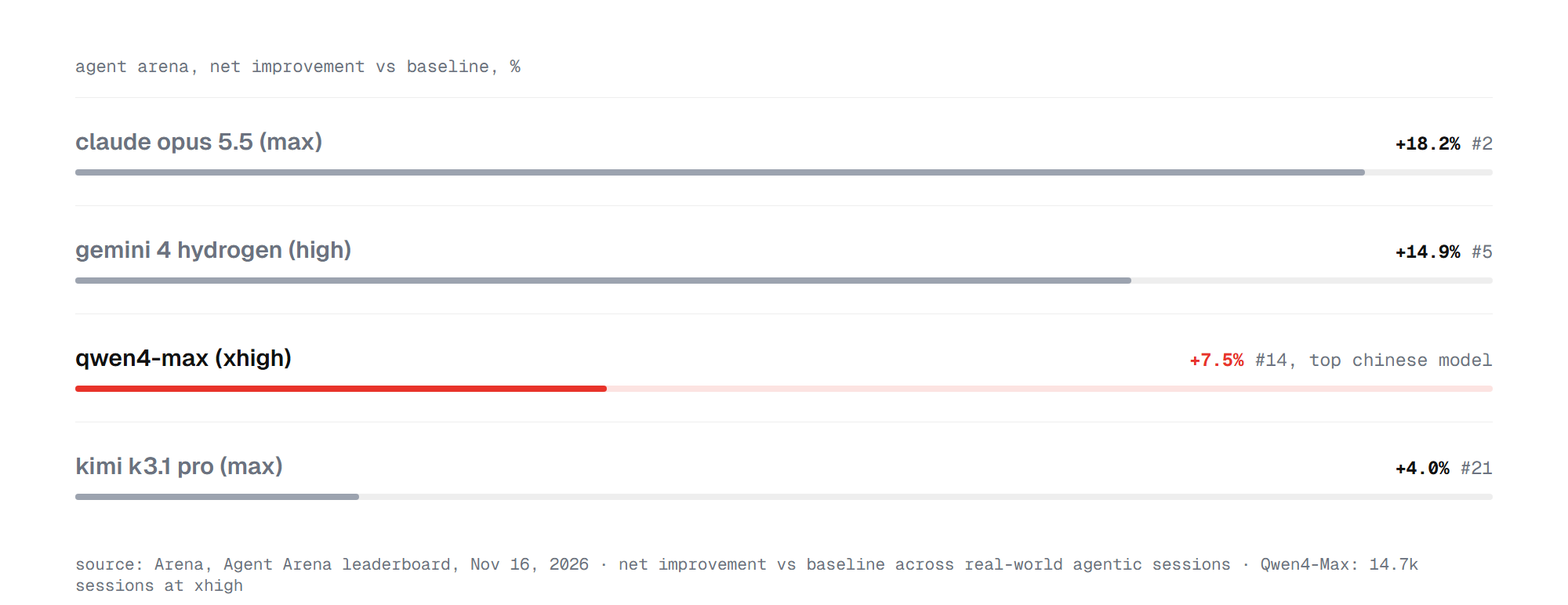
Qwen4-Max ranked 14th overall with a net improvement of 7.5% over the baseline. That makes it the top Chinese model on the board, ahead of Kimi K3.1 Pro at max effort in 21st place with 4.0%. It climbed from 39th place for Qwen3.8-Max. Among Chinese models it also led on confirmed task success and on users' praise versus complaints.
The US models are in a different league here. Opus 5.5 at max effort ranks second overall with 18.2%, behind only Claude Fable 5.2. Gemini 4 Hydrogen ranks fifth with 14.9%. Bash reliability is Qwen's weakest signal, at 29th place.
The benchmarks show the same order.
What independent benchmarks say
Two independent evaluators published results on launch day. Artificial Analysis combines nine tests of agents, coding, knowledge and science. Vals AI weights finance, coding, legal and tax tasks by their share of the US economy.
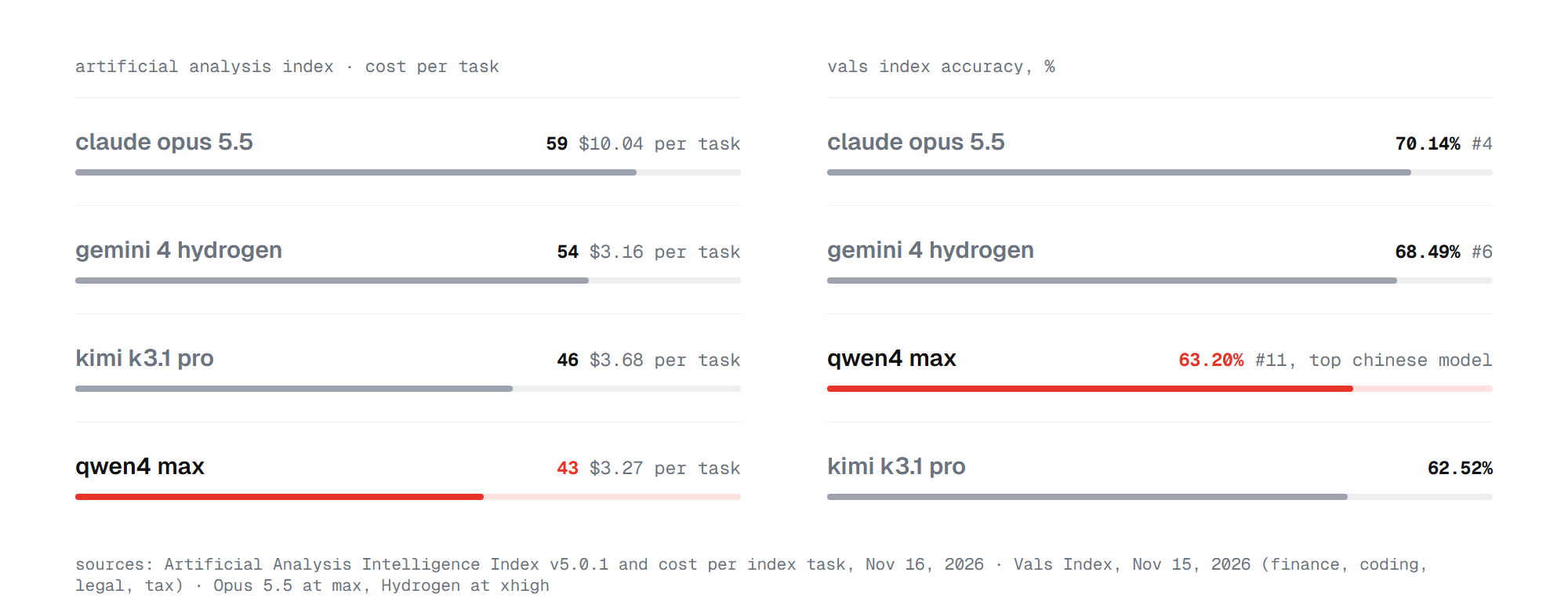
Both indexes rank Opus 5.5 first and Gemini 4 Hydrogen second. Hydrogen scores 54 on Artificial Analysis at $3.16 per task, a little less than Qwen4-Max costs for 43 points. The two Chinese models swap places. Kimi K3.1 Pro leads Qwen4-Max by three points on Artificial Analysis, while Qwen4-Max leads Kimi by 0.7 points on Vals. Vals called Qwen4-Max the top Chinese model on its index, at 11th place overall.
The test-by-test breakdown shows where each model is strong.
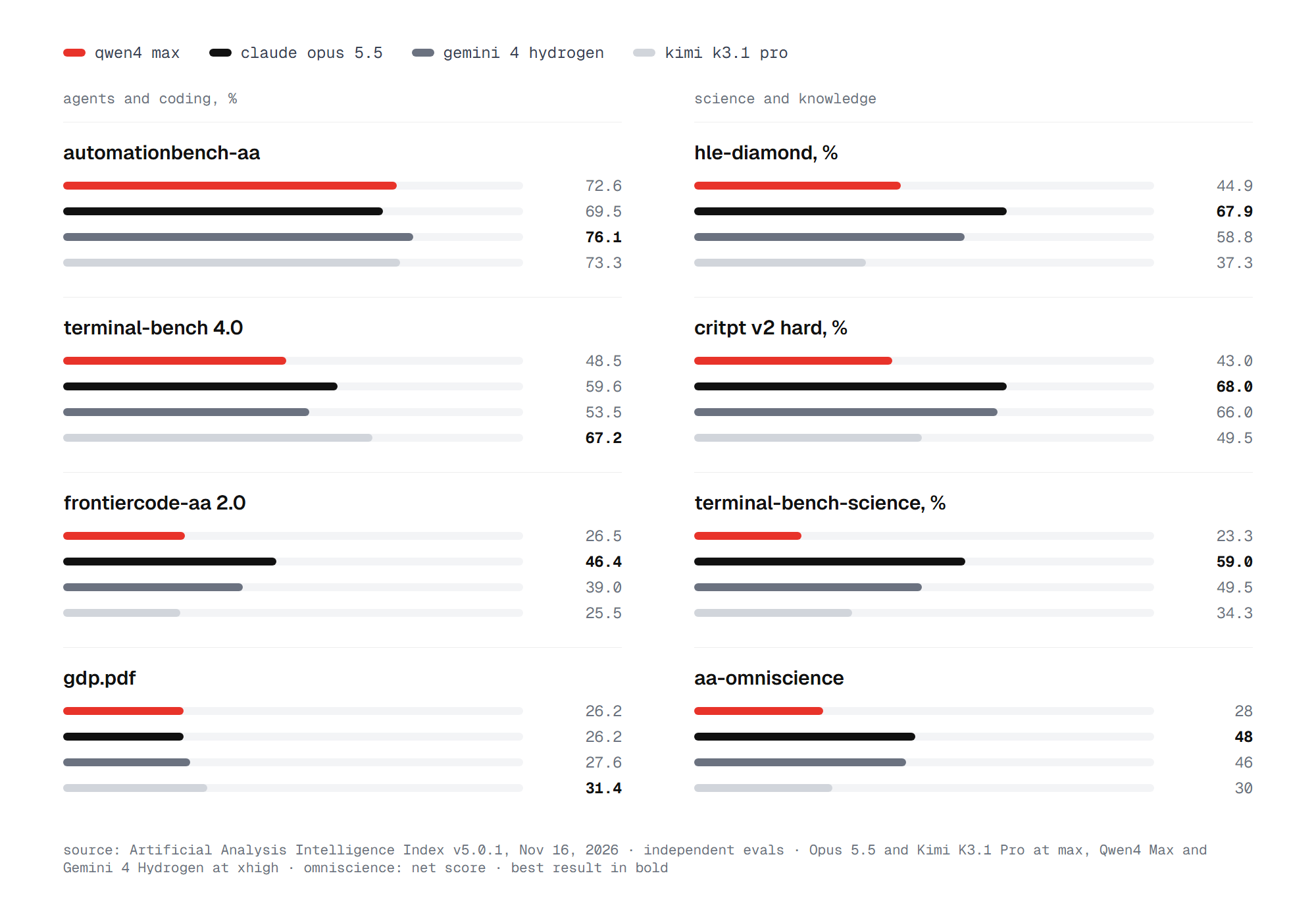
- Opus 5.5 dominates science and hard reasoning, with 67.9% on HLE-Diamond. It also leads FrontierCode 2.0, Cognition's test of real coding tasks, at 46.4%.
- Gemini 4 Hydrogen is a close second on science, with 66.0% on CritPt and 58.8% on HLE-Diamond. It leads AutomationBench-AA at 76.1%.
- Kimi K3.1 Pro is the strongest in the terminal, at 67.2% on Terminal-Bench 4.0.
- Qwen4-Max does not lead any of the eight tests. Its best result is 1686 Elo on AA-Briefcase, an agent test on real business files. There it beats Hydrogen and Kimi but trails Opus at max effort, which scores 1801.
The other side of the comparison is price.
Qwen4-Max vs Opus 5.5 vs Hydrogen vs Kimi: prices
All four models take text and images and have a context window of about 1 million tokens. Their prices differ a lot.
| Qwen4-Max | Claude Opus 5.5 | Gemini 4 Hydrogen | Kimi K3.1 Pro | |
|---|---|---|---|---|
| Input per 1M tokens | $1.50 | $4.00 | $1.50 | $2.00 |
| Output per 1M tokens | $4.50 | $20.00 | $7.50 | $10.00 |
| Cached input per 1M tokens | $0.075 | $0.20 | $0.075 | $0.20 |
| Cost per Artificial Analysis task | $3.27 | $10.04 at max | $3.16 at xhigh | $3.68 |
| Time per index task | not measured | 24.9 min | 14.9 min | 40.1 min |
| License | proprietary | proprietary | proprietary | open weights |
Qwen4-Max has the lowest token prices, but Hydrogen matches it on input and finishes an index task for slightly less money. In the user tests, Qwen was also by far the slowest, taking 6 to 40 times longer than Hydrogen. Kimi is the only one of the four with open weights. Alibaba promised open weights only for smaller Qwen4 models, as we noted in our Qwen4-Max preview coverage.
Which model is the strongest
Claude Opus 5.5 is the strongest of the four. It won our Family Guy test and the real bug fixes, ranks second on Agent Arena and leads both independent indexes. In our run, it was even cheaper than Qwen4-Max.
Gemini 4 Hydrogen is the best value. It beat Qwen4-Max in the pelican, electric motor and village tests and ranks fifth on Agent Arena. It also costs slightly less per index task and runs many times faster. Between the two Chinese models, Kimi K3.1 Pro won the only head-to-head and leads on Terminal-Bench. Qwen4-Max beats it on Agent Arena's real sessions and on office work. Qwen4-Max ends up last of the four on most user tests and on Artificial Analysis. Its main strength is a low price per token, which only pays off when caching works.
FAQ
Is Qwen4-Max better than Claude Opus 5.5?
No. Opus 5.5 won most user tests, including ours, and scores 59 on the Artificial Analysis Intelligence Index against 43 for Qwen4-Max. Qwen4-Max is cheaper per token and wins some office-style agent tests.
Is Qwen4-Max better than Gemini 4 Hydrogen?
No. Hydrogen won the launch-day pelican, electric motor and village tests and scores 54 against 43 on Artificial Analysis. It is also much faster, finishing the same tasks in seconds or minutes where Qwen4-Max took up to an hour.
Is Qwen4-Max cheaper than Opus 5.5?
Per token, yes: $1.50 and $4.50 per 1M input and output tokens, against $4.00 and $20.00 for Opus. Per task, not always. In our Family Guy test, Qwen4-Max cost $9.22 against $7.74 for Opus because most of its input missed the cache.
Is Qwen4-Max better than Kimi K3.1 Pro?
It depends on the task. Kimi K3.1 Pro won the fantasy city test, scores higher on Artificial Analysis and is much stronger on Terminal-Bench. Qwen4-Max is cheaper per token, ranks higher on Agent Arena and the Vals Index and wins on business-file tasks.
Which of the four models has open weights?
Only Kimi K3.1 Pro. Qwen4-Max, Claude Opus 5.5 and Gemini 4 Hydrogen are available only through their companies' APIs and apps.
Sources
- thehype's Family Guy test on X – November 16, 2026
- AI/ML API's post on X – November 16, 2026
- AI/ML API
- YxzRainy's post on X – November 16, 2026
- Alok's post on X – November 16, 2026
- Marc's post on X – November 16, 2026
- Jazii's post on X – November 16, 2026
- Qwen4-Max vs Claude Opus 5.5, Kingy AI – November 16, 2026
- Arena's post on X – November 16, 2026
- Qwen's post on X – November 16, 2026
- Qwen4 Max vs Claude Opus 5.5, Artificial Analysis
- Qwen4 Max vs Gemini 4 Hydrogen, Artificial Analysis
- Qwen4 Max vs Kimi K3.1 Pro, Artificial Analysis
- Vals AI's post on X – November 16, 2026
- Vals Index, Vals AI – November 15, 2026