 Felix Laurent

Baidu's Q3 2026 earnings, released on November 16, 2026, showed revenue of 30.8 billion yuan ($4.6 billion), down 1% from a year earlier. It was the company's sixth straight quarterly sales decline, Bloomberg noted. Its AI cloud business nearly doubled, but not fast enough to make up for shrinking search advertising.
The results show a company in the middle of a swap. AI products now bring in more than half of Baidu's core revenue, while its old search ad business keeps falling. The question for investors is how long the overlap will last.
Baidu Q3 2026 results at a glance
The headline numbers for the quarter ended September 30:
| Metric | Q3 2026 | Change from a year earlier |
|---|---|---|
| Total revenue | 30.8 billion yuan ($4.60 billion) | −1% |
| Baidu General Business revenue | 25.0 billion yuan | +1% |
| iQIYI revenue | 6.0 billion yuan | −10% |
| Operating income | 626 million yuan | margin 2% |
| Net income attributable to Baidu | 1.4 billion yuan ($208 million) | margin 5% |
| Non-GAAP net income | 2.4 billion yuan ($357 million) | margin 8% |
Baidu's own business, which it calls Baidu General Business, returned to growth with a 1% rise. The group total still fell because of iQIYI, Baidu's video streaming unit, whose revenue dropped 10%.
Costs rose faster than sales. Cost of revenue grew 9% to 19.9 billion yuan, driven by the cloud business and traffic acquisition. Research and development spending fell 7% to 4.8 billion yuan. Baidu ended the quarter with 276.6 billion yuan ($41.3 billion) in cash and investments.
Inside those totals, the business lines are moving in opposite directions.
AI cloud doubles while search ads shrink
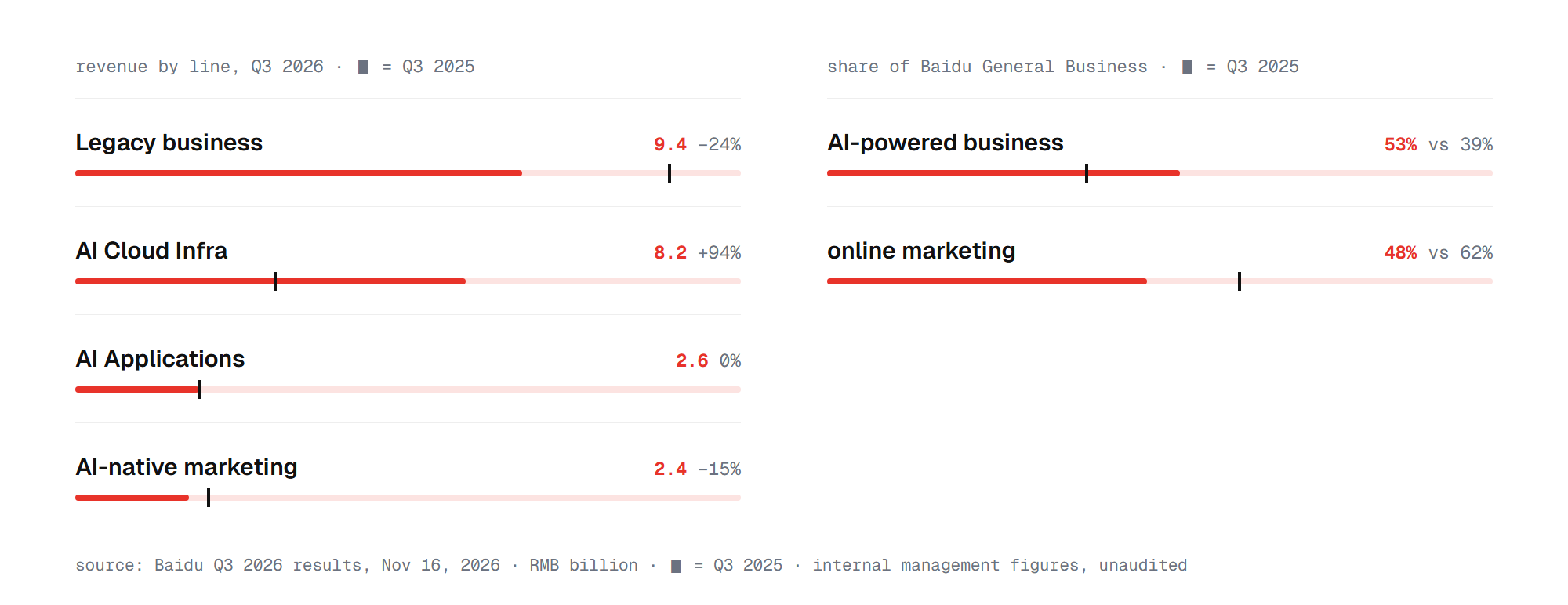
Baidu now splits its core revenue into an AI-powered business and a legacy business. The AI side grew 37% to 13.2 billion yuan and made up 53% of Baidu General Business revenue, up from 39% a year earlier.
AI Cloud Infra did most of the work. Its revenue rose 94% to 8.2 billion yuan. Within it, GPU cloud revenue, from renting AI computing power, grew 191% from a year earlier and 43% from the previous quarter. Revenue from outside customers' token usage on Baidu's Qianfan model platform rose 1,159%.
The rest of the AI business is weaker:
- AI Applications, including Wenku and Baidu Drive, were flat at 2.6 billion yuan;
- AI-native marketing, the AI-driven part of advertising, fell 15% to 2.4 billion yuan;
- legacy business, mostly classic search ads, fell 24% to 9.4 billion yuan.
Total online marketing revenue fell 22% to 11.9 billion yuan and is now under half of Baidu's core revenue. Baidu blamed a weak economy and tougher competition. It also chose to put user experience ahead of short-term ad income while it rebuilds search around AI.
Baidu is betting that new models and agents will keep the cloud side growing.
Baidu's AI products and robotaxis
The quarter closed just before a busy November. Baidu released ERNIE 5.5 Flash Preview, its newest model, which it says ranks second among open-source models on the Code Arena WebDev leaderboard. Two days earlier it showed ERNIE Evolve, an automated research system that sped up inference for the same model family.
At its Baidu World 2026 event, the company also launched Token Exchange, a marketplace connecting AI model providers with customers. It added Famou Agent 3.0, an agent for enterprise operations problems, and kept folding coding and office tools into its DuMate work agent. Baidu's Kunlunxin M100 inference chip is due for volume production by the end of 2026.
Apollo Go, Baidu's robotaxi service, now runs in 30 cities. Fully driverless rides in Shenzhen grew about 170% from the previous quarter, and the fleet in Dubai doubled. Apollo Go has driven more than 390 million autonomous kilometers in total.
Those projects cost money, and Baidu's margins show it.
What the results mean for Baidu
The company's operating margin was only 2%, or 6% on a non-GAAP basis. Cloud growth brings higher computing costs, and the company still pays heavily to attract traffic. Chief financial officer Haijian He said Baidu would keep a "disciplined approach to capital allocation" while it invests in AI.
Shareholders are getting some return. Baidu has bought back $373 million of stock since the start of 2026. It also expects to declare its first dividend before the end of the year, subject to board approval.
Chinese rivals are running the same race. Alibaba, Tencent and ByteDance all sell AI cloud services, and price competition in China's model market has been fierce. Baidu's 94% cloud growth shows strong demand, but it also starts from a smaller base than Alibaba Cloud.
Can AI cloud save Baidu's business
Not yet, but it is getting closer. Compared with the same quarter last year, AI Cloud Infra added about 4 billion yuan in revenue, while the legacy business lost about 3 billion. That is why Baidu's own business grew again by 1%. If cloud keeps nearly doubling, it could soon outgrow the decline in search ads.
The weak spots are clear, though. AI applications are flat, AI-native ads are shrinking and margins are thin. For the sales decline to end at the group level, Baidu needs its AI search and apps to earn money, not only its GPU rentals. Until then, the company is trading one business for another, and the next quarters will show which side moves faster.
Sources
- Baidu Announces Third Quarter 2026 Results, Baidu via PR Newswire – November 16, 2026
- Baidu Announces Third Quarter 2026 Results, Baidu Investor Relations – November 16, 2026
- Baidu posts sixth straight sales drop after AI drag persists, Bloomberg – November 16, 2026
- Bloomberg on X – November 16, 2026