Felix Laurent

Alibaba has opened a preview of Qwen4-Max, the first model in its Qwen 4 family. The Qwen team announced it on X at 02:01 UTC on November 11, 2026, under the headline "Qwen4 is coming" with an image card. The model has a 1 million-token context window, but Alibaba published no benchmarks, no model card and no parameter count.
Within hours, rumors spread that the model disappoints. AI commentator Chubby (@kimmonismus), who has 158,000 followers, wrote that "Qwen 4 is disappointing," calling his sources rumors. He linked it to Anthropic's crackdown on distillation, a claim no one has backed with evidence so far.
What Alibaba released in the Qwen4-Max Preview
According to Alibaba Cloud's documentation, qwen4-max-preview takes text, images and video. It can write up to 393,216 tokens per answer, including its reasoning. Thinking is on by default, and the reasoning effort setting goes from low to xhigh, with xhigh as the default.
The model supports function calling, web search and structured JSON output. It also works with OpenAI-style and Anthropic-style APIs, so existing coding tools can connect to it.
The preview runs until November 25 and the model will then be retired, according to the docs. It is available in the Qwen app and Qwen Chat, in the coding tool Qoder and in Alibaba's QwenWork and QwenStudio. OpenRouter did not list it as of the afternoon of November 11.
How developers pay for it is less usual.
How to access Qwen4-Max and what it costs
There is no per-token price. Developers outside the apps can use the model only through Alibaba's Token Plan, a monthly subscription with a credit allowance:
| Plan | Price per month | First month for new users | Credits per month |
|---|---|---|---|
| Lite | $6 | $3 | 20,000 |
| Essential | $10 | $5 | 45,000 |
| Standard | $18 | – | 80,000 |
| Pro | $43 | – | 200,000 |
During the preview, Qwen4-Max uses credits at 20% of the standard rate. At night in China, from 22:00 to 08:00 Beijing time, that drops to 8%. The discount on new plans lasts until November 30.
The launch also left out the numbers that usually come with a Qwen release.
Why Qwen4-Max launched without benchmarks
Alibaba has not explained the missing scores. The Qwen 3.8 Max preview also came without benchmarks in July, before its full release in August. LuminaBench, whose tracker spotted the model, still noted the gap. "But no benchmarks 🤔, I wonder why," the account wrote.
The road to launch was bumpy. Alibaba first said Qwen 4 was in training at its Apsara conference on September 22. In late October, Alibaba Cloud CTO Feifei Li reportedly said Qwen 4 would arrive "next week," and that date slipped. The Qwen account posted a teaser on November 6, and code in Qwen Chat pointed to the model a day before launch.
Anonymous models on LMArena, including one called Kerria, drew attention in the weeks before. Tokenizer tests by the tracker account @aitrackerbot suggested a link to Qwen. The account itself noted that this "isn't proof," and Alibaba has not confirmed anything.
Without official numbers, the first verdicts came from users.
Early tests of Qwen4-Max
Reactions on day one were mixed. LuminaBench called it "probably the best Chinese model so far" in one post. It added that Chinese labs "are falling more and more behind the US" overall. Its own one-shot test, an interactive 3D helicopter, was "not that bad" but "still not on the level" of current top models. Other users said the model was painfully slow and overthought simple tasks.
On Hacker News, one commenter found its writing "drier" but with fewer obvious AI patterns. Another said it felt slightly slower than OpenAI's GPT-6.1 Terra. Several posts said the preview refused reverse-engineering and offensive security prompts, though no one has documented that in detail.
Positive posts came mostly from developers who ran longer tasks. Qoder, which had tested the model under the code name QoDuck, promoted it with an 80% discount on its own account. One developer reported that it finished an agentic task in about 30 minutes, against about 70 for MiniMax M3.1 Flash.
Artificial Analysis and LMArena had not listed the model by the evening of November 11. The clearest picture so far comes from users who ran it side by side with other models.
How Qwen4-Max did in user comparisons
The most viewed test was not a comparison at all. Chinese blogger @YxzRainy posted a 3D pelican riding a bicycle that Qwen4-Max had built. The caption said something was "definitely off" with it. The video drew 186,000 views, and replies pointed to a wheel rotation bug seen in Qwen 3.8.
The most cited number came from GameFeel, a community benchmark for game design tasks. Its author, @follistatindev, posted a chart of the reverse-evaluation category, where models give feedback on game proposals. Qwen4-Max Preview scored 10.3, below Qwen 3.8 Max and early versions of Qwen 4 Flash and Qwen 4 27B. "It is actively worse than qwen-3.8-max in all of my testing," the author wrote.
The same chart tells a more mixed story:
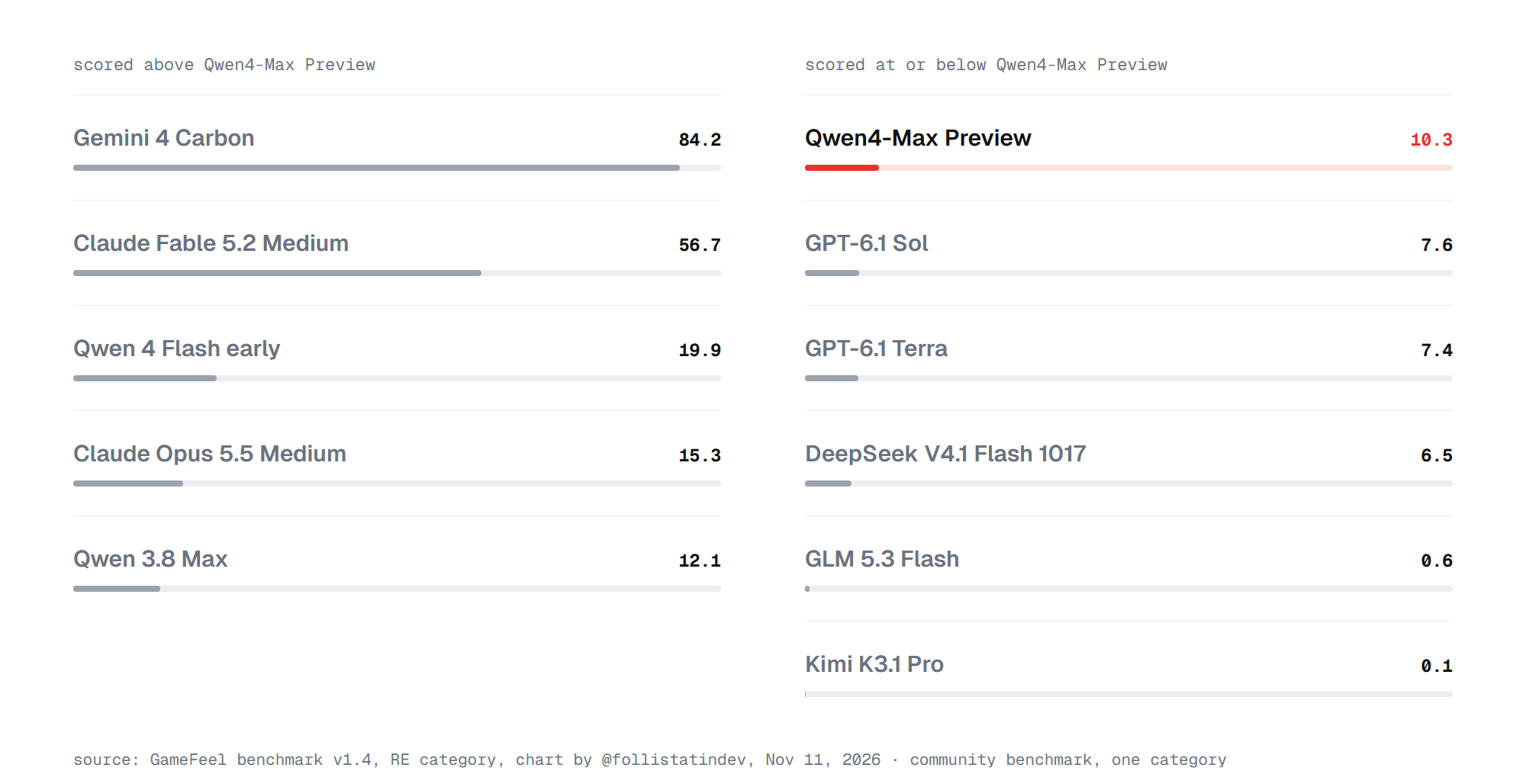
In that category, the preview beat GPT-6.1 Sol, GPT-6.1 Terra, DeepSeek V4.1 Flash and Kimi K3.1 Pro. It cost about $0.02 per task. Gemini 4 Carbon and Claude Fable 5.2 led by a wide margin, and the test covers only one narrow skill.
Direct duels with US models mostly involved Claude Opus 5.5. Developer Mark Santos asked both models to build a Crossy Road clone. "I think Opus won this one. But it was definitely close!" Santos wrote.
Another tester, @leo114119, ran both models on a black hole simulation and said they were not far apart. In the clip, Opus 5.5 draws a larger and more detailed accretion disk.
The most detailed review came from Chinese AI blogger Huashu (@AlchainHust), who has 74,000 followers. Huashu ran six one-shot prompts and eight agent tasks in Claude Code, including a Rube Goldberg machine that took over 90 minutes. Every result ran. The review rated Qwen4-Max slightly behind Opus 5.5 on visual polish, roughly level with GPT-6, and strong on long tasks.
Other users were harsher. LuminaBench said the model broke on a 3D pagoda it had not seen before. On the Chinese forum linux.do, one user wrote that beating Opus 5.5 was "a stretch," mainly because the model misread intent. Several testers noted that single generations took 30 minutes to an hour. A voxel pagoda by @leo114119 took a full hour, though the result looked slightly better than DeepSeek V4.1 Flash to its author.
No one has posted a clear head-to-head against Fable 5.2, GPT-6.1 Sol or Gemini 4 Carbon yet. The negative wave rests on one viral video, one narrow benchmark and rumors. That leaves the distillation theory as the loudest explanation for now.
The distillation rumor behind Qwen 4
Distillation means training a model on the outputs of a stronger one. Anthropic has accused Chinese labs of doing this with Claude at scale. In February, it named DeepSeek, Moonshot and MiniMax, citing more than 16 million exchanges through about 24,000 fake accounts.
Alibaba came next. In June, Bloomberg reported a letter in which Anthropic accused operators linked to Qwen of about 28.8 million exchanges. Anthropic's September threat report went further and described an Alibaba-linked campaign as "the largest distillation attack we have ever measured" by the company. It counted over 151 million exchanges from May to July and said the data went into Qwen 3.5, 3.6 and 3.7.
In October, Anthropic said new defenses cut the data such campaigns could harvest by about 90% to 99%. Washington has also moved, with a White House memo on adversarial distillation in April and a bill to sanction model theft in the House. Alibaba has not publicly addressed Anthropic's claims in detail.
None of this proves the rumor. Anthropic's October post does not mention Alibaba or Chinese release schedules. The idea that losing access to Claude slowed Qwen 4 has circulated on X since October without named sources. In replies, several users asked for real evaluations first, noting that a weaker release alone would not show the cause.
What is measurable is the gap the rumor points to.
Where Qwen stands against US models
On the Artificial Analysis Intelligence Index v5, which launched in October with harder tests, US models lead clearly. Qwen 3.8 Max, the current flagship, scores 34. The best Chinese model on the list, Moonshot's Kimi K3.1 Pro, scores 46.
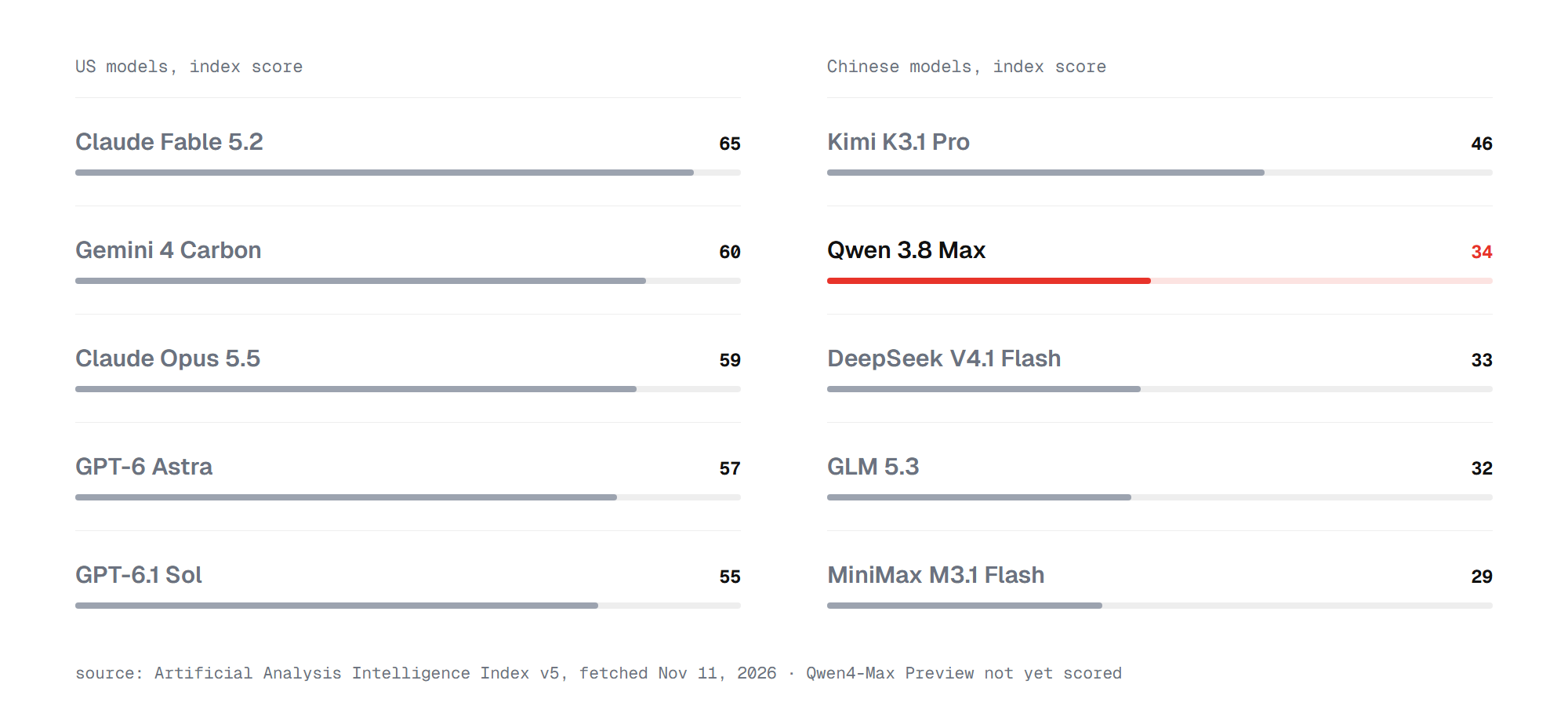
Anthropic's Claude Fable 5.2, released on November 9, tops the index at 65. Google's Gemini 4 Carbon follows at 60, and Claude Opus 5.5 scores 59. Qwen 4 would need a jump of more than 12 points just to match Kimi.
Qwen's earlier models did well in head-to-head tests, such as our comparison of Qwen 3.8 Max, GLM 5.3 and HY4 Preview. The family's strength has been its open weights. Qwen 3.8 shipped a 27B model under Apache 2.0, and fans hope Qwen 4 will follow, though Alibaba has not said so.
Is Qwen4-Max disappointing
It is too early to say. The preview is days old and has no published scores. The loudest criticism traces back to rumors and a few narrow tests. The most careful user reviews put it a little behind Claude Opus 5.5 and ahead of other Chinese models.
For developers, the preview is a cheap way to test the model before it is retired. Token Plan starts at $3 for new users, and preview credits cost a fifth of the usual rate. The real verdict will come when Artificial Analysis and LMArena score it and Alibaba shows benchmarks for the final release. Until then, the claim that blocked distillation hurt Qwen 4 remains a theory on X.
Sources
- Chubby (@kimmonismus) post on X – November 11, 2026
- Qwen4-Max preview announcement, Alibaba Qwen on X – November 11, 2026
- LuminaBench post on X – November 11, 2026
- Qwen4-Max-Preview, Alibaba Cloud Model Studio – November 11, 2026
- Token Plan overview, Alibaba Cloud Model Studio – November 11, 2026
- Alibaba opens Qwen4-Max preview with a million-token context window, TechNode – November 11, 2026
- GameFeel RE chart, @follistatindev on X – November 11, 2026
- Bicycle wheel test, @YxzRainy on X – November 11, 2026
- Crossy Road test vs Opus 5.5, Mark Santos on X – November 11, 2026
- Black hole test vs Opus 5.5, @leo114119 on X – November 11, 2026
- 3D helicopter test, LuminaBench on X – November 11, 2026
- Qwen4-Max hands-on review, Huashu – November 11, 2026
- Qwen4-Max is now in preview, Hacker News – November 11, 2026
- Detecting and preventing distillation attacks, Anthropic – February 23, 2026
- Threat Intelligence Report, Anthropic – September 2026
- Distillation defenses, Anthropic – October 12, 2026
- Anthropic accuses Alibaba of illicitly accessing its AI models, Bloomberg – June 24, 2026
- Artificial Analysis leaderboard – accessed November 11, 2026