Felix Laurent
Tencent has open-sourced LoopForge, a self-hosted platform that runs AI coding agents through a team's delivery process. Planning, coding, review and testing go to separate agents. Builds and tests decide what passes, and a human approves the result before it ships.
The company promoted it worldwide on November 16, 2026, with a line that sums up its pitch: "Code was never the bottleneck. The handoff is." LoopForge is MIT-licensed and works with 10 coding agent CLIs, including Claude Code, Codex and Cursor. It also scores every run from 0 to 100.
What LoopForge does
LoopForge turns a team's way of shipping software into SOPs, standard operating procedures that agents follow step by step. Each SOP is a graph of nodes, edited in a visual designer.
There are five kinds of nodes:
- Agent nodes give a task to a role, such as a designer, coder or reviewer.
- Script nodes run builds and tests. The project's motto for them is "No AI where AI is not needed."
- Human gate nodes let a person approve, add context or send the work back.
- Sub-SOP nodes run another procedure inside this one.
- Preview nodes show the result before sign-off.
The built-in flow goes through clarify, design, implement, review, test and accept. If a check fails, the work goes back upstream, for example from acceptance to implementation. The agent that writes the code is never the one that reviews it.
LoopForge ships with four ready SOPs: backend delivery, frontend delivery, product proposal and bug fix. Teams can also skip the SOPs and chat with a main bot. It opens a sandbox with the team's repositories and ends with a pull request.
The agents themselves come from other companies.
Which coding agents LoopForge supports
LoopForge does not include its own model or coding agent. It runs agents that teams already use and lets them be swapped per role.
| How it is installed | Agent CLIs |
|---|---|
| Bundled in the Docker image | CodeBuddy (default), Codex, DeepSeek Harness |
| Installed from npm on first use | Claude Code, OpenCode, Kimi Code, Pi |
| Installed by the provider, chat only | Cursor CLI, Antigravity |
| Not bundled | ZCode |
CodeBuddy is Tencent's own coding assistant. It is also the only agent that handles clarification questions, bot replies and run scoring. Tencent said in 2025 that 85% of its programmers use CodeBuddy.
Teams bring their own model keys. A demo SOP runs without any key, and the code and keys stay on the team's own servers.
The most unusual part of LoopForge comes after a run ends.
How the 0 to 100 score works
Tencent calls this part "engineering-grade RSI", short for recursive self-improvement. In the code, it is called run evaluation.
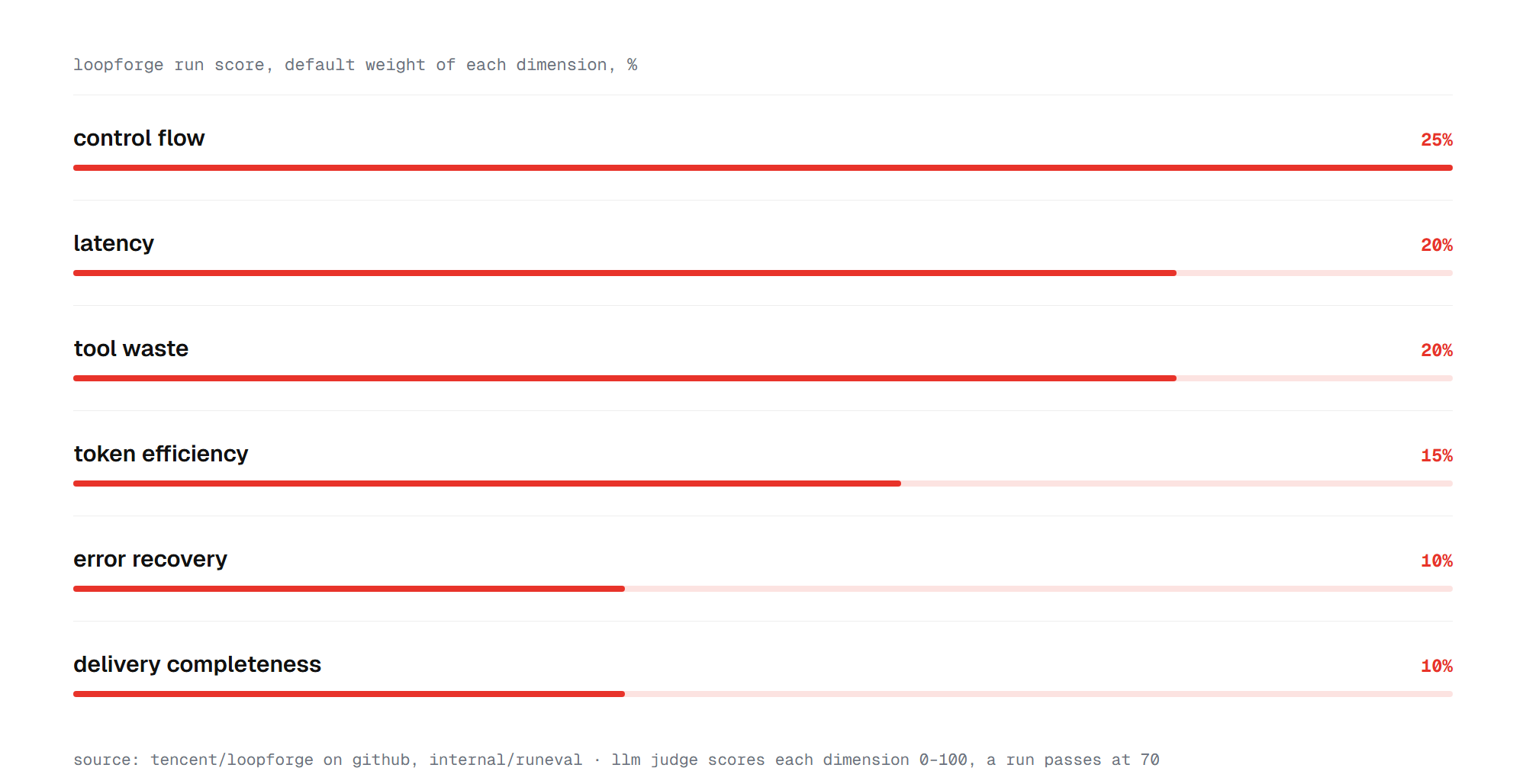
After a run, a user can ask for a score. An AI judge reads the facts of the run: retries, rework, work sent back and forth, failed tool calls, time, tokens and errors. It rates six dimensions from 0 to 100, and a run passes at 70.
The judge then suggests fixes, but only small ones. It can change a step's retry settings, add or remove a check for a role, or add text to a role's prompt. It is told not to rewrite whole SOPs, change the flow or delete steps.
Every suggestion waits for a person to select and apply it. Nothing changes on its own. So the "self-evolving" claim means a feedback loop with human approval rather than an agent that rewrites itself. Delivery completeness carries only 10% of the score, so the judge mostly rates how smoothly a run went.
The name RSI also links LoopForge to Tencent's other agent work.
Where LoopForge comes from
LoopForge is the public version of AgentFlow, an internal Tencent platform. The repository was created in July 2026, and a smaller local edition came out in September. The self-hosted platform shipped in early November and drew coverage in Chinese tech media from November 11.
The global launch pushed it up GitHub's trending lists. On November 16 alone, the repository gained about 700 stars, reaching more than 2,100. Tencent has not published internal usage figures or benchmarks for it.
Tencent has released several agent projects this year. Its Hyra research agent is pitched as recursively self-improving, and its Hy3 model is open-weight. LoopForge applies the same idea to software delivery.
Before trying it, teams should read the security notes.
Is LoopForge safe to run
We checked the repository before writing. It belongs to Tencent's verified GitHub organization, the commits look normal and the install scripts download only Docker from its official site. We found no telemetry sent to Tencent. The project documents its risks openly:
- It needs host-level trust. LoopForge mounts the host's Docker socket. Its docs call that "equivalent to root on the host", and anyone who can run SOPs can run code on that machine.
- It is open by default. The server listens on all network interfaces with open signup. Tencent says it is meant for "trusted teams, not untrusted multi-tenant isolation."
- Agents run with full permissions inside their containers, including Claude Code in its permission-bypass mode.
- Repositories can run commands. A bound repository's own agent settings and hooks can execute code, so only trusted repositories should be connected.
Recent releases fixed API keys showing in run logs, so early users should rotate their keys. An open bug can delete uncommitted work after a successful run. The chat interface is in Chinese only for now.
How to try LoopForge
The platform runs with Docker Compose. Clone the repository and start it:
git clone https://github.com/Tencent/LoopForge.git && cd LoopForge && ./start.shThere is also a lighter local edition that plugs into Claude Code. It installs with npx -y loopforge-cli@latest install claude, and then a delivery flow starts with the /start-devflow command.
LoopForge enters a field where big players already sell coding agents in the cloud.
How LoopForge compares with Devin, Codex and Copilot
Devin, OpenAI's Codex cloud and GitHub's Copilot coding agent all take a task and return a pull request. They are hosted products tied to their own agents. LoopForge's FAQ compares it with workflow tools such as Dify, n8n and Flowise instead.
The difference is control. LoopForge runs on the team's own servers, mixes agents from different vendors and makes every step of the process explicit. An early review on BestHub put it this way: "LoopForge does not build a coding agent; it governs how coding agents work."
The cost is setup and responsibility. Teams have to host it, secure it and supply their own model keys.
Is LoopForge worth using
For teams that already use several coding agents and want a repeatable process around them, yes. Separate writer and reviewer agents, script checks and a human gate address the main weakness of agents that grade their own work. The scoring loop gives concrete, reviewable fixes instead of vague advice.
It is not ready for every team. It needs root-level trust on its host, and its interface is in Chinese. Its "self-evolving" loop is still a small set of tweaks that a person approves. Run it on an isolated machine with trusted repositories, and treat the run scores as a guide, not a verdict.
FAQ
Is LoopForge free?
Yes. It is open source under the MIT license. You pay only for the models your agents use.
Which coding agents work with LoopForge?
Ten CLIs, including CodeBuddy, Codex, Claude Code, Cursor CLI, OpenCode and Kimi Code. CodeBuddy is the default.
Does LoopForge change its own process automatically?
No. It scores each run and suggests small changes to retries, checks and prompts. A person has to apply them.
Does LoopForge send data to Tencent?
We found no telemetry to Tencent. Traffic goes to your model providers, GitHub and package registries.
Sources
- Tencent AI on X – November 16, 2026
- LoopForge repository, GitHub – accessed November 16, 2026
- LoopForge releases, GitHub – November 2026
- LoopForge hands-on review, Woshipm – November 11, 2026
- Tencent's open-source AI agent stack, BestHub – October 3, 2026