
 Felix Laurent

Qwen3 TTS 1.7B, the open text-to-speech model from Alibaba's Qwen team, is now available on OpenRouter. It went live on November 20 at $20 per million characters, served by a single provider, Together. The model reads text aloud in 10 languages with 9 preset voices.
The model itself is not new. Qwen released the Qwen3-TTS family with open weights in January under the Apache 2.0 license. What changes now is access: developers can call it through OpenRouter's standard API, next to about 40 other text-to-speech models.
Here is what the OpenRouter version can do, how it compares on price and when it makes sense to use it.
What Qwen3 TTS 1.7B on OpenRouter does
OpenRouter describes Qwen3 TTS 1.7B as a multilingual model for content production, localization and voice apps. Its specs on the platform:
- Languages: English, Chinese, Japanese, Korean, German, French, Russian, Spanish, Italian and Portuguese.
- Voices: 9 preset voices, passed as a voice ID in the request.
- Input: text only, with a 4K context limit, so long scripts have to be split.
- Latency: about 1.5 seconds before playback starts, the median on OpenRouter for the Together endpoint.
- Region: not available through OpenRouter's EU in-region routing.
The 10 languages and 9 voices match the CustomVoice version of the open model. Qwen's model card gives each of the 9 voices a native language. Vivian, Serena and Uncle_Fu speak Chinese, while Dylan and Eric cover the Beijing and Sichuan dialects. Ryan and Aiden speak English, Ono_Anna Japanese and Sohee Korean. Every voice can speak all 10 languages, but Qwen recommends each one's native language for the best quality.
That leaves out part of what made Qwen3-TTS popular in January.
What the API leaves out
The open Qwen3-TTS family has three 1.7B models, and OpenRouter serves one of them:
| Model | What it does | On OpenRouter |
|---|---|---|
| 1.7B CustomVoice | 9 preset voices with style control through text instructions | Yes, as Qwen3 TTS 1.7B |
| 1.7B VoiceDesign | Creates a new voice from a text description, such as "warm, slow, older male" | No |
| 1.7B Base | Clones a voice from about 3 seconds of reference audio | No |
So voice cloning and voice design still need the open weights or Alibaba's own cloud. The CustomVoice model can follow instructions about emotion and tone, such as "say it in a very angry tone". OpenRouter's documentation only mentions text input and a voice ID, so it is unclear whether those instructions pass through the API.
Qwen also says its 12Hz models can start streaming audio after a single character, with latency as low as 97 milliseconds. That figure comes from running the model directly. Through OpenRouter, the measured start is about 1.5 seconds.
The bigger question for most developers is the price.
Qwen3 TTS price compared with other TTS models
At $20 per million characters, Qwen3 TTS 1.7B sits in the middle of OpenRouter's speech catalog. Here is how it compares with a selection of models priced per character:
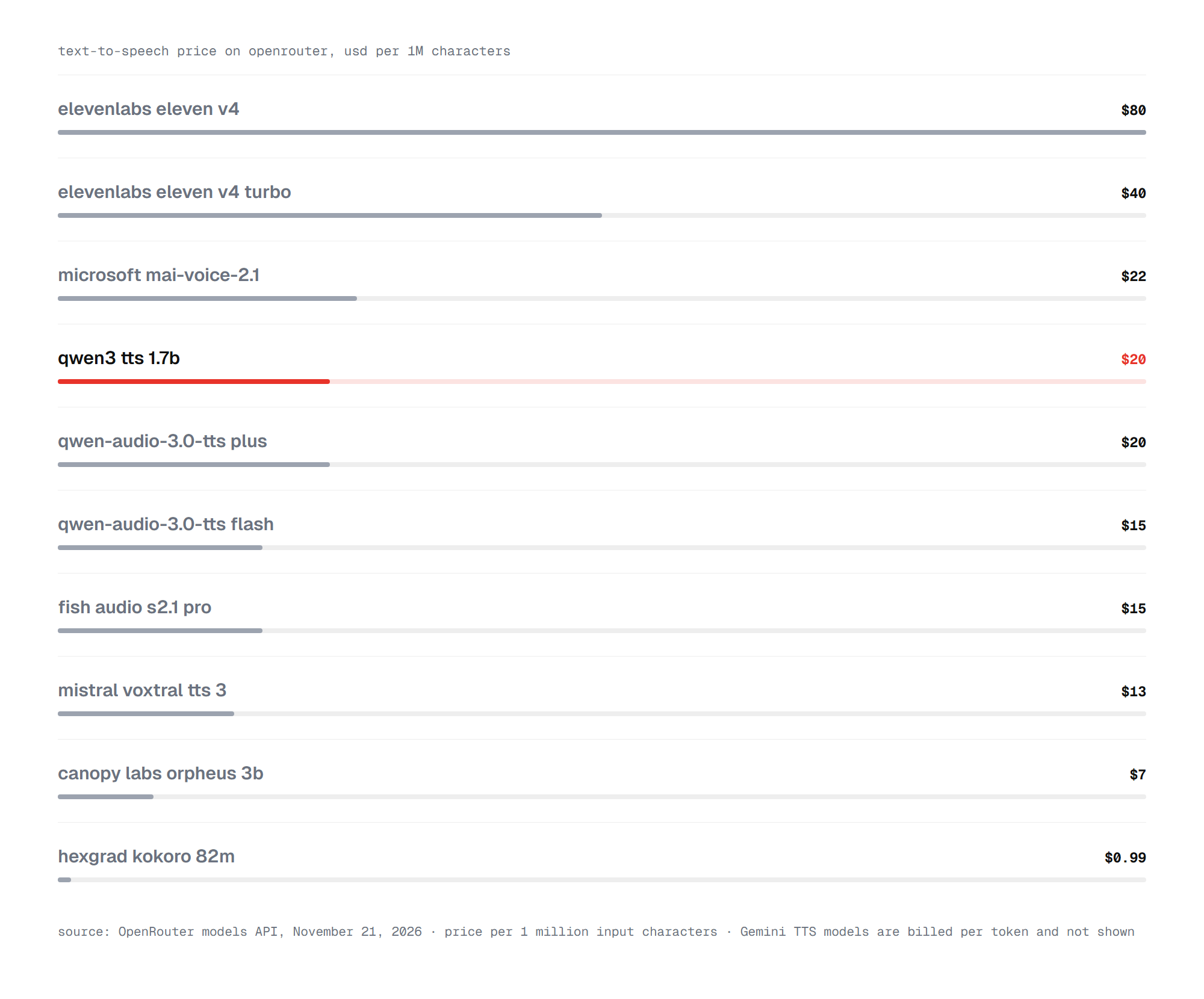
The comparison cuts both ways. Qwen3 TTS costs a quarter of ElevenLabs' Eleven v4 and half of Eleven v4 Turbo. But Qwen's own newer cloud models are no more expensive. Qwen-Audio-3.0-TTS Plus costs the same $20, and Qwen-Audio-3.0-TTS Flash costs $15.
Among open models, the gap is wider. Orpheus 3B from Canopy Labs costs $7, and Kokoro 82M costs $0.99 per million characters. A million characters is roughly 18 hours of speech, so at Qwen's price an hour of narration costs about a dollar, by our estimate.
Price is only half of the comparison, so the benchmarks matter too.
Qwen3-TTS benchmarks
Qwen published its results in the January technical report and on GitHub. All of them come from Qwen's own runs, and no independent leaderboard has tested the OpenRouter version yet.
The test that matters most for the OpenRouter model is InstructTTSEval. It checks how well a model follows spoken style instructions, such as emotion, pace and tone, and that is what the CustomVoice version does.
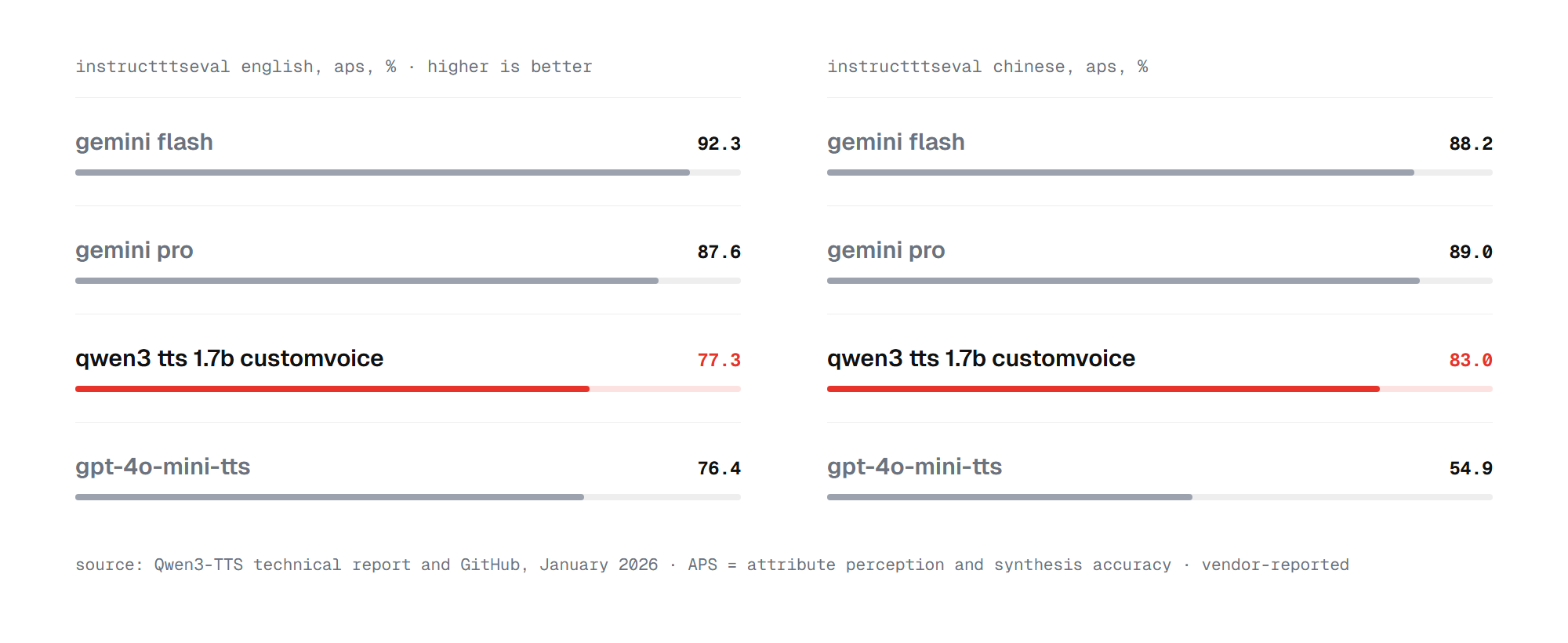
In English, Qwen3 TTS scores 77.3, close to GPT-4o-mini-tts at 76.4 and well behind Gemini Flash at 92.3. In Chinese the gap to Gemini narrows to about six points, and GPT-4o-mini-tts falls far behind at 54.9.
The strongest numbers belong to voice cloning. On the Seed-TTS test, the 1.7B Base model clones a voice from a short sample and then reads new text. Lower word error rate means fewer mistakes in the spoken words.
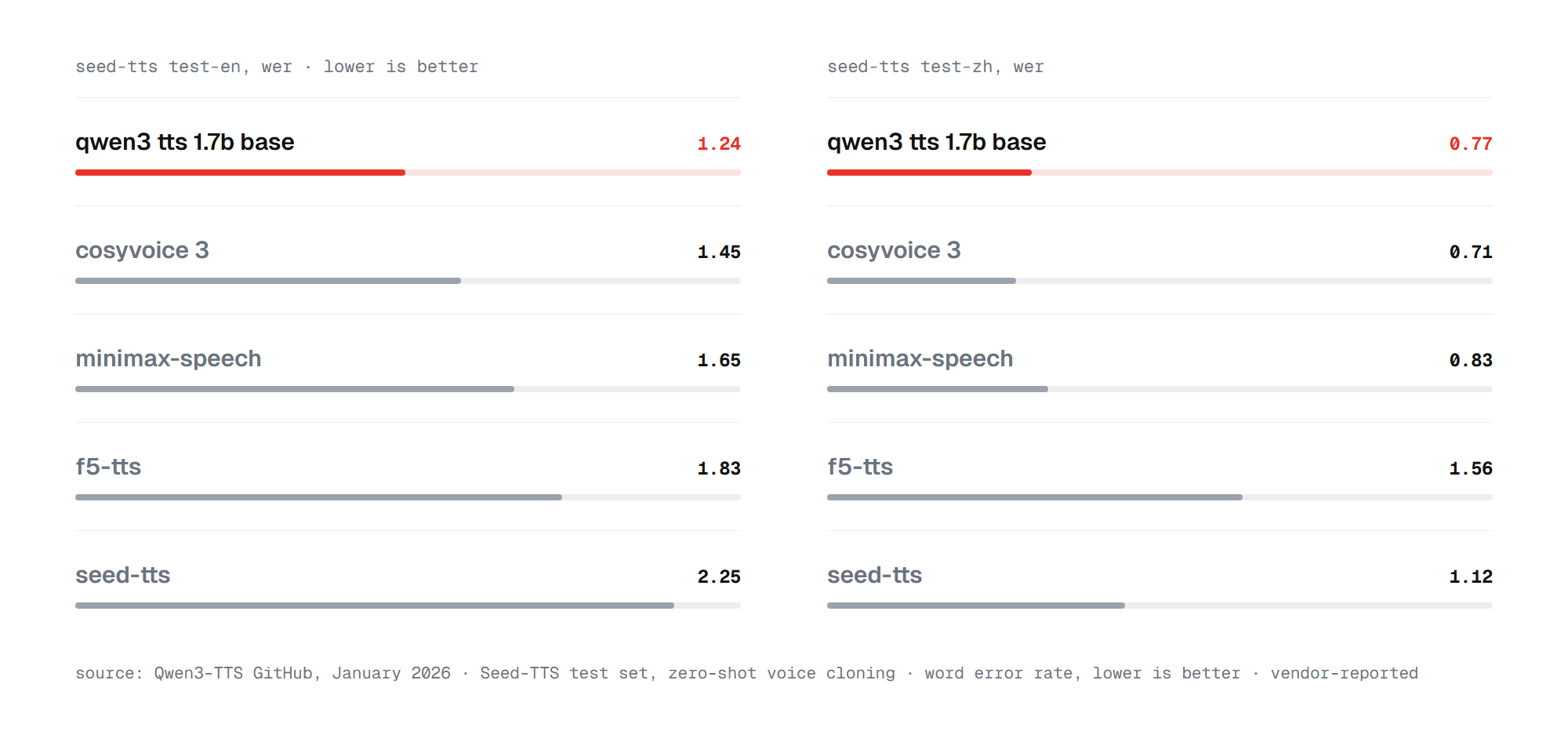
In English, Qwen3 TTS has the lowest error rate of the five models at 1.24. In Chinese, CosyVoice 3 edges it out, 0.71 against 0.77. Across 10 languages, the 1.7B Base model also had higher speaker similarity than MiniMax and ElevenLabs in every language Qwen tested.
Those cloning results come from the Base model, which OpenRouter does not serve. That gap shapes who should use the API version.
Who should use Qwen3 TTS 1.7B on OpenRouter
Yes, if you need multilingual speech with fixed voices and already route your models through OpenRouter. It covers 10 languages, including Russian, under one API key and one bill, at a quarter of ElevenLabs' top price. It is a weak choice if you need cloning or voice design, since those models are not on OpenRouter. It is also hard to justify against Qwen-Audio-3.0-TTS Flash at $15, unless you want an open model you could later move to your own servers. For the lowest latency or price, running the open weights yourself is still the better option.
Sources
- Qwen3 TTS 1.7B, OpenRouter – November 20, 2026
- OpenRouter models API – November 21, 2026
- Qwen3-TTS on GitHub, Qwen – January 22, 2026
- Qwen3-TTS-12Hz-1.7B-CustomVoice, Hugging Face
- Qwen3-TTS technical report, arXiv – January 2026