Felix Laurent

OpenRouter processed 790T tokens in October 2026, the largest month in its history. Volume rose 37% from September and almost 25x from January, the company said in its October data recap, published on November 6. AI agents used 76% of those tokens.
The recap comes from requests sent through the OpenRouter API, a router that gives developers one key for hundreds of models. It shows where agent traffic goes, what tokens cost and which labs are winning users. Agents are the place to start, since they now drive most of the volume.
How agents took over OpenRouter traffic
A year ago, agentic API keys took 8% of tokens on OpenRouter. In October they took 76%, or about 600T tokens. OpenRouter credits much of the October jump to the refresh of DeepSeek V4.1 Flash. The launch of Haiku 5.5 and the rest of the Claude 5.5 family added more.
The label "agentic" is OpenRouter's own. It scores every API key on seven signals, including tool-call rate, turns per request, cache hit rate and time between requests. A key that scores 0.50 or higher counts as an agent.
Agents resend the same long context on every turn, so prompt caching matters more for them. The median cache hit rate on agentic traffic rose from 76.1% in June to over 90% in October. Most providers served cached prefixes for 85 to 97% of agentic prompt tokens.
That cheap, repeated traffic favors cheap models, which is where open weights come in.
Open-weight models hold the token lead
Open-weight models briefly lost ground in late September. Their share of paid tokens fell to 52% in the week of September 28, when Claude Opus 5.5, Sonnet 5.5 and GPT-6.1 Sol all launched. Two weeks later it was back above 70%, primarily due to DeepSeek V4.1 Flash. We ran that model in our DeepSeek V4.1 Flash test, where four Three.js scenes cost $0.15.
Spend tells a different story. Open weights take about a quarter of paid spend on OpenRouter, up from 11% in January. That share has barely moved over the last quarter. So most of the money on the platform still goes to closed models.
Other datasets look different again. Menlo Ventures put the open-source share of spend at 4%, as we covered in our piece on open-source token and spend share. Menlo uses its own data and methods, so the two shares are not directly comparable.
The gap between tokens and spend comes down to price.
How far token prices fell since January
The effective price per token on OpenRouter is now 57 to 70% below January. Closed models fell less, and the price gap between the two groups grew.
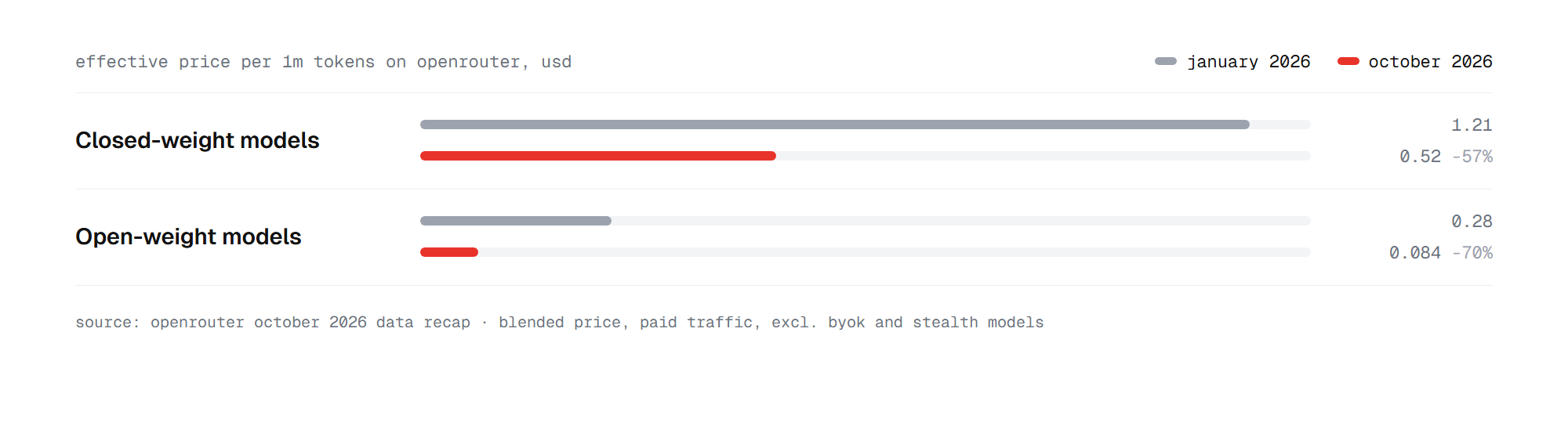
These are blended prices. They move with list prices, the mix of models and cache hit rates, OpenRouter notes. Most of the August drop for closed models was a mix shift. GPT-5.6 Luna, at about $0.07 per million tokens, became the most used paid closed model right after its launch.
A similar trend showed up in a16z's numbers, which we checked in our look at token prices and spend. There, prices fell 67% since May while spend rose more than 120%.
Cheaper tokens also reshuffled which labs grow fastest.
Which AI labs grew and kept users
Open-weight labs grew fastest. Since May, Z.ai's monthly tokens on OpenRouter grew about 20x and DeepSeek's about 12x. On spend, Z.ai grew about 6x and Anthropic's rose 76%. MiniMax's spend fell 20%, even as its token volume grew substantially.
Closed labs keep their users better. OpenRouter counts accounts that sent at least 100 paid requests to a lab in a month and checks whether they came back the next month. From September to October, Google kept 78% of those accounts, Anthropic 74% and OpenAI 74%. The leading open-weight labs had lower retention, as in earlier months.
By task, the split repeats. DeepSeek V4.1 Flash leads most coding and agent tasks by tokens, from code generation (23%) to shell execution (24%). Ranked by spend, Claude Opus 5.5 leads most of the board.
The recap also tracks a new kind of model. Decision models, which pick the model for each request, appeared as a category in mid-September. By the week of October 26 they handled 21% of all requests.
Behind the labs are the companies that actually run the open-weight models.
Which inference providers serve the most tokens
Among providers of open-weight models, Together moved from 18th place in June to first in October by tokens served. DeepSeek's own API fell to ninth in September and returned to second with V4.1 Flash. InferenceNet entered the top ten at fourth.
These rankings exclude bring-your-own-key traffic and stealth models. That leaves the last question: what the numbers say about the market as a whole.
What OpenRouter's October data says about the AI market
Agents now generate most of the traffic, and they run mostly on cheap open-weight models with cached context. The money still flows mainly to closed labs, which also keep their customers longer. OpenRouter is one router, used mostly by developers who compare prices, so its numbers do not describe all AI usage. Within that audience, the trend is clear: volume grows on open weights, while revenue concentrates at Anthropic, OpenAI and Google. If Z.ai and DeepSeek can turn token growth into retained, paying users, that split will start to narrow. For now, October data shows no sign of it.
Sources
- October 2026 data recap, OpenRouter – full report with charts and methodology
- Our October data recap, OpenRouter on X – thread, November 6, 2026
- OpenRouter: Agents used 76% of its 790T tokens in October, FourWeekMBA – November 7, 2026