Felix Laurent
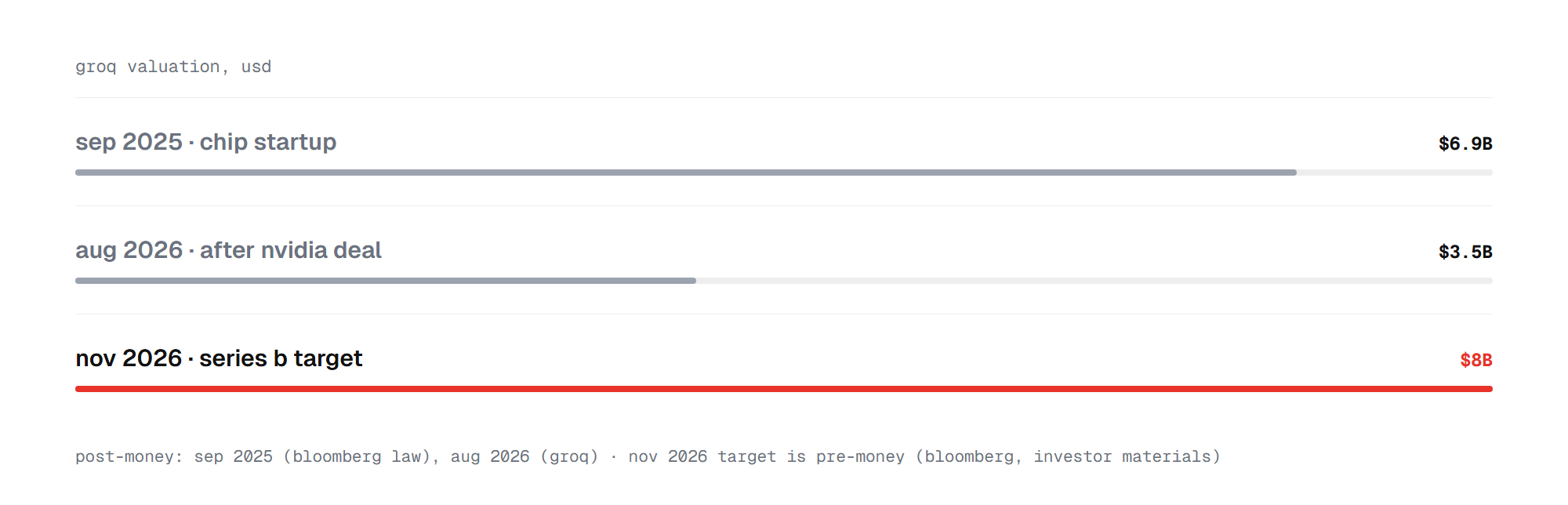
Groq, the company that rents out AI computing power after licensing its chip technology to Nvidia, wants to more than double its valuation. It is pitching a Series B round at an $8 billion valuation before new money, Bloomberg reported on November 6, 2026, citing investor materials.
The pitch comes less than three months after Groq was valued at $3.15 billion before its last raise. It also comes in the middle of a sharp AI selloff. Executive chairman Alex Davis is using the moment to argue that Groq is safer than its debt-heavy rivals.
What Groq is pitching to investors
The new round would be Groq's Series B. Its size, lead investor and timing have not been reported. Groq and Davis's investment firm, Disruptive, declined to comment to Bloomberg.
In an investor letter, Davis forecasts that Groq's revenue will grow eightfold next year. He also projects EBITDA of $2 billion by 2028. The company says the money will help meet "substantial demand for its inference compute through short- and medium-term contracts."
Inference is the work of running trained AI models to answer requests, as opposed to training them. Groq sells that capacity as a cloud service, and Bloomberg says its business leans on cybersecurity customers.
The $8 billion target is about 2.5 times the August pre-money valuation, FourWeekMBA calculated. To see why the jump is so large, it helps to know how much Groq has changed in a year.
How Groq went from chips to a neocloud
Groq began as a chip startup. Its founder Jonathan Ross helped create Google's TPU, and Groq built its own inference chip, the LPU. In September 2025, it raised $750 million at a $6.9 billion valuation, in a round led by Disruptive.
Three months later, on December 24, 2025, Nvidia signed a non-exclusive license for Groq's inference technology. Ross, president Sunny Madra and other staff moved to Nvidia. The deal was widely reported at about $20 billion, and Groq's investors were paid out in cash.
Groq stayed independent with its cloud business, GroqCloud. In 2026, it rebuilt its leadership, raised $650 million in June and then $350 million in August. The August round valued it at $3.15 billion before the new money and about $3.5 billion after, roughly half of its 2025 peak. Groq said this was not a down round but a new price for "the post-Nvidia-licensing-deal version" of the company.
Today, Groq calls itself an AI inference cloud. It runs 13 data centers in North America, Europe, the Middle East and Asia-Pacific. They have 54 megawatts of capacity, with plans for more than 200 megawatts in 2027. It is now an Nvidia Cloud Partner and sells Nvidia-powered clusters, TechCrunch reported.
That makes Groq a neocloud, one of the specialist AI clouds that compete with Amazon, Microsoft and Google. Most of its rivals in that group are funded very differently.
Why Davis is attacking debt-funded rivals
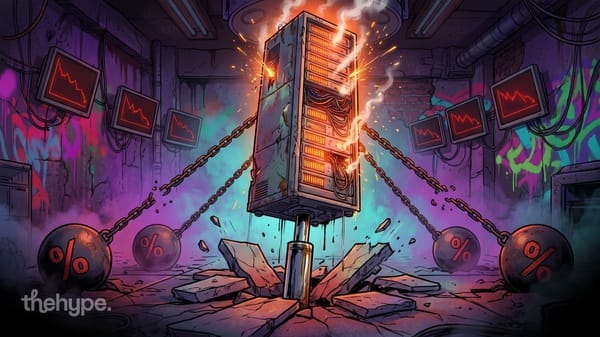
Neoclouds such as CoreWeave, Nebius, Lambda and Nscale have borrowed heavily to buy GPUs and build data centers. Davis argues that Groq can grow its margins without that kind of leverage.
According to Briefs, which relayed the letter, Davis wrote that heavy debt limits rivals' "ability to thrive as truly successful businesses". He called other neoclouds "industry facilitators with massive unmet obligations." He did not name them.
This is not a new theme for him. In December 2025, Davis warned of a "significant financing crisis" in speculative data center markets as soon as 2027 or 2028. He repeated the point this week to Alex Heath's Sources newsletter. "I could see a lot of people getting hurt putting a lot of debt on these projects," he said.
The market has started to agree with the concern. In October, CoreWeave's bonds sold off, with yields near 15% on its 2031 and 2032 notes. "The era of easy money... is starting to disappear," Luis Alvarado of Wells Fargo told CNBC at the time.
The selloff this week made that worry sharper.
The AI selloff behind the pitch
On November 5, the Nasdaq 100 fell 6.3%, NBC News reported. The Philadelphia semiconductor index dropped 12.3%, its worst day since March 2020. Nvidia lost 9.2%. Investors reacted to the Democrats' midterm wins, mixed chip earnings and doubts about returns on AI spending.
Listed neoclouds were hit hardest. CoreWeave and Nebius each lost about half their value between October 6 and November 6, according to 24/7 Wall St.
| CoreWeave | Nebius | |
|---|---|---|
| Change, Oct 6 to Nov 6 | −49.9% | −47.7% |
| Share price, Nov 6 | $45.89 | $130.78 |
| Next earnings | November 10 | November 12 |
CoreWeave's interest costs show the problem Davis points to. Its interest expense rose to $640 million in the second quarter, up from $267 million. For the third quarter, it guided to $860 million to $940 million.
Davis is betting that investors will now pay a premium for a neocloud with little debt. Whether that works depends on numbers Groq has not shared.
Can Groq double its valuation in a selloff
It is possible, but the case rests on projections. Groq has a clean balance sheet after the Nvidia payout and a clear story about avoiding debt. Its executive chairman's firm also just raised a $10 billion fund. Those are real advantages when rivals' bonds trade near 15%.
But Groq has not disclosed its revenue, its customers or how big the new round is. An eightfold revenue jump and $2 billion in EBITDA by 2028 are targets, not results. With 54 megawatts today, Groq is also far smaller than the neoclouds it criticizes. If the round closes at $8 billion, investors are still willing to pay up for AI infrastructure that comes without heavy debt.
Sources
- Neocloud Groq aims to double value to $8 billion amid AI selloff, Bloomberg – November 6, 2026
- Nvidia-backed Groq seeks $8 billion valuation, Investing.com via Yahoo Finance – November 7, 2026
- Groq closes $350 million Series A, Groq – August 17, 2026
- Groq and Nvidia enter non-exclusive inference technology licensing agreement, Groq – December 24, 2025
- AI cloud crash puts CoreWeave and Nebius on sale, 24/7 Wall St. – November 6, 2026
- Tech stocks plunge as AI fears and midterms rattle markets, NBC News – November 5, 2026