 Felix Laurent
Menlo Ventures says open-source models grew token volume 22.5x in a year, yet their share of model spending slipped from 6% to 4%. The figures come from its 2026 State of Enterprise AI report, published on Nov 3. A post by Rohan Paul on Nov 5 retold them under a "winning work" framing.
What the report measures
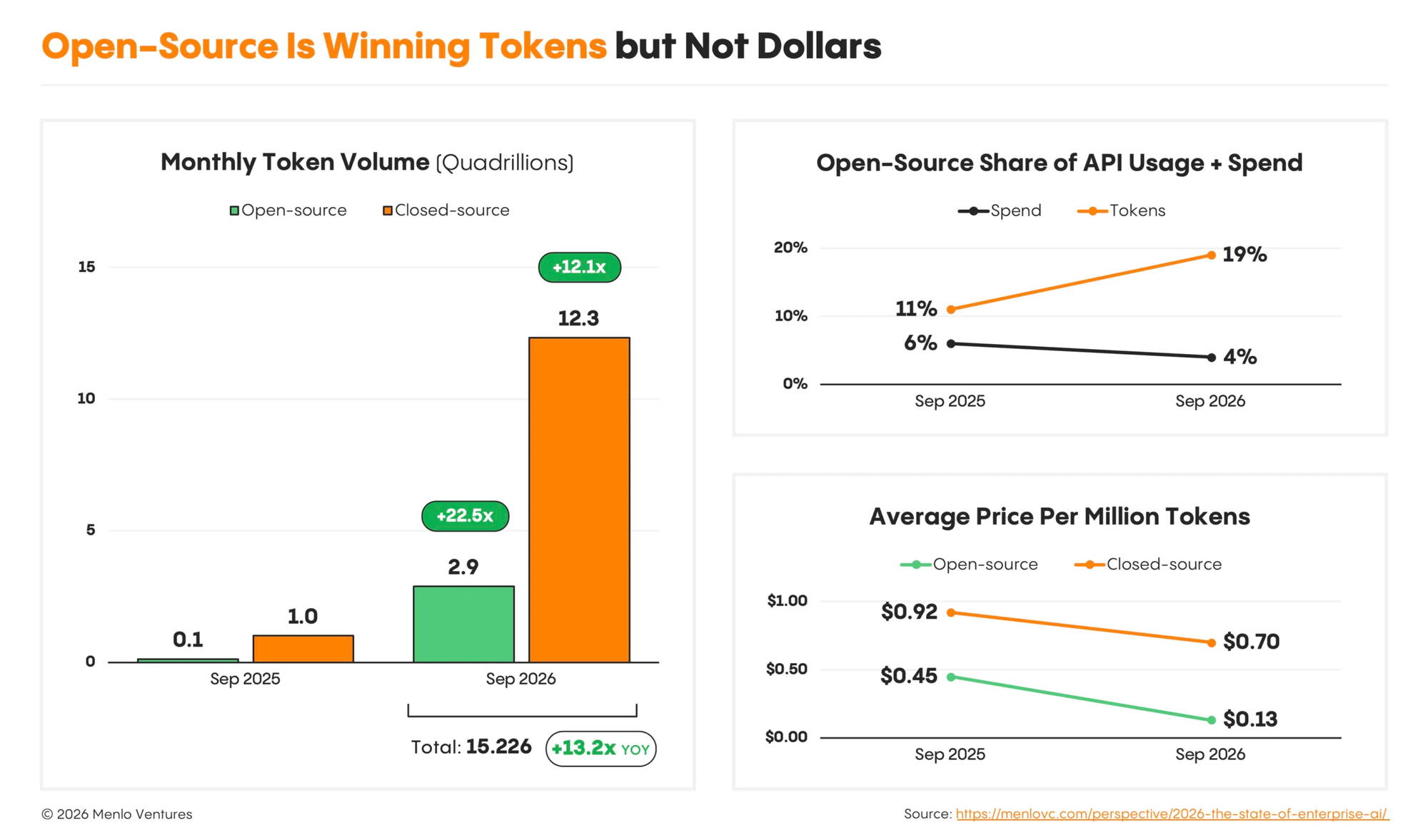
Menlo estimates open-source volume at 2.9 quadrillion tokens per month in September 2026, up from about 0.1 quadrillion a year earlier. Closed models grew 12.1x over the same year, to 12.3 quadrillion. Across both, monthly tokens rose 13.2x to about 15.2 quadrillion.
Over that year, from September 2025 to September 2026, the open-source share of tokens rose from 11% to 19%. Its share of spending fell from 6% to 4%. The report puts it simply: open source handles about one in five tokens but takes about one in 25 dollars of model spending. Menlo's chart shows all three numbers side by side.
Why spend share fell
Price explains the gap. Menlo says the average open-source token fell 3.3x in price, from $0.45 to $0.13 per million. The blended price of closed-model tokens fell 24%, from $0.92 to $0.70.
That leaves closed models about 5.4x more expensive per token. Rohan Paul rounded this to "about 5x", which is consistent with the report. Open models got cheaper much faster than closed ones, so even a near doubling of their token share bought them a smaller slice of the dollars.
Agents push prices down further. Menlo notes that cached input for Claude Opus 5.5 costs $0.20 per million tokens, against $4 for fresh input and $20 for output. An agent session that rereads its context costs about $0.70 per million tokens on average. Agents now make up 80% of the tokens on OpenRouter, Menlo says. The money still goes to a few labs.
Where the money goes
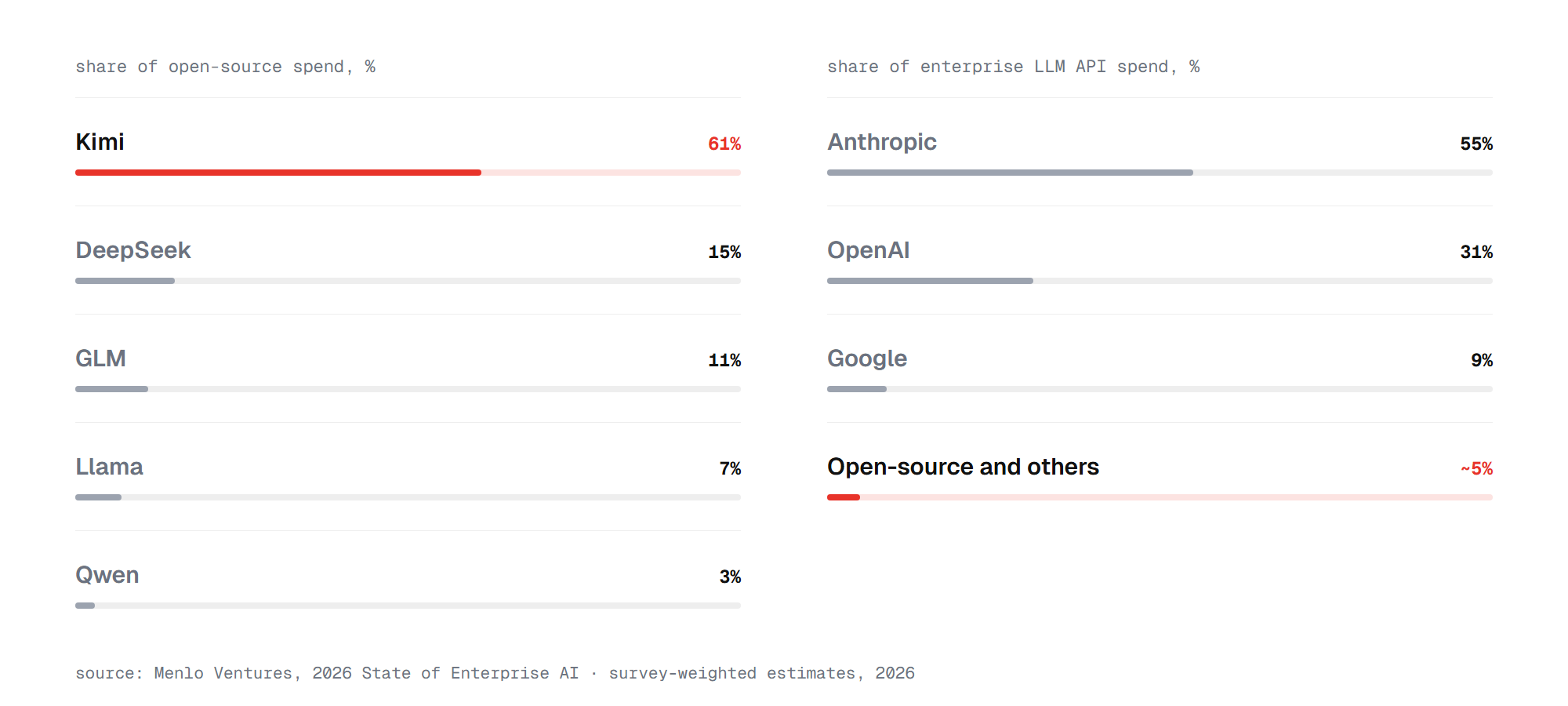
By Menlo's estimate, enterprises spent $176.8B on AI by September 2026, 5.4x more than a year earlier. Anthropic took 55% of enterprise spending on model APIs, up from 40%, and OpenAI 31%. Google's share fell to 9% from 21%. Open-source and near-frontier models such as Kimi K3, DeepSeek V4, GLM-5.3 and Grok 4.7 hold just under 5%.
Inside that small open-source slice, Chinese models take 89% of the spend. Kimi alone has 61%, DeepSeek 15%, GLM 11% and Qwen 3%. Meta's Llama is the largest Western open model at 7%.
Most open-source tokens run on inference clouds. Menlo says Fireworks and Modal each passed $1B in annual revenue run rate this year. Post-training, where companies tune open models on their own data, rose from 6% of AI builders in 2025 to 10%. Buyers still put capability ahead of cost, Menlo writes, which keeps spending on frontier models. That is where the report's framing and the X post part ways.
Two readings of the same data
The Rohan Paul post says open source is winning work by getting cheap faster than it gains volume. Menlo's wording is narrower. Its chart is titled "Open-Source Is Winning Tokens but Not Dollars", and its section heading adds "yet".
The numbers support Menlo's version. Open models now do almost a fifth of the work by volume, so they are winning work in that sense. But the work they do earns much less per token, and the share of dollars went down. The report does not say how many customers use open models or what tasks those tokens serve.
What the numbers do not say
The prices and token counts come from a model Menlo built from the bottom up and checked against OpenRouter, Ramp and Vercel. They are estimates and not billing data. The OpenRouter data skews toward individual developers and startups, Menlo notes, and Menlo is an investor in OpenRouter. Spending shares come from a Morning Consult survey of nearly 400 US enterprise decision-makers, fielded in September.
So is open-source AI winning? By volume, it is gaining fast: 22.5x more tokens in a year and almost a fifth of all model traffic. By money, it is shrinking, from 6% to 4% of spend, because its prices fell even faster than its usage grew. For now, enterprises send cheap, high-volume work to open models and keep paying Anthropic and OpenAI for the hard parts. Whether open models turn that volume into revenue depends on whether their prices stop falling.
Sources
- Menlo Ventures, 2026: The State of Enterprise AI – primary report, Nov 3
- Rohan Paul post on X – retelling of the Menlo figures, Nov 5