Felix Laurent
OpenAI will give up to 200,000 scientists free access to ChatGPT, and it brought data to back the move. On November 16, the company expanded its ChatGPT for Academic Researchers program and published a study of how scientists in its pilot used ChatGPT. Surveyed participants said the same research work at the same quality would have taken 1.9 times as long without AI.
The two announcements are one story. The pilot started in July and has grown to about 20,000 researchers in 33 countries. OpenAI's economists studied how its members worked with ChatGPT, and the results shaped the next, much bigger round of the program.
What OpenAI learned from its science pilot
The study, called "Science at the Frontier", covers more than 580,000 research messages from 1,819 scientists between August 20 and September 22, 2026. They work in biology, chemistry, mathematics, computer science, physics, engineering and earth science. OpenAI also surveyed 251 of them.
Nobody read the messages themselves. An internal tool sorted each one into a type of research activity, such as reviewing literature, writing code or analyzing data. The team saw only those categories. By default, OpenAI does not train its models on data from the program.
The pilot also shows what this looks like in practice. Shuqi Li, a researcher at Brigham and Women's Hospital and Harvard Medical School, looks for drug targets that could shorten tuberculosis treatment. Arthur Porto of the Florida Museum of Natural History and his team turn photos of museum specimens into searchable databases.
The message data shows where ChatGPT fits into that work.
What scientists use ChatGPT for
Four activities make up 85% of the average scientist's messages: reading and learning, writing, scientific analysis and research code. Fully autonomous research, where AI runs a project end to end, is still rare at 0.4% of messages.
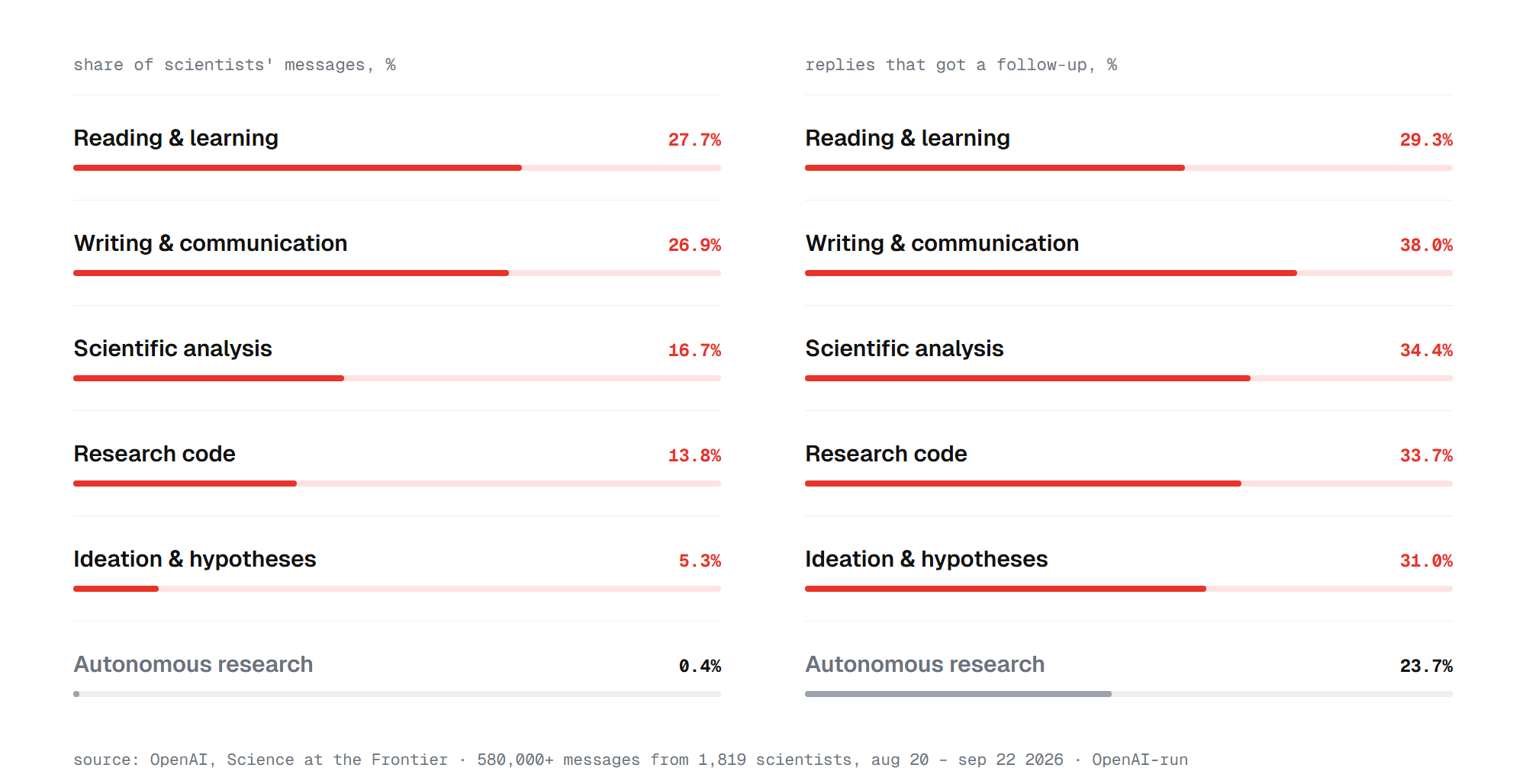
Ideas are a bigger topic than the 5.3% share suggests. Two in three scientists, or 68%, used ChatGPT to explore research directions at least once. When they developed a research question, scientists usually brought the idea and asked ChatGPT to improve it. During brainstorming, they more often asked ChatGPT for ideas.
Scientists also keep checking the answers. About one in three ChatGPT replies led to a follow-up within a week, such as a request to explain a result or redo a calculation. That held even for code, where AI has improved fastest.
The survey then asked what all this use is worth.
How much time ChatGPT saves scientists
Across eight research activities, scientists said AI lets them work nearly twice as fast at the same quality. The biggest saving came in research code: without AI, the same work would take nearly three times as long. Research ideation would take almost twice as long.
AI is not the only limit, though. Asked what would still slow them down even with capable AI, 51.8% named a lack of time or staff and 43.8% named funding. In total, 71% picked at least one of these two.
Those limits did not dent scientists' optimism about discovery.
How fast scientists expect AI to speed up discovery
The survey asked scientists to imagine a discovery that would take 10 years without AI. Almost all of them, 98%, said AI would bring it sooner. About half expected a gain of three to six years. More than one in five, 22%, said it could happen within three years.
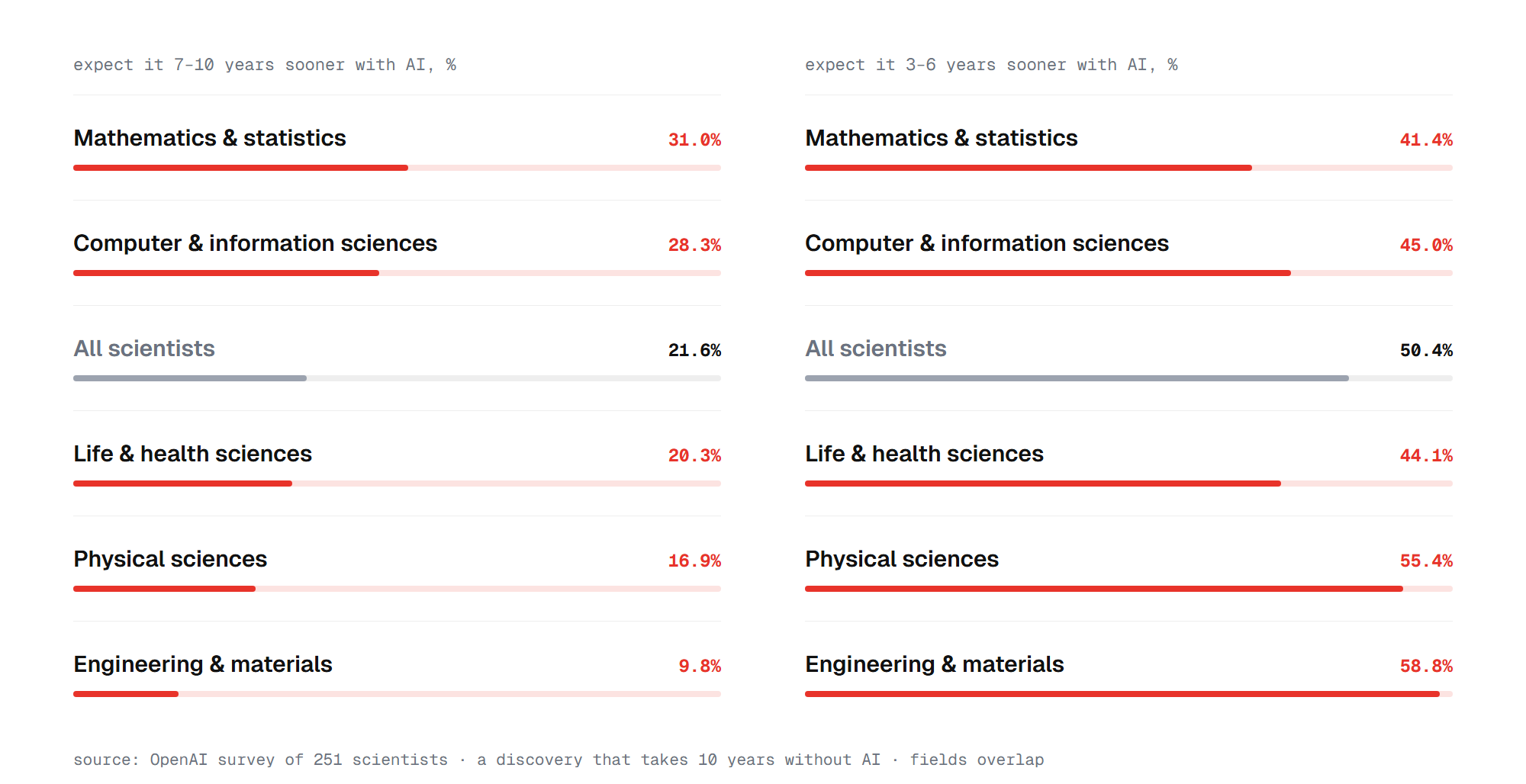
Optimism varies by field. Mathematicians and computer scientists are the most bullish: about three in ten expect a gain of seven to ten years. Engineers and materials scientists are more cautious, and most of them expect three to six years.
Results like these explain why OpenAI is now scaling the program up.
How OpenAI is expanding free ChatGPT for scientists
ChatGPT for Academic Researchers will now give up to 200,000 scientists worldwide free access to OpenAI's frontier models, with training and support. That doubles the goal OpenAI set in July, when it promised to start with 10,000 researchers and reach 100,000 through 2027.
The pilot changed how the next round works:
- Dates. Applications open on November 23.
- Selection. Based on feedback from researchers, OpenAI drops the lottery and gives 50,000 grants to the first eligible applicants.
- Seats. Each grant covers the recipient and up to two collaborators, or up to 150,000 researchers in total.
- Plan. New grants come with ChatGPT Plus. The pilot used ChatGPT Pro, but usage data showed most participants stayed within Plus limits, so the cheaper plan lets OpenAI reach more teams.
- Data. By default, OpenAI does not use data shared through the program to train its models.
The program is one of several routes for academics. Universities can buy ChatGPT Edu for their whole campus. For biology, the Rosalind Academic Plan gives eligible US university labs up to 30 free seats of GPT-Rosalind for up to 12 months. Access requires a trusted-access review. In mathematics, OpenAI gave $5 million to a new Simons Foundation initiative that helps mathematicians check and build on results produced by AI.
AI labs increasingly compete for scientists. Baidu has shown ERNIE Evolve for automated AI research, and Tencent built the HyRA research agent.
Will free ChatGPT for 200,000 scientists speed up science
It will speed up research tasks, but faster discoveries are not proven yet. The headline 1.9x gain is self-reported by 251 people inside OpenAI's own free program, who are likely keen AI users. OpenAI ran the study about its own product, and self-estimated time savings are often too generous. The usage data is more solid: scientists mostly read, write, analyze and code with ChatGPT, and they check about one answer in three.
The expansion is still a meaningful bet. Free access for up to 200,000 researchers removes cost as a barrier and gives OpenAI a huge base of scientific users and feedback. But the study's own respondents point to the real bottlenecks: time, staff and funding. A free Plus account helps with none of those, so the next round will show whether faster tasks add up to new discoveries.
Sources
- Expanding free access for up to 200,000 scientists, OpenAI on X – November 16, 2026
- Scientists report nearly doubling their productivity with AI, OpenAI on X – November 16, 2026
- Broadening access to AI for scientists, OpenAI – November 16, 2026
- Science at the frontier: how scientists use ChatGPT, OpenAI – November 16, 2026
- Science at the Frontier, full report, OpenAI – November 16, 2026