Felix Laurent

Baidu introduced ERNIE Evolve on November 9, 2026. It is an automated research system that improves AI training and inference code with little human help. Given a goal, it picks research directions, edits code, runs experiments and keeps only changes that pass independent checks.
Baidu says ERNIE Evolve beat the best public results on NanoChat AutoResearch and both NanoGPT Speedrun tracks. It also sped up inference for ERNIE 5.5 Flash, the company's new model, by up to 33.7% in production tests. Baidu calls it a practical step toward recursive self-improvement, where AI improves the systems that build AI.
How ERNIE Evolve works
ERNIE Evolve runs research as two nested loops. The outer loop decides what to investigate. The inner loop builds and tests improvements inside each chosen direction.
Five roles split the work:
- Director picks the next research direction and a starting version of the code. It draws on an Experience Bank of past runs and a Knowledge Base of papers, open-source code and expert notes.
- Selector chooses which candidate to build on next and states the hypothesis to test. It weighs scores, code changes and the reasons earlier attempts failed.
- Executor writes the code changes and runs tests in an isolated environment.
- Evaluator is a fixed program that measures speed and checks correctness on real workloads. It sits outside the repository, and no agent can see it.
- Reviewer reads the code changes next to the results. It throws out gains that come from exploiting holes in the evaluation.
Several research lanes run in parallel, each with its own tree of code versions. A gain counts only when it beats the measurement noise. Changes outside the allowed files are excluded before evaluation.

Baidu first tested this loop on public tasks, where other teams had already set records.
ERNIE Evolve results on public benchmarks
Baidu picked three public AI research tasks. NanoChat AutoResearch tests training algorithms, NanoGPT Speedrun tests training speed and SOL-ExecBench tests GPU kernel optimization. All three have open leaderboards and results from people and other automated systems.
| Benchmark | Metric | Best public result | Recursive | Hyra-1.0 | ERNIE Evolve |
|---|---|---|---|---|---|
| NanoChat AutoResearch | Validation BPB, lower is better | 0.8878 | 0.9109 | 0.9015 | 0.8763 |
| NanoGPT Speedrun Track 1 | Time to target loss | 39.9 s | 77.5 s | — | 38.9 s |
| NanoGPT Speedrun Track 3 | Steps to target loss | 2,690 | — | — | 2,590 |
| SOL-ExecBench | Mean SOL score, higher is better | 0.827 | 0.676 | 0.736 | 0.819 |
On NanoChat, the model gets five minutes of training on one GPU. ERNIE Evolve added two prediction branches next to the neural network. One uses n-gram statistics from the training corpus. The other finds matching training documents and uses their continuations. A gate mixes the branches based on how well each one predicted earlier tokens.
NanoGPT Speedrun has more than two years of community work and over 90 recorded improvements. On Track 1, ERNIE Evolve cut the time per training step by overlapping communication and trimming gradient work. On Track 3, it changed the optimizer's update rule and reached the target loss in 100 fewer steps.
SOL-ExecBench is the one task where Baidu did not take the top spot. Its 235 kernel problems have drawn nearly 50,000 submissions from over 700 developers. ERNIE Evolve scored 0.819, close to the leader's 0.827. The optimized code is published in the ERNIE-Evolve-Results repository on GitHub.
Benchmarks are clean by design, so Baidu then moved the same loop into its own engineering work.
How ERNIE Evolve sped up ERNIE 5.5 Flash
The real test was inference for ERNIE 5.5 Flash, which Baidu is still developing. Its open base model, ERNIE 5.5 Flash Base, came out on November 5. Every change from ERNIE Evolve had to pass the same load tests and correctness checks as code from engineers.
Baidu gave it three tasks:
- Low latency on Kunlunxin P800, Baidu's own AI chip. Over four rounds, generation speed rose to 623.6% of the baseline. Most of the gain came from switching on fused operators, speculative decoding and a faster communication path.
- Throughput for deterministic inference, which reinforcement learning training needs. Outputs must stay bitwise identical whatever else is in the batch. After about three days of work, throughput rose 33.7%. Time per output token fell 26%, and time to first token fell 12%.
- Single-request decoding speed on GPUs, on a service engineers had already tuned. ERNIE Evolve tried seven directions, and three of them worked. Decoding got 14.9% faster with accuracy unchanged.
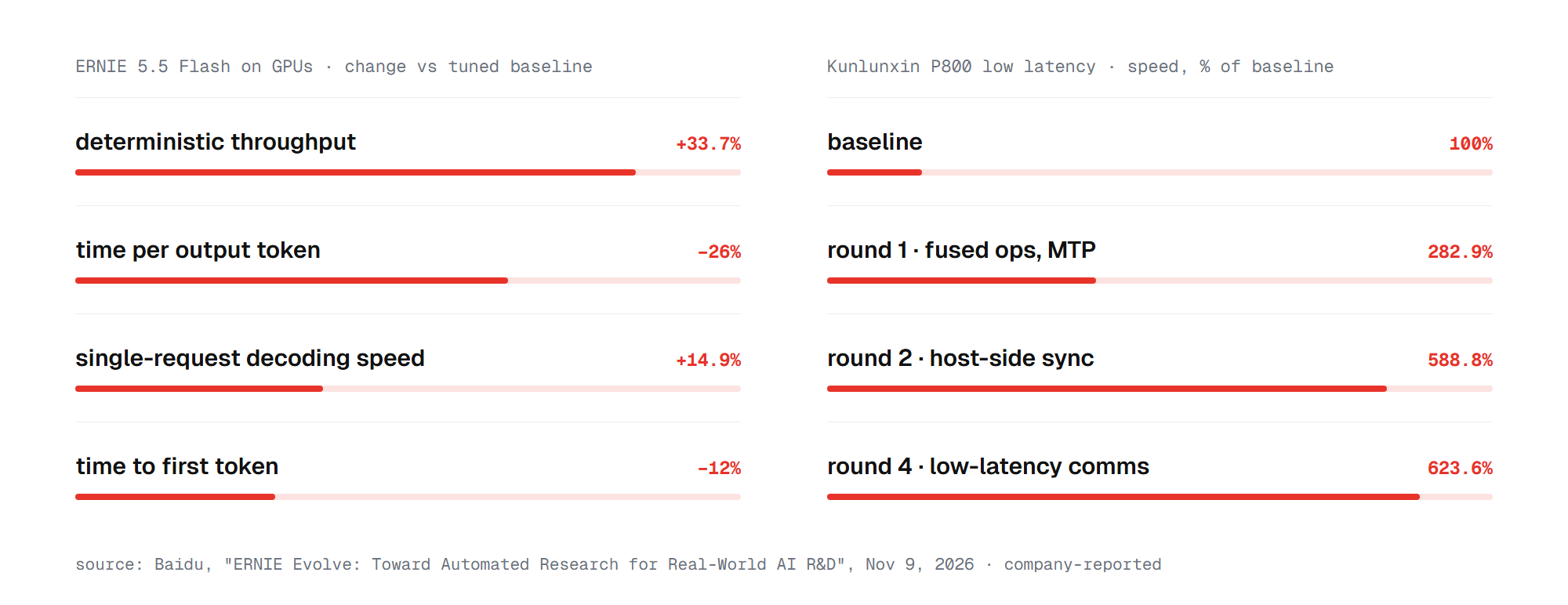
The large P800 number needs context. The model ran on that chip but did not yet use its optimized paths, so the baseline was weak. The GPU results came from setups engineers had already optimized. There, many useful changes gave only 0.3% to 2% each, close to measurement noise.
The failures are part of the record. Replacing a specialized communication call with a general one cut speed by 14%, so the system dropped it. ERNIE Evolve also ruled out several suspected bottlenecks by measuring them.
Baidu is not alone in building systems like this.
The race for automated AI research
Chinese labs and startups are all chasing the same idea. Recursive, a startup co-founded by former Meta researcher Tian Yuandong, showed its first automated research results in June 2026. It set records at the time on NanoGPT Speedrun and SOL-ExecBench.
Tencent's Hunyuan team built Hyra, which Baidu compares against in its table. Its successor, Hyra 2.0, came out on November 2. It builds reusable science models and tools. Baidu used Hyra-1.0 because Hyra 2.0 has not reported results on these tasks. The NanoChat AutoResearch task itself grew out of Andrej Karpathy's autoresearch project.
Several caveats apply. All results are self-reported. Baidu published a blog post and a results repository, but no paper. The public benchmark margins are small: one second on Track 1 and 100 steps on Track 3. Leaderboard records also move quickly, and rivals may already have updated their own entries.
Baidu also says recursive self-improvement must stay under human control. The system should remain interruptible, with clear limits on goals, permissions and resources. Its scope should grow only while people can still understand, supervise and stop it.
Is ERNIE Evolve a real step toward recursive self-improvement
Partly. ERNIE Evolve improves the code that trains and runs Baidu's models, and those gains passed production checks. That is a concrete, narrow kind of self-improvement. It does not invent new model abilities on its own.
The more useful signal is the method. Hidden evaluators, a reviewer that rejects metric hacks and a memory of failed ideas address the main risks of letting AI run experiments. Baidu next plans to apply the loop to training systems, model capabilities and evaluation itself. Those steps will show whether it can do more than polish inference code, and independent checks of the public records would make the case stronger.
Sources
- ERNIE Evolve: Toward Automated Research for Real-World AI R&D, Baidu – November 9, 2026
- Baidu announcement on X – November 9, 2026
- ERNIE-Evolve-Results, GitHub
- modded-nanogpt (NanoGPT Speedrun), GitHub
- SOL-ExecBench, NVIDIA, GitHub
- autoresearch, Andrej Karpathy, GitHub
- Recursive Superintelligence unveils its first automated AI research system, KuCoin News – June 2026