Felix Laurent

Cohere added Video Intelligence to Compass, its enterprise search platform, on November 16, 2026. Cohere video intelligence finds the exact moment in a video library that answers a question. It returns that moment with a timestamp, a transcript and a description of what is on screen. It is in private preview, and Cohere is recruiting design partners to test it on their own footage.
Cohere says its video search beats seven rival embedding models, including ones from Google, Amazon and Alibaba's Qwen team. By its own numbers, it leads on average across 11 datasets, though it loses on three of them.
What Video Intelligence in Compass does
Compass is Cohere's retrieval engine. It powers search in North, the company's workspace for enterprise AI agents. Since September it has also been available as a managed cloud service in private beta. Until now it worked with documents. Video Intelligence adds recorded meetings, training videos and media archives to the same index.
Cohere describes four main properties:
- Moments instead of files. Compass picks the start and end of a clip at search time, so a question returns the minute that answers it.
- Video and documents together. One search can return a clip alongside the matching page, slide or spreadsheet.
- Evidence to check. Every result links back to the original footage with its timestamp, transcript and visual description.
- Enterprise controls. Search respects what each user may see, and companies can pick fields, models and where to deploy.
The search reads both the audio and the picture. Cohere's example is a presenter who describes rising KPIs while the chart on screen shows the opposite. A transcript alone would miss the gap. A sequence matters too: one frame shows a player leaving the pitch, but only the clip shows the player was sent off.
AI agents can reach the same index through the Compass MCP server. That lets an agent ask what leadership decided about a launch and get back the minutes of the meeting where it happened.
Who Cohere built video search for
Cohere names four groups of use cases:
| Area | Example questions |
|---|---|
| Meetings and company knowledge | Decisions and forecasts from meetings, earnings calls and analyst briefings |
| Education and training | The exact explanation in a recorded lecture or onboarding session |
| Sports and media | Specific plays, players, camera angles or visible sponsor brands in an archive |
| Legal and compliance | Statements and disclosures in recorded footage, with transcript and visual context |
Sports archives are a telling choice for a company focused on banks and governments. Cohere tested its system on World Cup broadcasts, and that is also where it reports its widest lead.
How Cohere's video search compares with rival models
Cohere measured nDCG@10, a score of how well the top ten results are ranked. It ran 11,133 queries across 11 datasets: six public benchmarks, three enterprise sets of meetings, lectures and safety training, and two soccer datasets.
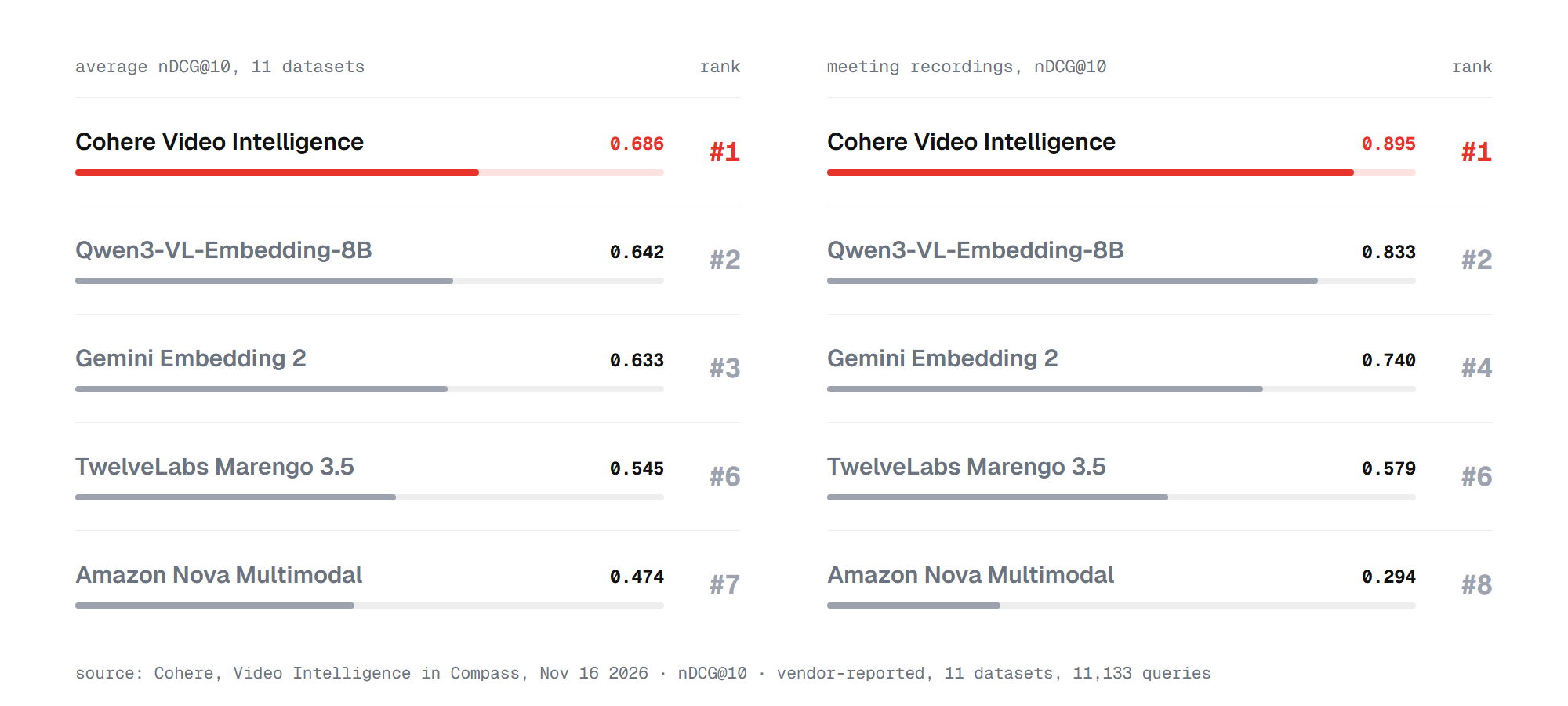
Compass scores 0.686 on average, 4.4 points ahead of Qwen3-VL-Embedding-8B at 0.642. Gemini Embedding 2 follows at 0.633. TwelveLabs Marengo 3.5, a model built specifically for video, scores 0.545.
The lead changes size by domain. On soccer footage Compass beats Gemini Embedding 2 by 5.1 points. On the public benchmarks it is 2.4 points ahead of Amazon Nova Multimodal Embeddings. In enterprise knowledge it leads Qwen3-VL-Embedding-8B by 2 points.
Cohere's own table also shows where it loses:
| Dataset | Cohere | Best rival |
|---|---|---|
| MSR-VTT, short web clips | 0.567 | 0.701, Qwen3-VL-Embedding-8B |
| OSHA workplace safety videos | 0.831 | 0.912, Qwen3-VL-Embedding-8B |
| QVHighlights, vlog and news moments | 0.511 | 0.523, TwelveLabs Marengo 3.5 |
Five of the 11 datasets are Cohere's own internal sets, so outsiders cannot repeat those tests. The results are also a comparison of a full search system against embedding models, which handle only one part of the job.
How to get access to Video Intelligence
Video Intelligence is in private preview, and Cohere has not announced pricing or a release date. Design partners can run it in Cohere's managed cloud or in their own environment. They test it on their own footage and queries and work with Cohere's engineers, who use the feedback to shape the product.
The self-hosted option is the main draw for Cohere's core customers. Banks, telecoms and public sector teams often cannot send meeting recordings to an outside cloud. Cohere's recent launches follow the same plan, including Context Focus in Rerank 5. They are retrieval tools that can run inside a company's own systems.
Is Cohere's video search worth testing?
For companies sitting on hours of recorded meetings and training, yes, if they can join the preview. Returning the minute that answers a question, with a link to check it, solves a real problem: nobody rewatches a recording to find one decision. The benchmark lead is real but modest, about 4 points on average, and it comes from Cohere's own tests on partly private data. Qwen's open embedding model beats Compass on two datasets, which gives teams a cheaper option to compare. The deciding factor will be deployment. A search system that runs in a company's own environment and respects access rights matters more to regulated customers than a few points of nDCG.
Sources
- Video intelligence: Make every moment in your video library searchable, Cohere – November 16, 2026
- Introducing Video Intelligence in Compass, Cohere on X – November 16, 2026
- Compass is coming to the cloud, Cohere – September 25, 2026
- Compass product page, Cohere