Felix Laurent
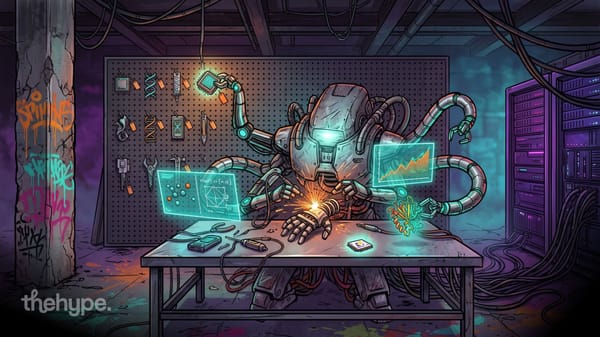
Tencent Hunyuan released Hyra 2.0 on November 1, 2026. It is the second version of the company's AI research agent, and it changes the goal. Hyra 1.0 tried to solve hard problems. Hyra 2.0 builds the scientific tools that solve whole classes of them.
Tencent's team frames it as the "second half" of automated research: a shift from brute-force problem solving to upgrading tools. The first results include two protein models trained from scratch, a quantum code that beats a public leaderboard and a faster open-source RISC-V chip.
From Hyra 1.0 answers to Hyra 2.0 tools
Hyra 1.0 came out three months earlier as a minimal agent loop for research problems. A week after its release, Hyra settled an open problem in additive combinatorics. It concerned the optimal exponent linking sumsets and difference sets, a problem Tencent says stayed open for more than 50 years.
The result became an arXiv preprint by Haowei Lin and Shanda Li, submitted on July 29, 2026. Its abstract says the construction and proof were developed with Hyra running on Tencent's open-weights Hy3 model. Tencent calls it the first time a Chinese open model solved an open math problem fully on its own.
That approach works when a problem has a clear scoring rule: the agent keeps trying until it beats the best known result. But Tencent argues such wins do not compound. A solved problem does not make the next one easier. A better tool improves every task that uses it.
So Hyra 2.0 targets tools: code, workflows and trained models that people and agents can reuse. Building them takes days or weeks, which needed a different kind of agent setup.
How the Hyra 2.0 agent works
Hyra 2.0 runs inside the team's real research stack. It talks to researchers in WeCom, submits jobs on the compute platform and commits changes to code repositories. Large compute spending and changes to shared knowledge need human approval.
The work is split across three layers:
- Overall talks to the researchers, sets project priorities and allocates resources;
- Mission owns one research question long term, plans experiments and answers for the conclusions;
- Worker reads code, runs experiments and analyzes failures, and can push back on its Mission.
Tasks sit in a persistent queue, so one project can wait for a training run while others continue. Progress goes onto a shared Research Board. When a Worker reports a result, it must attach code versions, logs or raw traces as evidence. A separate Review Worker can then check the claim from scratch.
Lessons that carry over between projects go into a shared knowledge base called Books. Each entry is marked as an observation, a verified finding or a team convention, and only humans can approve conventions. Methods that prove useful become skills for future tasks.
This setup is what let Hyra 2.0 train new models from scratch, not just speed up old ones.
What Hyra 2.0 has built so far
Tencent lists results in biology, chemistry, math, quantum computing, robotics and chip design. The main numbers below are reported by Tencent and not yet independently checked.
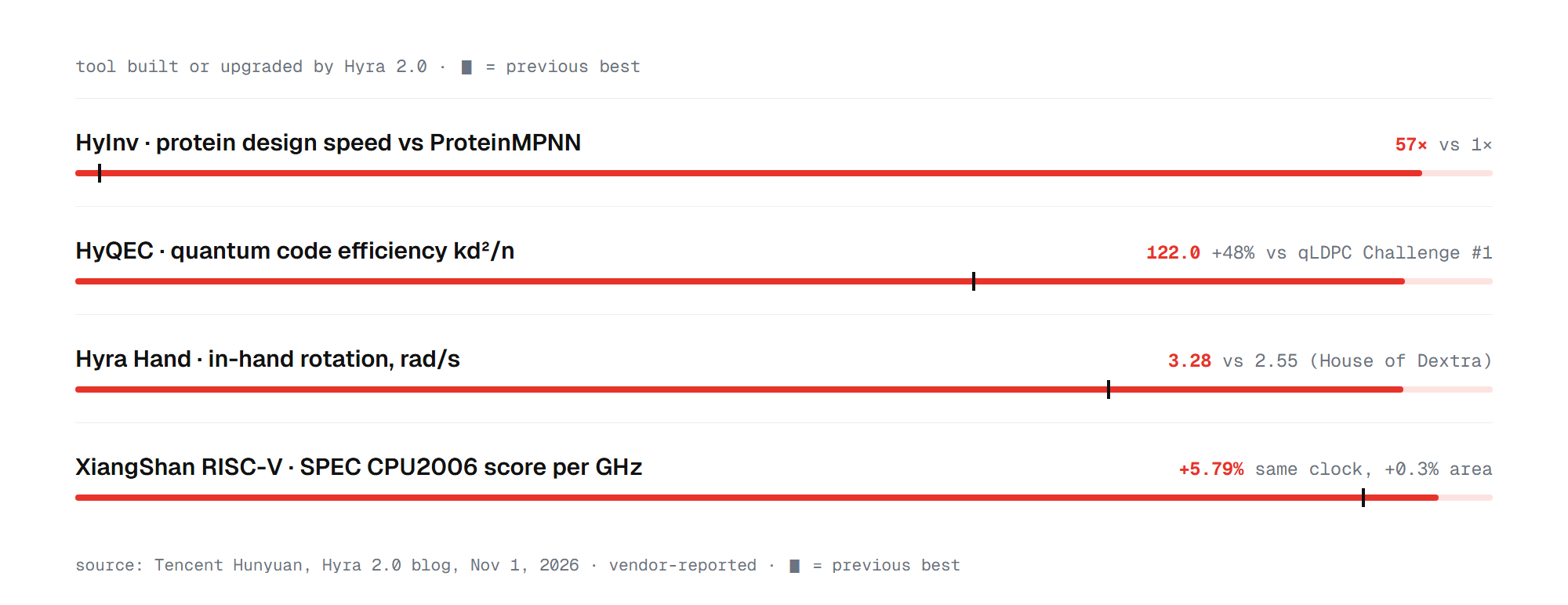
HyInv handles protein inverse folding: finding a sequence that folds into a target shape. It is a graph neural network with only 1.96 million parameters. Tencent says it designs 128 sequences in 50 milliseconds and runs 57 times faster than ProteinMPNN, with better structural fit.
HyPLM-Flash is a protein language model with 650 million parameters, trained on 726 billion tokens. That is 0.73 times the data of ESM-2 650M. Among 12 protein language models, it was the fastest and ranked third on average across 35 tasks.
HyFF is a machine-learning force field for molecular simulation, in five sizes from 2.3 million to 1.2 billion parameters. All five sit on the accuracy-speed Pareto front against 16 public models. It simulated a 60,000-atom water channel protein for 100 nanoseconds.
HyProver is a workflow for pure math proofs. Tencent says it fully solved several open problems, including Shing-Tung Yau's circle action conjecture and the five-dimensional Petty equilateral point conjecture. Mathematicians checked both proofs with the team.
HyQEC builds and verifies quantum error-correcting codes. It found a [488,123,22] code with an efficiency score kd²/n of 122.0. That is about 48% above the previous leader in its category of the qLDPC Challenge. It also certified exact code distances for 178 of the leaderboard's 187 entries.
Hyra Hand is a five-finger robot hand design in which the fingers spiral around the palm like a staircase. After equal fine-tuning, it rotated objects at 3.28 rad/s, 28.6% faster than the best design from the House of Dextra paper. The result is from simulation only.
XiangShan, an open-source RISC-V processor, got 5.79% more performance per GHz on SPEC CPU2006 at the same clock speed. Tencent estimates that equals two to three months of the official team's progress. Hyra's fuzz tests also found 10 bugs that were not in the project's issue list.
The table sums up what each tool is and how far it has gone.
| Tool | Field | Status |
|---|---|---|
| HyInv | Protein design | Trained from scratch; technical report coming |
| HyPLM-Flash | Protein language model | Trained from scratch; technical report coming |
| HyFF | Molecular simulation | Five sizes, tested on real simulations |
| HyProver | Pure math | Two proofs checked with mathematicians |
| HyQEC | Quantum error correction | Public release planned |
| Hyra Hand | Robotics | Simulation only, no real hardware yet |
| XiangShan upgrades | Chip design | Fix contributed to the OpenLLC cache project |
Tencent says it will publish the results in its Hyra GitHub repository. The last item on the list points the agent at Tencent's own models.
Hyra 2.0 and the next Hy model
Inside Hunyuan, Hyra 2.0 already works on the next Hy model. In pre-training, it tunes the training infrastructure and tests new methods. In post-training, it builds data synthesis pipelines. In inference, it optimizes the serving system to cut costs.
Tencent describes this as a loop. Better tools train a better Hy model, and that model then becomes a stronger tool for Hyra. The team places it in the context of recursive self-improvement, where AI helps build the next AI.
Tencent is not alone in this race. Its blog points to OpenAI, which announced results on ten long-open problems and later claimed a solution to the Navier-Stokes Millennium Prize Problem. In September, Anthropic said Claude optimized more than 30 open-source biomolecular models in under four weeks, making them about four times faster on average.
Is building tools the next step for AI research agents
Tencent makes a strong case that it is. A solved problem is used once, while a faster protein model or a verified proof workflow serves every later project. Hyra 2.0 already shows this at a small scale. It trained models from scratch, contributed a chip fix upstream and built a quantum code that tops its leaderboard class.
The evidence still needs time. Every number comes from Tencent, the protein models wait for technical reports, HyQEC is not out yet and the robot hand exists only in simulation. Anthropic's speedups, by contrast, came with public code. If Tencent's reports and repositories hold up to outside checks, Hyra 2.0 will mark the point where research agents moved from answers to tools.
Sources
- Hyra 2.0: the next step for automated research, Tencent Hunyuan – November 1, 2026, in Chinese
- Hyra 1.0, Tencent Hunyuan – the first version of the research agent
- Settling the optimal exponent relating sumsets and difference sets, arXiv – Haowei Lin and Shanda Li, July 29, 2026
- Hyra-results, GitHub – Tencent's public research artifacts
- How Claude is uplifting biomolecular modeling, Anthropic – September 17, 2026