Felix Laurent

Ant Group's AI lab Ant Ling has released Ming-Image-0.2-Design, an open-weight image model built for graphic design work. It came out on November 26, 2026, under the MIT license, which allows commercial use. On Artificial Analysis's text-to-image leaderboard, it ranks first among open-weight models with 1,095 Elo.
Ant Ling also previewed Ming-Image-0.2-Design-Layer, a companion model that splits an image into editable layers. Its weights are due next week.
What Ming-Image-0.2-Design does
Ming-Image-0.2-Design is the second version of Ant Ling's design model. The first, Ming-Image-0.1-Design, came out in September. Ant Ling says the new version improves complex composition, lighting and text rendering. It targets three uses: e-commerce hero images, drafts of user interfaces and websites, and spatial renderings such as interiors.
Readable text is the hard part for most image models, and it matters most in design. Ant Ling's model card recommends prompts that spell out every heading and label, ending with "Render all text exactly as written." For better results, it suggests a structured, Figma-style JSON prompt. Ant Ling also publishes a prompt enhancer that rewrites short requests into that format.
The model has 6 billion parameters in its diffusion transformer, the part that generates the image. Ant Ling's recommended settings are:
- Resolution. 2048 × 2048 by default, with 2K formats such as 2560 × 1440 for 16:9. A 1024 × 1024 square is faster.
- Speed. 12 sampling steps.
- Hardware. One GPU with 80 GB of memory, the configuration Ant Ling has validated.
The weights are on Hugging Face and ModelScope, with inference code on GitHub. The model can also be served with vLLM-Omni.
How the model compares with rivals comes from an independent test.
Ming-Image-0.2-Design on the Artificial Analysis leaderboard
Artificial Analysis ranks image models by Elo, a score built from human votes in blind side-by-side comparisons. In its AA-Image-T2I v2.1 test, Ming-Image-0.2-Design scored 1,095, the highest of any open-weight model.
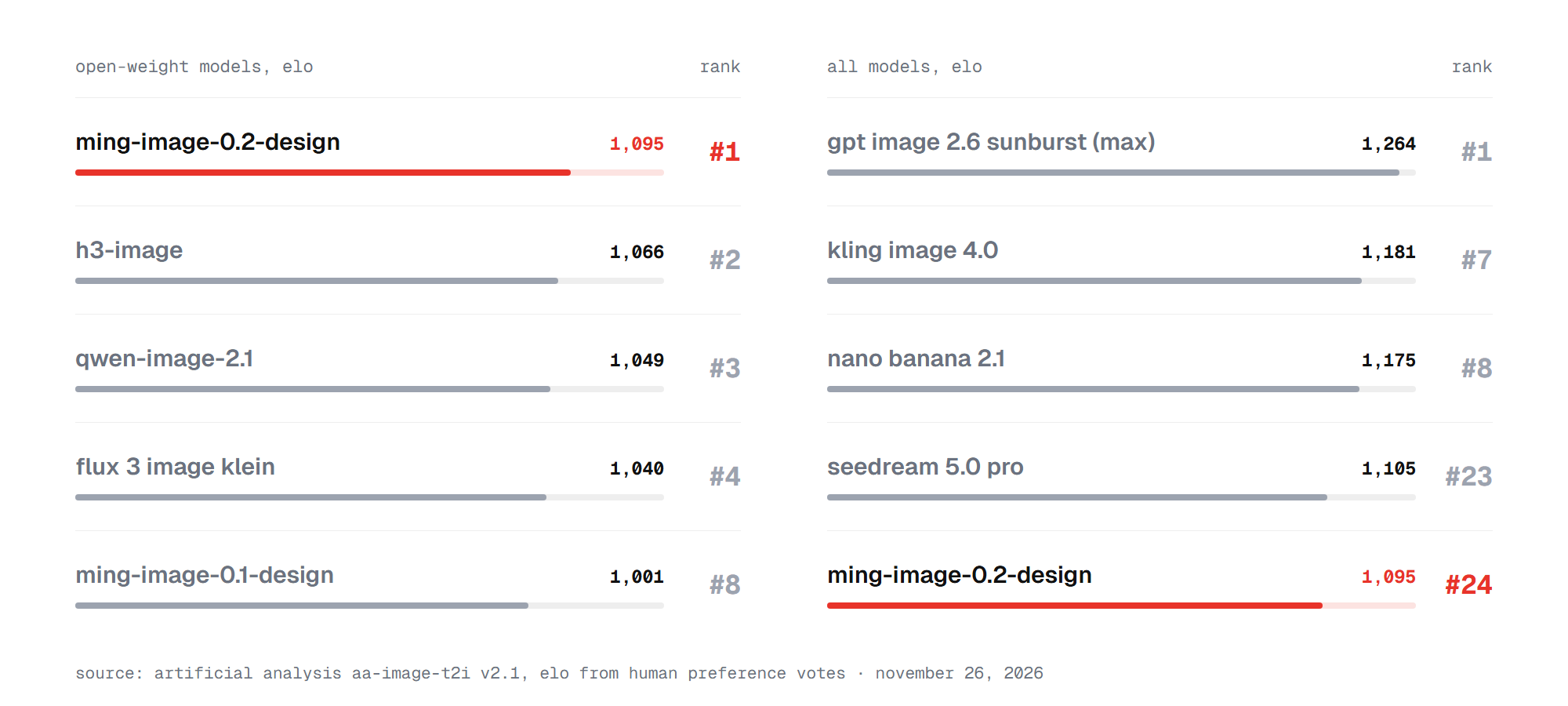
Its lead among open models is clear. H3-Image, in second place, scored 1,066, and Alibaba's Qwen-Image-2.1 1,049. The new model also scored 94 points above its own predecessor, Ming-Image-0.1-Design.
Against all models, the picture is different. Ming-Image-0.2-Design ranks 24th overall. OpenAI's GPT Image 2.6 Sunburst leads at 1,264, followed by other closed models such as Kling Image 4.0 and Nano Banana 2.1. Ming sits just behind ByteDance's Seedream 5.0 Pro, a gap within the margin of error.
The score is still preliminary. It rests on about 4,900 votes, fewer than most models on the board, and has a margin of 12 points either way. Artificial Analysis also lists no API price for the model yet.
Ming-Image-0.2-Design-Layer: images as editable layers
The second model targets a different problem. Images from a generator come as a single flat picture, while designers work in layers. Ming-Image-0.2-Design-Layer splits a finished image into transparent layers that can be edited on their own.
The first version, released in September, separated design images into layers. The new one goes down to the parts of a character. In Ant Ling's demo, it separates a character's wings, head, arms, outfit and lantern, then breaks each part down further. It produced 35 sublayers, and stacked back together they stay close to the original silhouette and colors. That makes the parts usable for animation and motion design.
Layers also help with repeated edits. In Ant Ling's demo, an image editor changes only the target layer, and the edited layer is composited back with the untouched ones. Ant Ling ran more than 20 rounds of edits this way. It says the layered approach kept more of the original colors and textures than editing the full image with OpenAI's GPT-Image-2.5 Sunburst.
These comparisons come from Ant Ling's own demos and have not been tested independently. Ant Ling also showed Ming-Image-0.2-Design working with its language model Ling-3.2-flash and a published design skill. The image model drew the visual reference for a website, and Ling-3.2-flash built a working page from it, including the mobile layout. Ant Ling's text models include the open-weight Ling-3.2-air.
Is Ming-Image-0.2-Design worth trying?
For teams that need an image model they can run on their own hardware, Ming-Image-0.2-Design is now the strongest option on Artificial Analysis's board. It leads open-weight models by 29 points and comes with an MIT license and a clear focus on design work with readable text. The limits are clear too. It needs an 80 GB GPU, and its score is still preliminary. It also trails the best closed models, such as GPT Image 2.6 Sunburst, by about 170 points. The layer model, due next week, may turn out to be the bigger release for designers. It makes generated images editable in the way their tools expect.
Sources
- Ming-Image-0.2-Design launch thread, Ant Ling on X – November 26, 2026
- Ming-Image-0.2-Design model card, inclusionAI on Hugging Face – November 26, 2026
- Ming-Image on GitHub, inclusionAI
- AA-Image-T2I v2.1 text-to-image leaderboard, Artificial Analysis – November 26, 2026
- Ling UI design skill, inclusionAI on GitHub