 Felix Laurent

Ant Group has released Ling-3.2-air, an open-weight model built for office work such as workflow automation and reading professional documents. It has 124 billion parameters, but only 5.5 billion are active for each token. The weights are on Hugging Face under the MIT license.
The Ant Ling team announced the model on X on November 23, 2026. Its headline number is AutomationBench-AA, a test of automating tasks across business apps. There, the score "rises from 15.7% to 61%" compared with the previous version.
What's new in Ling-3.2-air
Ling-3.2-air uses the same architecture as Ling-3.0-flash-VL, which Ant released in September. It reads text, images and video and answers in text. It is a reasoning model, so it thinks before answering by default.
The model mixes two kinds of attention. Of its 42 layers, 35 use Kimi Delta Attention, a linear method that keeps long inputs cheap, and 7 use standard attention. It is also a mixture-of-experts model, with 512 experts and 8 working on each token.
The size stays the same as before, so the gains come from training. Ant says the new version is stronger at workflow automation and at reasoning over professional documents. The context window is 256,000 tokens in the official setup.
The improvements show up most clearly in agent tests.
How Ling-3.2-air scores on benchmarks
Ant compares the model with its predecessor and two Qwen models from Alibaba. The table also includes three closed models: OpenAI's GPT-5.6 Luna, Anthropic's Claude Sonnet 5 and Google's Gemini 3.8 Flash. The jumps over the old version are large:
| Benchmark | Ling-3.2-air | Ling-3.0-flash-VL |
|---|---|---|
| AutomationBench-AA | 61.0 | 15.7 |
| SWE-bench Pro | 58.3 | 26.4 |
| Terminal-Bench 4.0 | 27.0 | 0.0 |
| SkillsBench | 67.8 | 42.9 |
| BrowseComp | 85.5 | 72.2 |
| Humanity's Last Exam | 31.4 | 22.0 |
On AutomationBench-AA, Ling-3.2-air beats every model in Ant's table, including Gemini 3.8 Flash at 59.9. It also leads on SkillsBench, the banking agent test TAU3-Banking and BrowseComp, a web research test.
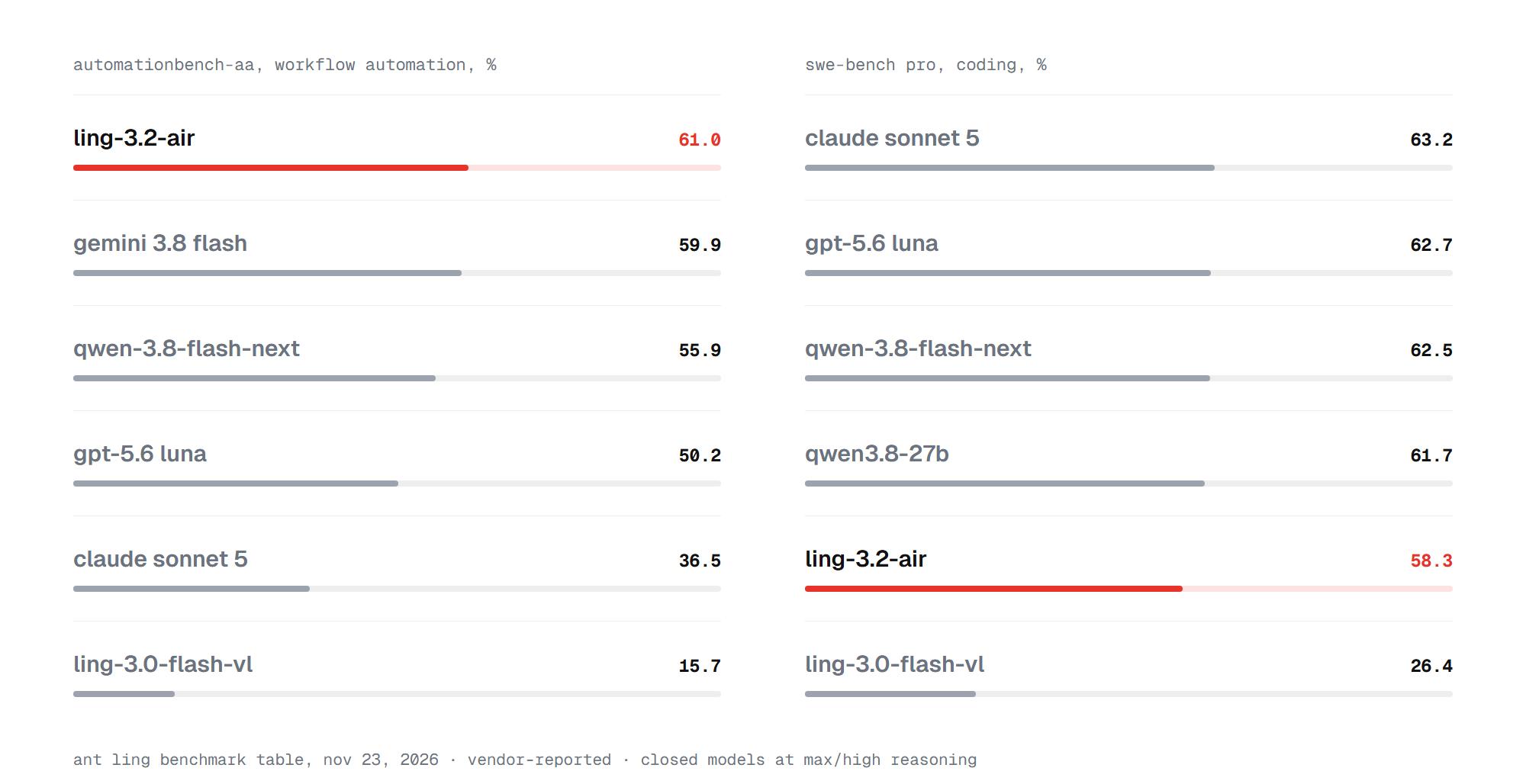
Coding is more mixed. On SWE-bench Pro, Ling-3.2-air trails both Qwen models and the closed models by 3 to 5 points. On DeepSWE it scores 42.5, against 58.7 for Qwen-3.8-Flash-Next and 73.7 for Gemini 3.8 Flash. It also falls behind on Humanity's Last Exam and the Finance Agent test.
For images and documents, the model is close to the leaders. It scores 92.3 on OmniDocBench, a document parsing test, the best result in the table. On MMMU-Pro, a visual reasoning test, it scores 79, level with Qwen-3.8-Flash-Next and GPT-5.6 Luna, while Gemini 3.8 Flash reaches 86.
Several of these numbers come from Artificial Analysis, which has also tested the model on its own.
What Artificial Analysis found
The independent benchmarking firm gives Ling-3.2-air a score of 23 on its Intelligence Index v5. That is well above the median of 5 for open models of a similar size. Among all open models, it ranks above Qwen3.8 27B at 20 but below Ant's larger Ling 3.1 Flash at 30.
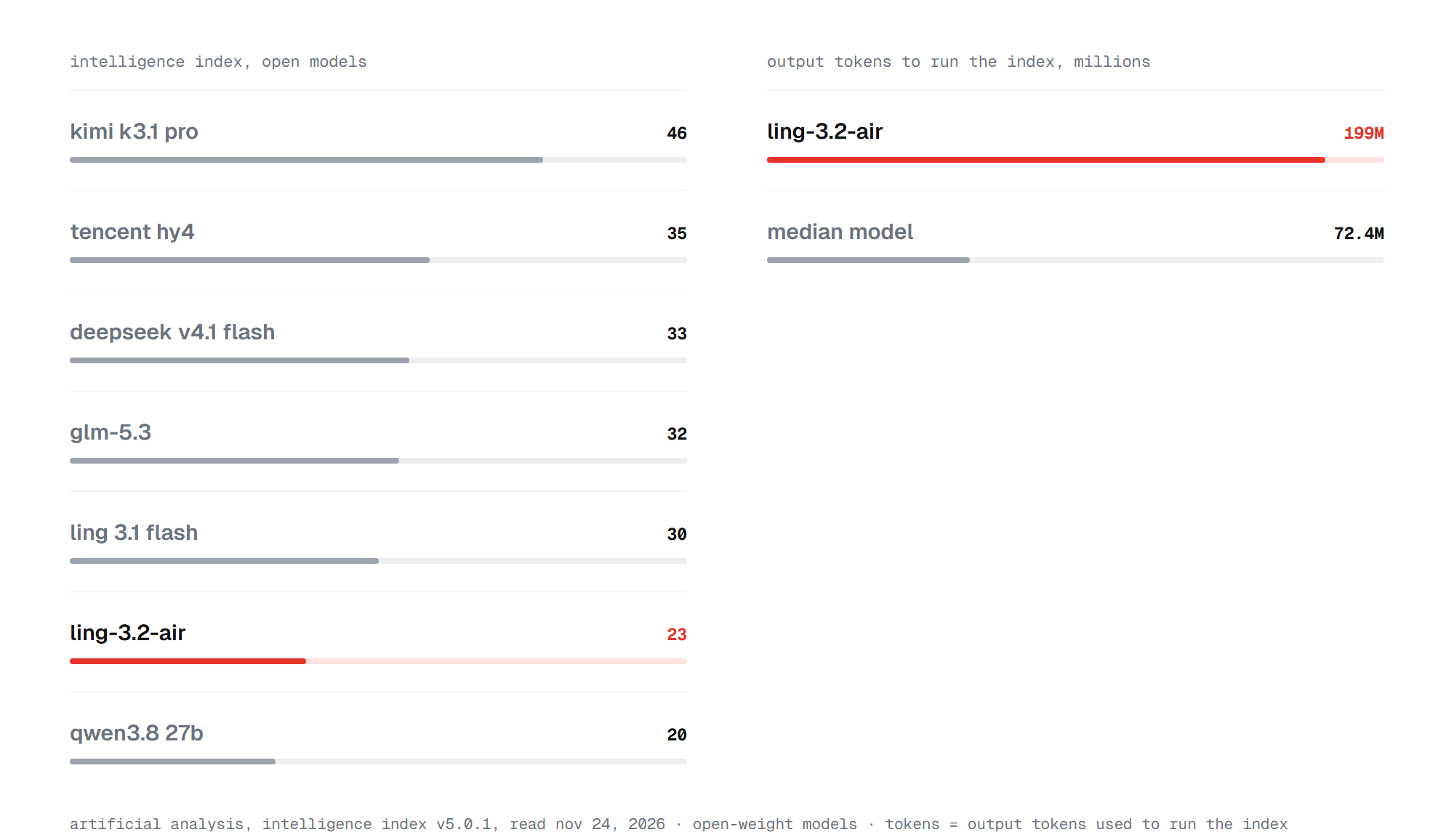
The model is very talkative. It produced 199 million output tokens during the index run, while the median model used 72.4 million. Long reasoning can mean higher bills and slower answers.
The legal results are weak. On Harvey LAB-AA, a test of legal work, Ling-3.2-air passes 87.7% of individual criteria. But Artificial Analysis fails any task with a serious factual error, such as a wrong date or amount. By that rule, only 0.8% of tasks pass, and the model ranks 37th of 46.
Running the model yourself is the only option for now.
How to run Ling-3.2-air
There is no hosted API at launch. Artificial Analysis lists "no publicly available API," and no inference provider offers the model on Hugging Face yet. To use it, you have to download the weights.
The setup is heavy:
- Weights: FP8 only, about 129 GB in total.
- GPUs: four cards with 141 GB of memory each, such as Nvidia H200 or H20-3e, or a four-GPU B300 node. With 80 GB cards like the H100, you need eight.
- Software: Ant recommends SGLang, which offers a ready Docker image. vLLM works only through Ant's own fork for now.
Community GGUF files are already on Hugging Face for smaller setups. The MIT license allows commercial use with no revenue limits or regional bans, which is rare among large open models.
The release is part of a busy year for Ant's AI lab.
Where Ling-3.2-air fits in Ant's lineup
Ant Group, the company behind Alipay, publishes its open models through its inclusionAI lab. The Ling line covers general models, Ring covers reasoning and Ming handles audio and other media.
In May, Ant released Ring-2.6-1T, a model with a trillion parameters. In August came Ling-3.0-flash, which Ant said matched the larger model at a fraction of the size. A vision version followed in September and a bigger Ling 3.1 Flash in October. Just days before Ling-3.2-air, Ant also released LingSante-3.1-flash, a medical model.
Ling-3.2-air keeps the small size of the flash models and points them at office work. The response so far has been modest.
What developers say about Ling-3.2-air
The announcement drew more than 780 likes on X, but few detailed reviews. Developer Ajay KV highlighted the coding scores and argued that the model beats Qwen-3.8-Flash-Next at almost the same size. The benchmark table only partly supports that claim, since Qwen wins on SWE-bench Pro and DeepSWE.
Ling-3.2-air has not appeared on Hacker News yet. Apart from the Artificial Analysis tests, no independent hands-on reviews have been published.
Is Ling-3.2-air worth trying
For teams that want to build office agents on their own hardware, yes. Ling-3.2-air leads its table on workflow automation, handles documents well and comes under one of the most permissive licenses in the field. With 5.5 billion active parameters, each answer is cheap to compute once the model is loaded.
It is a weaker fit for legal work, hard coding tasks or anyone without access to large GPUs. The model makes serious factual errors in legal tests and spends a lot of tokens reasoning. The lack of an API also limits it to teams that can host it themselves. If a provider picks it up, Ling-3.2-air could become a cheap option for automation agents.
Sources
- Ant Ling on X – November 23, 2026
- Ling-3.2-air model card, Hugging Face – November 23, 2026
- Ling-3.2-air, Artificial Analysis – accessed November 24, 2026
- Harvey LAB-AA, Artificial Analysis – accessed November 24, 2026
- Ling-3.0-flash-VL model card, Hugging Face – September 2026
- SGLang cookbook for Ling-3.2-air, GitHub – November 23, 2026