Felix Laurent
Kling AI released Kling Image 4.0 on November 17, a new image model from Kuaishou's creative platform. The image model renders at native 8K and fits up to 2,000 characters of text into one picture. It also builds sets of up to 10 related shots from a single prompt. It went live in the Kling app and the API on the same day. On fal it costs about $0.063 per image.
Kling calls 8K a first for the industry. On independent leaderboards the preview version sits in sixth place, behind four OpenAI models.
Here is what changed compared with earlier Kling image models.
What is new in Kling Image 4.0
Kling lists five main upgrades in its announcement:
- Photographic realism. Images should look like straight-from-camera photos, with soft light, skin texture and small facial expressions. In group portraits the model varies faces, body types, ages and poses, so a crowd no longer looks like one person copied ten times.
- Native 8K. The model renders at 8K instead of upscaling a smaller image. Kling pitches it for close crops, product shots and large outdoor ads.
- Text rendering. One image can hold up to 2,000 characters. Kling says small text on posters stays legible, and you can edit the words and the font after generation.
- Image sets. One prompt returns a set of up to 10 images that keep the same subject and style while changing framing and angle.
- Long images. The model lays out a full e-commerce product page or a website mockup, with text and images on separate layers.
Kling also says instruction following and reference consistency improved. The release comes a month after Kling 4.0, the company's video model. Creators can now draw a storyboard in Image 4.0 and animate it in Kling 4.0.
The text and the sets are the parts most designers will try first.
Text, fonts and languages
Text has long been a weak spot for image models, and Kling puts it at the center of this release. Kling Image 4.0 ships with more than 70 preset fonts. You can also upload a picture of a typeface you want, and the model follows its style.
Layouts can mix big headlines, small body copy and several levels of hierarchy in one poster. The model writes text in seven languages: English, Japanese, Korean, Spanish, Portuguese, and simplified and traditional Chinese. Russian, German and French are not on the list.
Early testers on X focused on the same thing. Several creators posted posters and product pages where titles and info blocks kept their structure. Most of those posts came from Kling's partner and affiliate accounts, so they show the best results rather than average ones.
The second big feature works across many images at once.
Image sets and long product pages
In series mode, the model reads the whole brief and plans the set before drawing. For a storyboard it plans shots and story order. For a store it shows the product from several angles and highlights selling points. For slides it arranges the information across frames.
The long-image mode targets online shops. On fal it has two skills:
- E-commerce takes 1 to 3 product photos and builds a product detail page. A short page has about 2 to 5 sections, a medium one 6 to 10 and a long one 11 to 18.
- Webpage designs a website from a prompt. It can follow a style reference image and build the page around a subject image.
The result is one tall image. One tester on X pointed out that turning it into a real page is still a separate job.
Those modes sit on top of a standard set of API options.
Kling Image 4.0 API, resolution and price
The API opened on the day of the launch. fal lists three endpoints: text to image, image to image and long image. Here is what they accept:
| Option | Value |
|---|---|
| Resolution | 2K, 4K or 8K (long image: 1K or 2K) |
| Aspect ratios | auto, 16:9, 9:16, 1:1, 4:3, 3:4, 3:2, 2:3, 21:9 |
| Independent images per request | 1 to 9 |
| Images in a coherent set | 2 to 10, or auto |
| Reference images in editing | up to 10, including up to 7 elements |
| Price on fal | $0.063 per image at 4K, $0.235 per long image at 2K |
Design Arena lists the same price of about $0.063 per image. That is more than double the $28 per 1,000 images that Artificial Analysis lists for Kling's previous image models. Those are Kling Image 3.0 Omni and Kling Image O1. Kling has not published 8K prices or app credit costs in its announcement.
The price matters more once you see where the model ranks.
Artificial Analysis and Design Arena results
Kling's press release says the preview version holds "a leading position" on the Artificial Analysis image leaderboard. The board itself shows a more modest picture. Kling Image 4.0 (preview) is sixth in text to image with 1180 Elo, 81 points behind GPT Image 2.6 Sunburst. In image editing it is also sixth, with 1183 against 1211 for the leader.
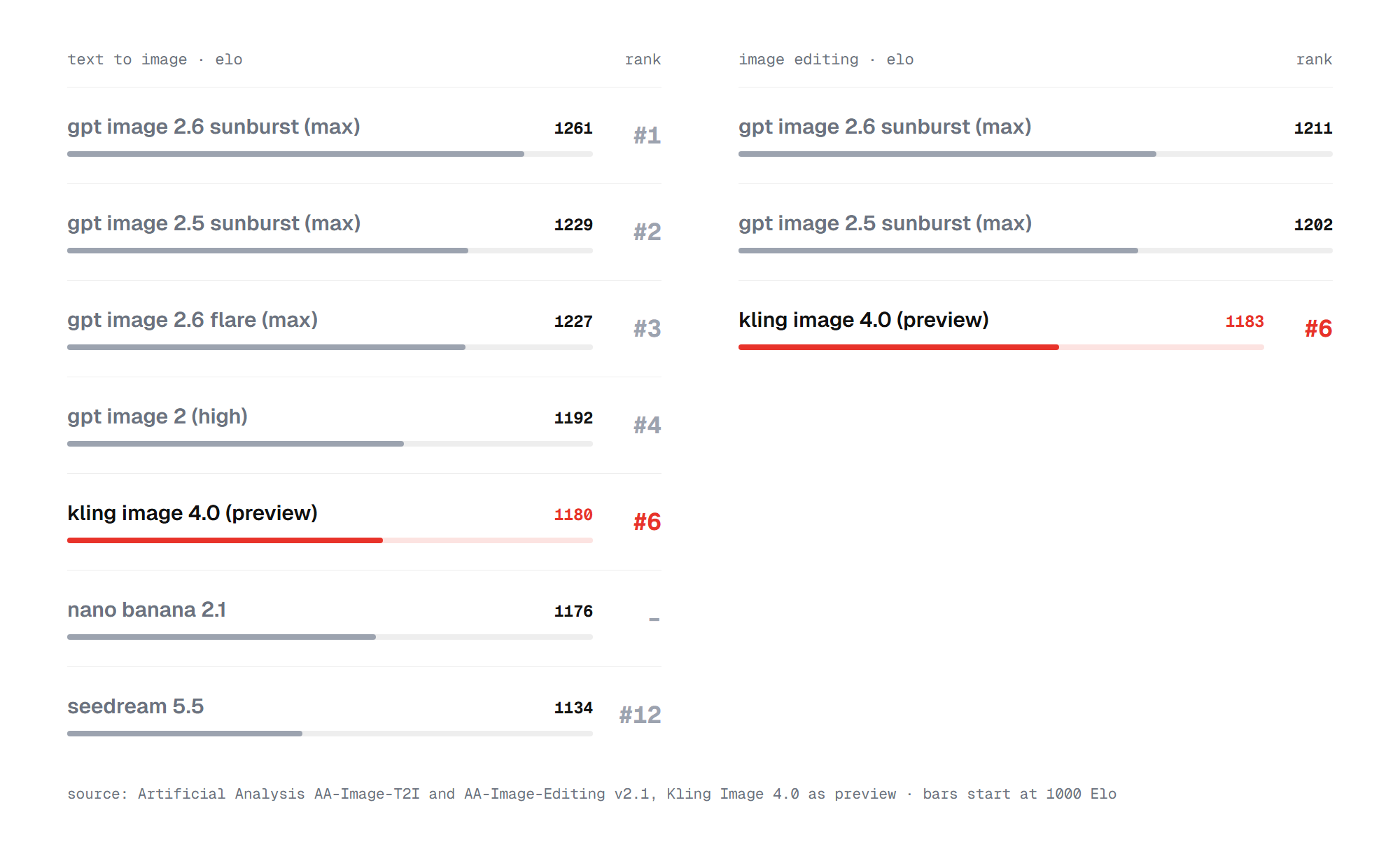
The gap to the top four is real. All of them are OpenAI models: GPT Image 2.6 Sunburst, GPT Image 2.5 Sunburst, GPT Image 2.6 Flare and GPT Image 2. Kling does edge out Google's Nano Banana 2.1 at 1176. It also sits well above ByteDance's Seedream 5.5 at 1134. We compared that model with OpenAI and Google rivals in our Seedream 5.5 vs GPT Image vs Nano Banana test.
Kling points to one category where it does better. It says its text-to-image results rank third for UI and UX design, which fits the focus on layouts and long pages. On Design Arena, another blind-vote board, the model debuted 13th in image editing with 1247 Elo and 14th on the image board with 1279.
These are early numbers for a preview build, and they will move as votes come in.
Where Kling Image 4.0 falls short
Realism is the headline claim, and it is also where the first complaints landed. Under Kling's launch post, some users wrote that the faces still look generated. Others asked the question every image model faces: does the same character stay consistent across ten frames, or only in curated demos? Kling answered by pointing to the batch feature, but it published no consistency benchmark.
There are a few more limits to keep in mind:
- Vendor claims. The 8K "industry first", the 2,000-character limit and the realism claims come from Kling. No independent test has checked them yet.
- Language list. Text rendering covers seven languages, so Cyrillic and most European alphabets beyond English, Spanish and Portuguese are not officially supported.
- Price. At about $0.063 per image, Kling Image 4.0 costs more than twice as much as Kling's earlier image models.
None of these rule the model out, but they shape where it fits best.
Is Kling Image 4.0 worth trying
Yes, if your work is posters, product pages or storyboards. The 8K output, the long-page mode and the 10-image sets solve real production chores. Few rival models offer this combination in one API. For a single photorealistic image, OpenAI's GPT Image models still win more blind votes, and they are the safer default. If you already use Kling 4.0 for video, Image 4.0 is the natural tool for planning the frames first.
FAQ
When was Kling Image 4.0 released?
Kling AI released Kling Image 4.0 on November 17, 2026. It is available in the Kling app and through the API, including on fal.
Does Kling Image 4.0 really generate 8K images?
Yes. The API offers 2K, 4K and 8K output, and Kling says 8K is rendered natively, not upscaled. No independent test of that claim exists yet.
How much does Kling Image 4.0 cost?
On fal, one 4K image costs $0.063 and one long image at 2K costs $0.235. Kling has not announced separate 8K prices.
How many images can it make from one prompt?
Up to 10 related images in one set, with the same subject and style. In single mode, one request returns up to 9 independent images.
Which languages does the text rendering support?
English, Japanese, Korean, Spanish, Portuguese, and simplified and traditional Chinese, with up to 2,000 characters per image.
How does Kling Image 4.0 rank against GPT Image and Nano Banana?
On Artificial Analysis, the preview version is sixth in text to image with 1180 Elo. It trails four OpenAI GPT Image models and edges out Google's Nano Banana 2.1 at 1176.
Sources
- Kling AI's announcement on X – November 17, 2026
- Kling AI launches Kling Image 4.0 with photographic realism and native 8K generation, Media OutReach Newswire – November 17, 2026
- Kling Image V4 text to image on fal
- Kling Image V4 long image on fal
- AA-Image-T2I v2.1 leaderboard, Artificial Analysis
- AA-Image-Editing v2.1 leaderboard, Artificial Analysis
- Pandaily on Design Arena rankings, X – November 17, 2026