Felix Laurent

Liquid AI has released d1.3-ultra, its most capable decision model so far. The company announced it on X on November 27, 2026, eleven days after d1.2-ultra. Liquid says the new model was "recursively improved" from d1-ultra, its first ultra model from October, but it has not explained what that process involves.
The model leads the Artificial Analysis Decision Index v2.1 with a score of 76.4, according to Liquid. It also adds three new kinds of answers: rankings, values read from pictures and audio, and time spans in recordings.
What d1.3-ultra changes
A decision model does not write text. It takes a document, picture or recording plus a set of typed questions, and returns each answer with a probability. That makes it cheap and fast for routing, extraction, moderation and other structured decisions. OpenAI and Google launched their own decision APIs this fall.
Liquid lists four improvements over d1.2-ultra. The model makes better decisions across the company's internal suite of more than 100 benchmarks. It is better at decisions that must follow a policy, a guide or a contract. On knowledge and hard questions, it declines to answer more often when it is unsure.
The fourth change is wider training data. Liquid says d1.3-ultra saw real scanned documents, receipts, tables, long reports, dates in local formats and more languages. It was also trained to treat instructions planted in the input as data. That is a defense against prompt injection, where a document tries to give the model orders.
Liquid has not published a blog post, a technical report or its own benchmark tables for d1.3-ultra yet. The new answer types are described only in the announcement.
New answer types in d1.3-ultra
Rankings are the first addition. The model can order a set of options, or return only the top k of them. That suits tasks like picking the best match for a support ticket or sorting candidates by fit.
Extraction now works on pictures and audio as well as text. The model can read a number or a date straight from an image or a clip. Liquid's examples are a total on a receipt and a date heard in a recording.
Spans, which d1.2 introduced for finding passages in text, now cover audio too. The model can say where in a clip something is said, with start and end times. That helps with call reviews, compliance checks and searching long recordings.
These features matter only if the model holds up on independent tests.
How d1.3-ultra scores on the Decision Index
Artificial Analysis runs the Decision Index on six evaluations. Document decisions and extraction carry the largest weight, at 30%. Job-task judgement, knowledge, hard reasoning questions and answer consistency take 15% each, and tool calling 10%. Each answer earns points for being right and loses points when the model's confidence does not match its accuracy.
On the index page, d1.3-ultra shows 76, one point above d1.2-ultra's 75. The lead is narrow, though. Bison 31B also rounds to 76, so the first place rests on Liquid's decimal figure of 76.4. Drex Max v1.1, SubQ Snap 1.2 and GLiDE v1.2 follow at 73.
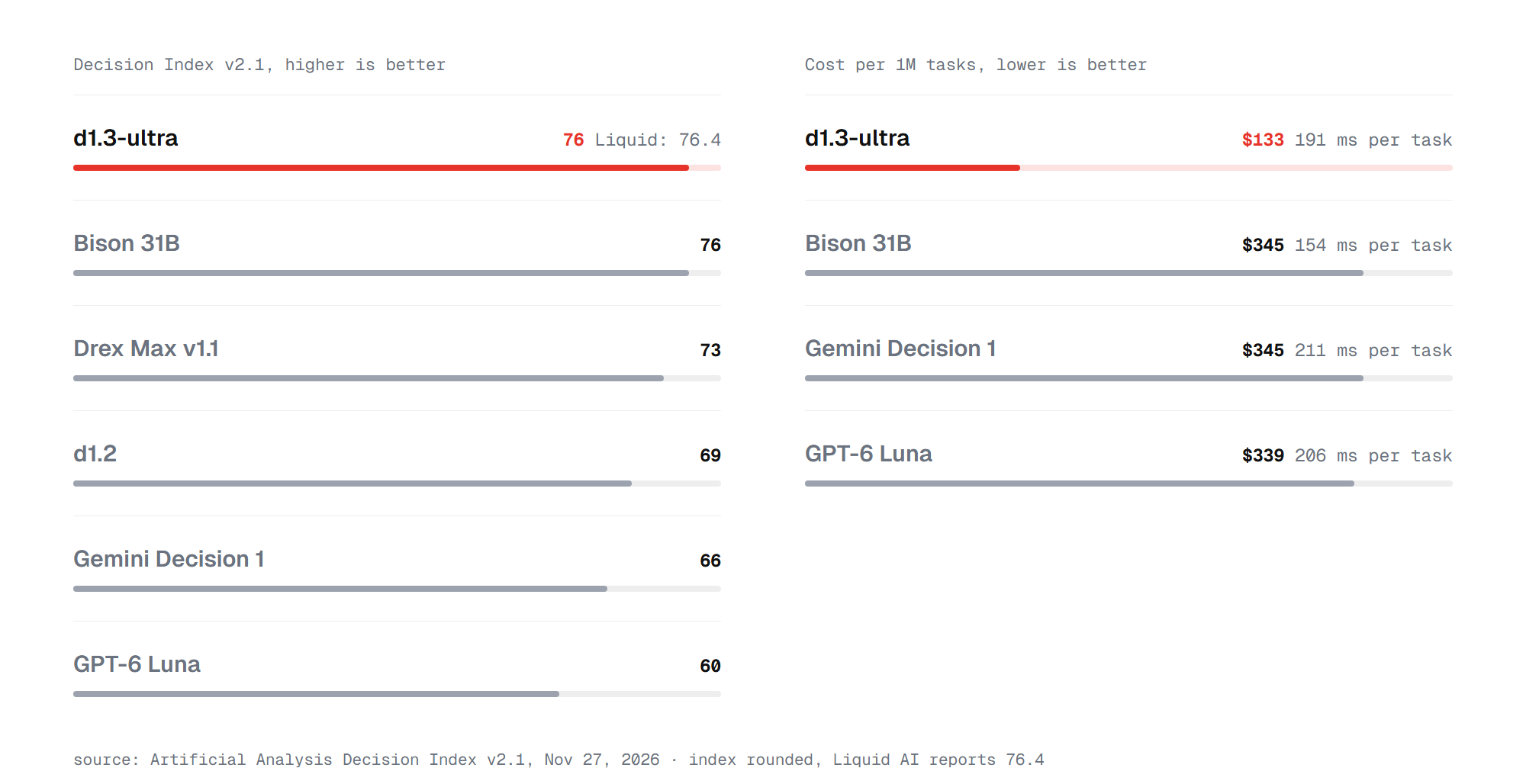
The big-lab APIs trail by a wide margin. Google's Gemini Decision 1 scores 66, and OpenAI's GPT-6 Luna in the Decisions API scores 60. Liquid's own cheaper d1.2 sits at 69.
The two leaders win in different places. On AA-Paperclip, the document test with the largest weight, d1.3-ultra scores 77 against 73 for Bison 31B. Bison 31B leads on most of the other tests and has slightly better calibration, with a Brier score of 0.14 against 0.15.
Cost is where d1.3-ultra pulls ahead. Running the full index costs $133 per million tasks with d1.3-ultra and $345 with Bison 31B. Bison 31B answers faster, though, at 154 milliseconds per task against 191.
How to use d1.3-ultra
The model is available now in the Liquid Console. OpenRouter and Vercel support is coming soon, according to Liquid. The company has not listed a price for d1.3-ultra on its pricing page yet.
The index cost of $133 per million tasks matches d1.2-ultra exactly. That suggests the price stays at $0.042 per million input tokens, with free output, but Liquid has not confirmed it. The decision model docs still list d1.2-ultra as the latest release.
Liquid has not published a migration note for teams already on d1.2-ultra. Its docs advise calibrating every decision threshold on data from your own use, and that applies to an upgrade too.
Is d1.3-ultra worth switching to
For teams that already run d1.2-ultra on documents, receipts and reports, yes, it is worth a test. The upgrade targets exactly the messy inputs that break decision models in production, and the cost per task has not changed. Resistance to planted instructions is a useful bonus for anyone feeding the model untrusted documents.
The headline claim needs a footnote. The index lead over Bison 31B comes down to decimals, and Bison 31B is better calibrated and faster. Liquid's other claims, including the 100+ internal benchmarks, have no published numbers yet. The new rankings and audio features are the most practical news here, so check them on your own data before you move production traffic.
Sources
- Liquid AI on X – November 27, 2026
- Artificial Analysis Decision Index v2.1 – November 2026
- d1-ultra: Introducing the world's best decision model, Liquid AI – October 15, 2026
- Decision models, Liquid AI docs – November 2026
- Pricing, Liquid AI – November 2026