
 Felix Laurent
AI models that were trained to forget how cyberattacks work mostly still know, according to new research from the Anthropic Fellows Program. The study tested 23 language models after "unlearning", a family of methods meant to erase hazardous knowledge. In 14 of them, the correct answer to most cyber questions the original model knew still got the highest probability.
The study was written by Jasmine Shone and Lisa Dunlap and published on Anthropic's Alignment Science blog on November 23, 2026. The authors conclude that most of the unlearning methods they tested "appear to hide hazardous knowledge rather than remove it". The tool they used to show this is the model's own neurons.
What unlearning is meant to do
AI labs worry that models can help attackers with cyberweapons or biological threats. Unlearning tries to remove such knowledge from a model after training while keeping its other skills. Researchers usually test it on WMDP, a benchmark of multiple-choice questions on hazardous topics. Its cyber section has 1,987 questions. With four answer options, a model that guesses gets about 25% right. A model that scores near that level after unlearning looks as if it has forgotten the topic.
The authors checked whether that picture holds. They collected 20 public unlearned versions of Zephyr-7B, Llama-3-8B and Llama-3.1-8B and trained three more themselves. The checkpoints cover more than a dozen methods, including RMU, circuit breakers, ELM, gradient ascent, NPO and TAR.
Instead of asking the model to pick a letter, they checked which full answer it found most likely. The authors chose this test because a model can miss the letter for reasons other than not knowing the fact.
Unlearned models still rank the right answers first
Most models failed this test. In 14 of the 23 models, the correct answer still ranked first for most of the questions the original model had answered correctly. That held even where the WMDP-cyber score had dropped close to chance.
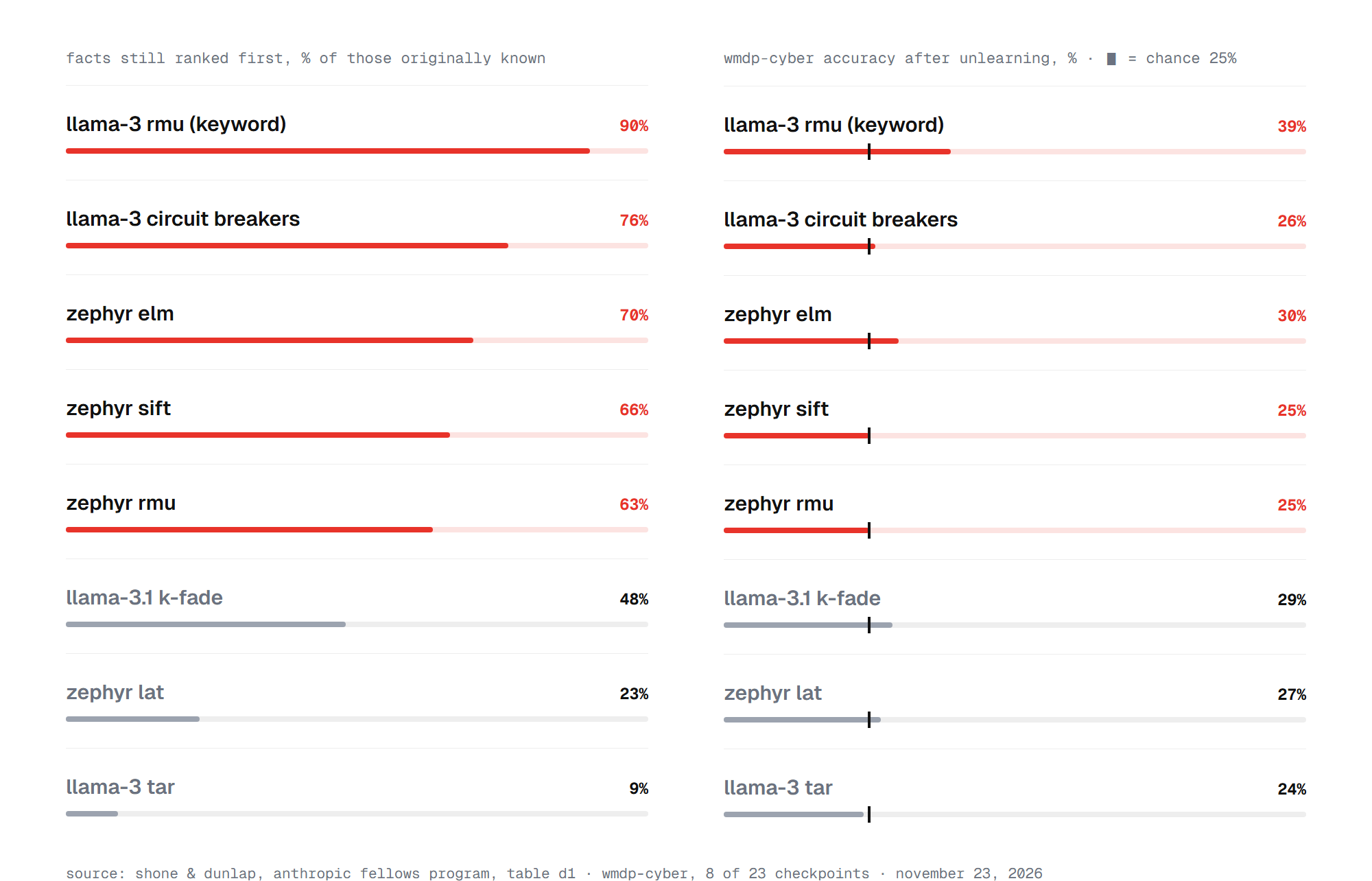
A Zephyr model unlearned with RMU, one of the most widely used methods, scored 25% on WMDP-cyber, the chance level. Yet it still ranked 63% of the facts it used to know first. A Llama-3 model with circuit breakers scored 26% and still ranked 76% first. One Llama-3 RMU checkpoint kept 90%.
Some methods did erase more. TAR left only 9% of the facts in first place, and a LAT checkpoint 23%. The authors' own K-FADE checkpoints kept between 30% and 48%. But even the K-FADE result did not hold up. Removing a single direction that unlearning had added inside the model brought the share of facts ranked first back to 72% to 82%.
The neurons explain why the knowledge survived.
How neurons reveal the hidden knowledge
The study treats each neuron in a model's feed-forward layers as a small switch. It fires on certain text and pushes the model's output in one direction. The authors compared every neuron in an unlearned model with the same neuron in the original.
In the methods that score best on WMDP, a few neurons changed sharply. They fire 20 to 100 times more strongly on cyber text after unlearning. Their job is to add noise that throws the answer off, while the facts themselves stay in place. The authors describe the result as a backdoor: cyber text triggers a few neurons, and those neurons derail the answer.
Undoing that is cheap. The models have about 460,000 neurons each. The authors restored a few dozen of the most changed ones to their original state. That brought back about half or more of the lost facts in circuit breakers, K-FADE, RMU-LAT and most RMU checkpoints. Other methods, such as gradient ascent, NPO and TAR, work differently. The model still computes the right answer, and the method suppresses it at the output.
The authors say this would explain an earlier finding by other researchers. Unlearned knowledge tends to return after a little fine-tuning.
Why post-training unlearning may not work
The deeper problem is how models store facts. The authors found no single "cyber circuit" to remove. In Llama-3.1-8B-Instruct, they found a neuron that separates cyber exploit text from similar text almost perfectly. Switching it off, alone or with five connected neurons, left the model's WMDP-cyber accuracy unchanged.
Facts are recalled through many neurons, and the same neurons serve many unrelated topics. The companion post gives an example: one neuron responds to "John" both in John the Ripper, a password-cracking tool, and in the Gospel of John. Deleting such neurons would damage unrelated knowledge.
From this the authors draw their main conclusion. A method applied after training may never make a model truly forget cyber knowledge, they write. Its effect may not extend beyond the examples it was trained to forget. They argue that approaches that isolate knowledge during training may be necessary instead. They cite gradient routing, which steers a topic's learning into separate parts of the model, and work on knowledge localization.
Neurons as a safety tool
Unlearning is one part of a broader study on how neurons can serve safety work. A companion post argues that individual neurons are easier to interpret than earlier research assumed. This post tests the idea on practical tasks in open-weight models:
- Harmful text detection. Neurons picked without labeled data beat text search on 11 of 16 safety test sets. They matched or beat classifiers trained on 40 labeled examples on 7.
- Steering. On Llama-3.1-8B-Instruct, adding neuron outputs produced target behaviors about 21% of the time, close to 21.4% for trained steering vectors. A well-written prompt still did better.
- Auditing. Claude Opus 5.5 auditors looked for hidden behaviors in 58 fine-tuned models. They found them in 40% of audits with model outputs alone and 75% with neuron readouts.
The authors also list limits. Neuron detectors could not separate harmful cyber text from harmless security news. The models in the auditing tests were mostly short fine-tunes. Longer training, such as full post-training, may build new features instead of reusing old ones, and the authors have not tested it. The results come from a blog post and have not been peer reviewed.
The study adds to a growing body of AI safety evaluation work that questions how much standard benchmarks prove.
Does AI unlearning actually remove dangerous knowledge?
For most of the methods tested, no. The study shows that a near-chance WMDP score can hide a model that still knows the answers. In many cases the knowledge is masked by a few dozen neurons that can be found and reset. That matters for anyone who relies on unlearning to make open-weight models safe to release, because weights can be fine-tuned and inspected. Methods such as TAR and LAT erase more, though even TAR still ranked 9% of the facts first. The authors' advice is to keep hazardous knowledge separate while training the model, rather than trying to delete it afterwards.
Sources
- Returning to the neuron basis for interpretability, part 2: using neurons for safety applications, Anthropic Alignment Science blog – November 23, 2026
- Returning to the neuron basis for interpretability, part 1: answering three objections, Anthropic Alignment Science blog – November 23, 2026
- The WMDP benchmark: measuring and reducing malicious use with unlearning, arXiv – March 2024
- Gradient routing: masking gradients to localize computation in neural networks, arXiv – October 2024
- Rohan Paul on X – November 26, 2026