 Felix Laurent

Liquid AI released d1.2 and d1.2-ultra on November 16, two decision models that now accept audio as well as text and images. d1.2-ultra scored 75 on the Artificial Analysis Decision Index v2.1, two points above the previous leader, Nace.AI's Drex Max v1.1. That puts it in first place among the decision models the independent benchmark tracks.
The update also adds five new types of answers, from reading a value off an invoice to drawing boxes around objects in a photo. Prices stay low: $0.042 per million input tokens for d1.2-ultra and $0.02 for d1.2, with no charge for output.
To see why those numbers matter, it helps to know what a decision model is.
What a decision model is
A decision model does not write prose. You give it an input, such as a document, a picture or a recording, and a set of typed questions. It returns typed answers, each with a probability that says how sure it is. A support ticket can come back as "refund, 0.94," for example, and nothing downstream has to parse a chat reply.
The category took shape this autumn. OpenAI made its Decisions API generally available in October, and Google followed with the Gemini Decisions API in November. Perplexity, TypeSafe with Jev, Nace.AI and several startups have their own. Liquid entered with d1 and released d1-ultra in October.
The probability is the main selling point. Suppose a model says 80% and is right about 80% of the time. Then you can set a threshold and send only the low-confidence cases to a person. Artificial Analysis builds that idea into its index.
Artificial Analysis Decision Index results
The Decision Index v2.1 is a weighted average of six evaluations. They cover document extraction, job-task decisions, tool-call routing, factual knowledge, hard multiple-choice questions and answer consistency. Each answer earns points for being right and loses points when the model's confidence does not match how often it is right.
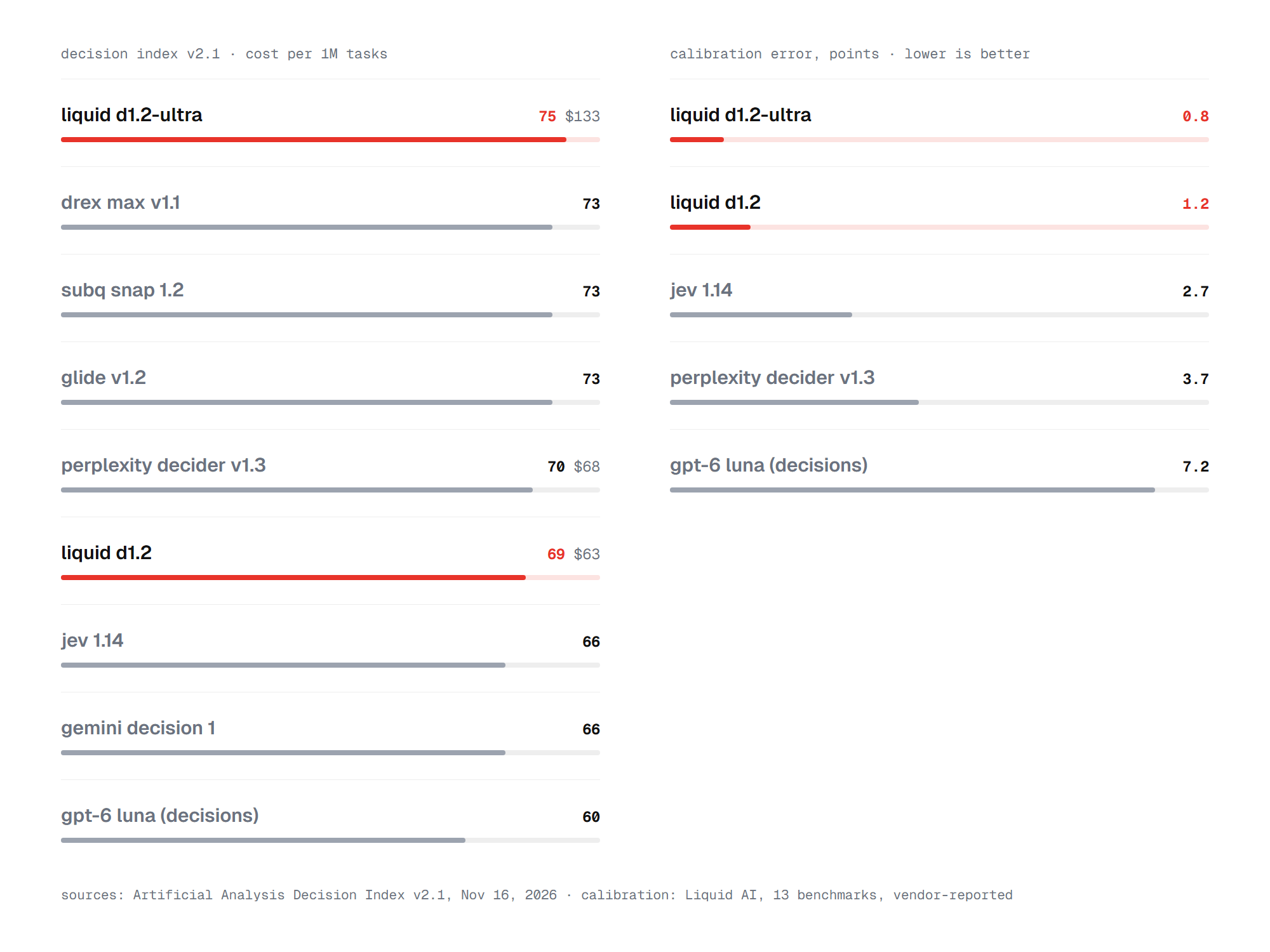
Artificial Analysis reported these results for the new models:
- d1.2-ultra scores 75, four points above d1-ultra. It also leads AA-Paperclip, the private document benchmark with the largest weight in the index, with 76, three points ahead of Drex Max v1.1.
- d1.2 scores 69, three points above d1.1. It sits just behind Perplexity's Decider v1.3 at 70.
- Big lab APIs trail both. Gemini Decision 1 scores 66, and GPT-6 Luna on OpenAI's Decisions API scores 60.
Cost matters as much as rank here. Running the full index costs $133 per million tasks with d1.2-ultra and $63 with d1.2. Both models sit on the Pareto line of quality against cost, so no model in the chart scores more for the same money. GLiDE v1.2 scores 73 but costs about six times as much as d1.2-ultra, and Gemini Decision 1 costs more than either Liquid model.
Liquid ran its own test on the probabilities as well.
Calibration: how honest the confidence is
Calibration error is the gap between the probability a model states and how often it turns out to be right. Liquid measured it on 13 benchmarks and 22,505 questions that all five models answered.
| Model | Calibration error, points |
|---|---|
| Liquid d1.2-ultra | 0.8 |
| Liquid d1.2 | 1.2 |
| TypeSafe Jev 1.14 | 2.7 |
| Perplexity Decider v1.3 | 3.7 |
| OpenAI GPT-6 Luna (Decisions API) | 7.2 |
On these numbers, an 80% answer from d1.2-ultra is right very close to 80% of the time. GPT-6 Luna's stated confidence is off by several points on average, which makes its thresholds less reliable. This test is Liquid's own, though Artificial Analysis also scores confidence inside its index.
The new task types are where d1.2 changes the most.
Five new tasks in the Liquid API
Earlier d1 models mostly picked one option from a list. d1.2 and d1.2-ultra add five new kinds of answers on the same API endpoint:
- Read a value. Ask "How much is due?" about an invoice and get the text, number or date, plus the characters it was read from. If the value is missing, the model answers "not found" instead of guessing.
- Find every passage of a kind. Ask for all personal data in a note and get each name, phone number and email with its position in the text.
- Locate things in a picture. One bounding box for a single object, such as a signature on a form, or a box for every instance plus a count.
- Estimate a number. Ask how many people are in a photo and get a best guess with a range, for example 12, between 10 and 14.
- Pick every option that applies. A support message about a late parcel and a double charge can come back as both "delivery" and "billing," each with its own probability.
Liquid published accuracy for these tasks on held-out splits of public datasets. These are vendor numbers, since no public benchmark covers the new tasks yet.
| Task (dataset) | d1.2-ultra | d1.2 |
|---|---|---|
| Receipt value reading (CORD, SROIE) | 98% | 96% |
| Object localization (RefCOCO family) | 94% | 94% |
| Counting within one (COCO) | 93% | 92% |
| PII passages, precision (Nemotron PII) | 94% | 92% |
| Pick every object present (COCO) | 87% | 90% |
The same box-and-count answers already run on Liquid's small open model. In its LFM3 launch demo, d1-2B tracks a face, hands and a phone in a live webcam feed.
Audio is the other new input.
d1.2 audio input and pricing
Both models accept audio in two ways. The recording can be the thing you ask about, such as which language a caller speaks or whether a siren is audible. The question itself can also be spoken instead of typed. Liquid reports 95% to 97% accuracy for sound identification on ESC-50 and for language identification across 43 languages on FLEURS. It has not published limits on recording length or format. The Artificial Analysis listing still shows text and image input with a 64K-token context window.
Pricing is input-only:
| Model | Input price per 1M tokens | Output |
|---|---|---|
| d1.2-ultra | $0.042 | free |
| d1.2 | $0.02 | free |
Images cost 1.5 tokens per 32×32 patch, so a 1024×1024 picture is 1,536 tokens. Liquid also changed billing. A request now pays for its text and images once, and each extra question adds only its own text. Previously d1-ultra billed the image again for every question, which made long question lists on one scan expensive.
The models are live on Liquid's API and playground under the names d1.2-ultra and d1.2. Liquid says OpenRouter and Vercel support is coming soon. When users asked for open weights, Liquid replied that an equally strong open version will follow, without a date.
Developers already run Liquid's small d1-2B model locally. Ivan Fioravanti showed it answering in about 66 ms on a MacBook Pro with an M5 Max. His app reads hand gestures and facial expressions from each frame and returns probabilities without generating a single token. On the Neural Engine, it slows to 197 ms but draws only 37 W.
The first place has a few weak spots worth knowing.
Where d1.2-ultra is weaker
The index rewards models that admit uncertainty, and d1.2-ultra plays that rule hard. OrcaRouter broke down the Artificial Analysis data for each test. On HLE-MultiChoice, d1.2-ultra answers only 2.36% of questions correctly, last of the 24 decision models on raw accuracy. Its decision score there is still mid-table because it rarely claims confidence it does not have. The smaller d1.2 knows more on hard trivia, with 5.30% on the same test.
Three more limits apply:
- Narrow wins. Drex Max v1.1, SubQ Snap 1.2 and GLiDE v1.2 all sit two points behind. A future update from any of them can retake first place.
- Vendor numbers. The task accuracy and calibration tables come from Liquid. Only the index scores are independent.
- Private benchmark. AA-Paperclip uses 1,500 private documents, so outsiders cannot inspect what it rewards.
For most teams the question is simpler than the leaderboard.
Is d1.2-ultra worth switching to
For document extraction, routing and moderation pipelines, yes, it is worth a test. d1.2-ultra has the best independent score in its class and the lowest calibration error in Liquid's test. Its input price also stays tiny next to general chat models. d1.2 gives almost the same calibration at less than half the cost per task.
The case is weaker if you need raw knowledge on hard questions or audio at scale, since those parts are less tested. The new span, box and range answers are the real change, because they replace custom extraction code with one API call. Run them on your own documents and check where the confidence threshold lands before you move production traffic.
FAQ
What are Liquid AI d1.2 and d1.2-ultra?
They are decision models from Liquid AI, released on November 16, 2026. They take text, images and audio and return typed answers with calibrated probabilities instead of generated text.
How does d1.2-ultra rank on the Artificial Analysis Decision Index?
It is first with 75 on version 2.1, two points ahead of Drex Max v1.1, SubQ Snap 1.2 and GLiDE v1.2. d1.2 scores 69.
How much do Liquid's decision models cost?
d1.2-ultra costs $0.042 and d1.2 costs $0.02 per million input tokens. Output is not billed. On the full Artificial Analysis index, that comes to $133 and $63 per million tasks.
What is calibration error?
It measures the gap between the confidence a model states and how often it is right. In Liquid's test, d1.2-ultra's error is 0.8 points, compared with 7.2 for GPT-6 Luna on OpenAI's Decisions API.
Are d1.2 weights open?
Not yet. Liquid says an open version will come later and has not given a date. Earlier small d1 models such as d1-2B already run locally.
Sources
- Liquid AI's post on X – November 16, 2026
- d1.2: State-of-the-art omnimodal decision models, Liquid AI – November 16, 2026
- Artificial Analysis post on d1.2-ultra and d1.2 – November 16, 2026
- d1.2-ultra tops the Decision Index at 75, last on HLE, OrcaRouter – November 2026
- Liquid AI's LFM3 announcement with the d1-2B demo on X – October 27, 2026
- Ivan Fioravanti's d1-2B test on X – November 16, 2026
- Liquid AI decision models documentation