Felix Laurent

Google's Gemini Decisions API now works inside the tools developers already use. On November 13, 2026, Google for Developers listed integrations with LangChain, Pipecat, OpenRouter, the Vercel AI SDK and Vercel's AI Gateway. All of them added the new Gemini Decision 1 model within two days of its launch.
Google introduced the Decisions API on November 11. It is a separate endpoint for quick, bounded choices: routing a request, picking a tool, checking a policy or grading an answer. Gemini Decision 1 does not write a reply. It scores a fixed set of options and returns a probability for each one, so the output costs nothing.
What the Gemini Decisions API does
A request has two parts: one shared input and a list of questions about it. The input can mix text, images, audio, video and PDFs, up to 256K tokens. A single request can carry up to 1,000 independent questions, and the model answers all of them in one forward pass.
There are three question types.
| Question type | What it returns | Example use |
|---|---|---|
noul (yes/no) | probability that a condition holds | "Is there a liquid spill on the counter?" |
choice | the winning option and probabilities for 2 to 255 options | which tool or model should handle a request |
score | a weighted score on an ordered rubric | how severe a problem is, from 0 to 2 |
Every answer comes with a confidence score from 0 to 1. Google's idea is that code reads that number and sends unclear cases to a fallback model or a human reviewer. In Google's own example, the model sees a photo of a breakroom counter and a short note. It finds a spill with 0.95 confidence and picks "wipe with cloth" as the next step. It rates the severity 1.19 out of 2.
The model ID is gemini-decision-1. It runs through the Gemini API in Google AI Studio, with Python, JavaScript and REST guides. Support in Gemini in Google Cloud is listed as coming soon.
Since November 13, developers can also call it from tools they already use.
Where developers can use Gemini Decision 1
Most of the partners shipped support on launch day. Google's blog post also names LiteLLM, Pydantic AI, LiveKit and OpenCode as integrations that are rolling out.
| Tool | What it added | Date |
|---|---|---|
| OpenRouter | Gemini Decision 1 as a model, with a 262K context | November 11 |
| Vercel AI Gateway | the model as google/gemini-decision-1 | November 11 |
| Vercel AI SDK | calls to the Decisions API from the SDK | November 11 |
| LangChain | day-zero support; Gemini and TypeSafe classifiers share one base class, so the same middleware takes either | November 11 |
| Pipecat 1.16 | PerceptionReader, which reads tone from streamed voice audio | November 12 |
The Pipecat integration shows a use that text-only classifiers cannot cover. Pipecat is an open-source framework for voice agents. Its new PerceptionReader streams the user's audio to Gemini Decision 1 and gets back a read on tone, prosody and even sarcasm. Pipecat's Jon Taylor wrote that "how someone speaks can matter just as much as what they say." He added that voice agents have mostly been missing that signal.
Fast support from these tools matters because a decision call usually sits inside an existing agent loop. A developer can swap the model behind a router or a guardrail without rewriting the app.
So how good is the model at those decisions?
How Gemini Decision 1 scores on benchmarks
Google compared Gemini Decision 1 with three rivals. TypeSafe's Jev 1.14 is a dedicated decision model. GPT-6 Luna runs through OpenAI's Decisions API. Gemini 3.5 Flash-Lite is a regular generative model, called through Google's Interactions API with minimal thinking.
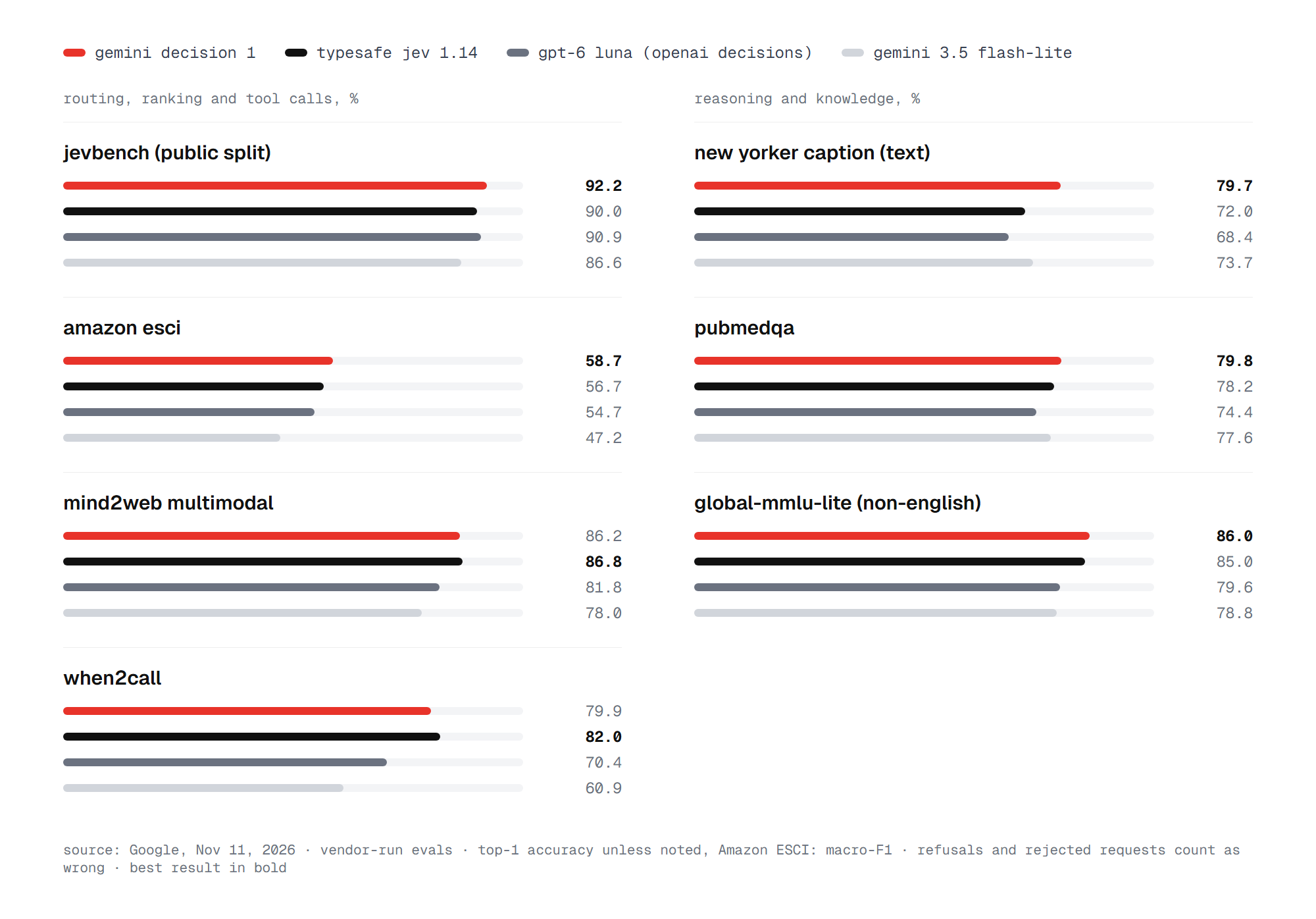
Gemini Decision 1 leads on five of the seven evals that all four models ran. The biggest gap is on New Yorker captions, a test of picking the funniest caption for a cartoon. There it scores 79.7% against 72.0% for Jev. TypeSafe's Jev wins on Mind2Web, a web agent test, and on When2Call, which checks whether a model knows when to call a tool. Those two tests are the closest to agent routing, so Jev remains a serious option there.
Google also ran two tests the rivals did not take: MMAU for audio, where Gemini Decision 1 scored 71.8%, and Video-MME without subtitles, at 69.1%. These are vendor-run numbers, so independent tests may differ.
Accuracy is only one part of a routing decision. Price and calibration matter just as much.
Gemini Decision 1 price and speed
Gemini Decision 1 costs $0.10 per 1M input tokens and nothing for output. The shared input is billed once per request, however many questions come with it. Each extra question adds only its own instruction tokens. There are no separate charges for thinking tokens, audio transcription or OCR. Google AI Studio also has a free tier for prototyping.
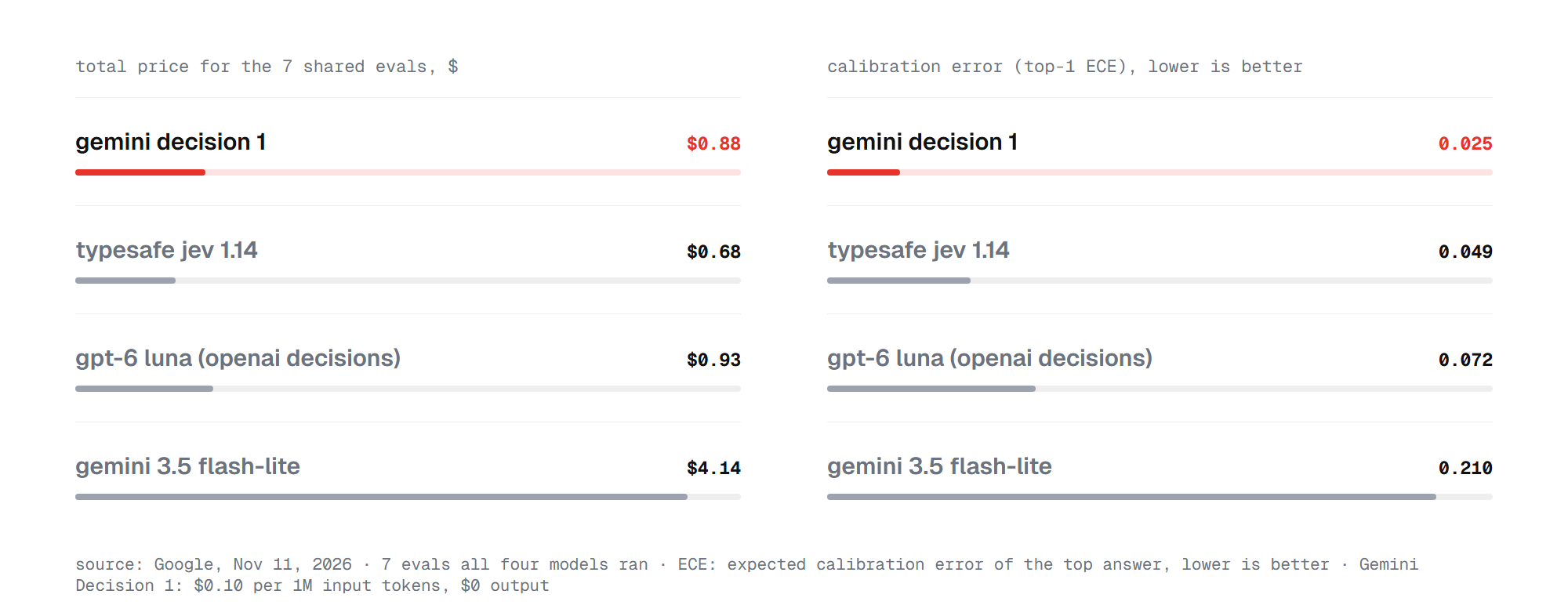
On the seven shared evals, Gemini Decision 1 cost $0.88 in total. That is less than OpenAI's Decisions API at $0.93 and nearly 5x cheaper than Gemini 3.5 Flash-Lite at $4.14. TypeSafe's Jev was the cheapest at $0.68.
Calibration is where Google's model stands out. Its calibration error is 0.025, half of Jev's 0.049. When a well-calibrated model reports 90% confidence, it is right about 90% of the time. That makes the confidence threshold for sending a case to a human much more reliable.
Speed is the other selling point. Google says median model compute takes 50 to 100 ms, or 150 to 250 ms end to end. Latency stays nearly flat between 1 and 100 questions per request, for contexts up to 16K tokens.
Google has already put those numbers to work in its own products.
How Google uses the Decisions API
Google says several of its teams use the Decisions API as a fast control layer instead of training custom classifiers.
- Gemini Notebook routes each query to the right model tier and thinking level. Everyday questions are served with up to 40% lower latency, while hard ones still go to deep reasoning models.
- Stitch, Google's design tool, uses it in a new rapid canvas experiment. It builds playable wireframes of a product flow in seconds and applies voice or tap edits almost instantly.
- CC from Google Labs picks an emoji reaction from more than 200 options in a fraction of a second.
- Google Search uses it as a safety layer for MCP tools, catching adversarial behavior within its latency limits.
Those are Google's own examples. The bigger question for most developers is how the API compares with OpenAI's.
Gemini Decisions API vs OpenAI Decisions API
OpenAI got there first. Its Decisions API entered public beta on October 6 and became generally available on October 22. The two products look similar on paper.
| Gemini Decisions API | OpenAI Decisions API | |
|---|---|---|
| Model | Gemini Decision 1 | GPT-6 Luna |
| Launch | November 11, 2026 | beta October 6, GA October 22, 2026 |
| Price | $0.10 per 1M input tokens, $0 output | $0.10 per 1M input tokens, $0 output, as reported |
| Inputs | text, images, audio, video, PDFs | text and images |
| Questions per request | up to 1,000 | not published |
| Price on Google's 7 evals | $0.88 | $0.93 |
| Calibration error on Google's evals | 0.025 | 0.072 |
Audio and video input is the clearest difference. That is what makes the Pipecat voice demo possible. The benchmark gap comes from Google's own tests, so it needs independent checks before anyone treats it as settled.
Is the Gemini Decisions API worth trying
Yes, if an app or agent makes many small choices before it does real work. Routing, tool selection, content checks and grading are exactly the jobs where generating text is a waste. Gemini Decision 1 answers them in a fraction of a second for a tenth of a dollar per million input tokens. The low calibration error makes its confidence scores useful for deciding when to escalate to a human.
The caveats are the usual ones for a launch week. Every benchmark comes from Google. TypeSafe's Jev is cheaper and wins on the two agent-routing tests, and Google Cloud support is not there yet. One developer replying to Google's post summed up the economics. Decision models "only work as agent gates if the per-call cost rounds to zero, since they fire before every tool call," the developer wrote. With LangChain, OpenRouter and Vercel already supporting it, the cheapest way to check Google's claims is to run your own routing step through it.
FAQ
What is Gemini Decision 1?
It is Google's first decision model, released on November 11, 2026. Instead of writing text, it scores answer options for yes/no, multiple-choice and rubric questions and returns probabilities with confidence scores.
How much does the Gemini Decisions API cost?
$0.10 per 1M input tokens and $0 for output tokens. The shared input is billed once per request, and Google AI Studio has a free tier for prototyping.
Which frameworks support Gemini Decision 1?
OpenRouter, LangChain, the Vercel AI SDK, Vercel AI Gateway and Pipecat already support it. Google says LiteLLM, Pydantic AI, LiveKit and OpenCode support is rolling out, and Gemini in Google Cloud is coming soon.
Is Gemini Decision 1 better than OpenAI's Decisions API?
On Google's seven shared evals, Gemini Decision 1 beat GPT-6 Luna through OpenAI's Decisions API on accuracy, price and calibration. These are Google's own numbers, and no independent comparison has been published yet.
Sources
- Google for Developers' post on X – November 13, 2026
- Gemini Decisions API: fast, calibrated multimodal decisions, Google – November 11, 2026
- Google for Developers' launch post on X – November 11, 2026
- LangChain's post on X – November 11, 2026
- OpenRouter's post on X – November 11, 2026
- AI SDK's post on X – November 11, 2026
- Gemini Decision 1 now available on AI Gateway, Vercel – November 11, 2026
- Jon Taylor's post on X about Pipecat 1.16 – November 12, 2026
- PerceptionReader, Pipecat documentation
- Google enters decision model market with Gemini Decisions API, SiliconANGLE – November 11, 2026