
 Felix Laurent

Xiaomi has introduced Xiaomi Auto World Model 2.0. The AI model predicts how a driving scene changes in response to a car's or robot's actions. The company announced it on X on November 27, 2026. Xiaomi calls it a causal world model for assisted driving and embodied AI, meaning robots and other machines that act in the physical world.
The model generates video from one to seven cameras at once and rebuilds the scene in 3D. It was trained on 12.6 million video clips. Xiaomi says it already uses the model to create synthetic training data and run simulations for its cars.
What Xiaomi Auto World Model 2.0 does
A world model imagines what happens next. Given camera footage and an action, such as a turn of the steering wheel, it generates the following frames. Carmakers use such models to test driving software on situations that are rare or dangerous to film on real roads.
Xiaomi's team says version 2.0 goes "beyond video generation". It combines four tasks in one model:
- Multi-view video. It generates footage from up to seven cameras around a car, kept consistent across views.
- Control. It follows a camera path, a driving action or a scene layout given by the user.
- 3D reconstruction. A part called WorldRec 2.0 turns multi-camera footage into a 3D scene of static and moving objects in a single pass.
- Actions. What the model learns can be passed on to driving and robot control models.
The model works in a stream, producing video chunk by chunk as the scene unfolds. That lets it run long rollouts. On its project page, Xiaomi shows a seven-camera scene generated over about 45 seconds along a logged route. It then edits the route to explore a different future.
The first version, published in May, was built only for driving. It handled one or three camera views and was controlled by scene layout. Version 2.0 adds more cameras, robots and direct action control.
How the model was built and trained
The 12.6 million clips come from four groups. Xiaomi used 5.4 million driving clips, 3.6 million general videos from the web and 3.6 million robot clips. The rest is a smaller set of "physical causal" videos from simulation, generated footage and public sources. They show rare events and interventions, so the model learns cause and effect.
Training ran in three stages. The model first learned from single-camera video at 480p. Later stages added up to seven cameras and 540p resolution. In the last stage, Xiaomi trained it to generate in fewer steps and to roll out long videos.
Speed is what makes the model usable for simulation. Xiaomi replaced standard attention with a lighter version called gated linear attention. The company says this makes each chunk of video 3.72 times faster to generate, at the cost of a 2.3% worse image quality score.
The paper, by a team of 23 authors, describes how the model compares with rivals.
How Xiaomi Auto World Model 2.0 compares
All results come from Xiaomi's own paper and have not been tested independently. The model leads clearly in two areas: following a camera path and rebuilding scenes in 3D.
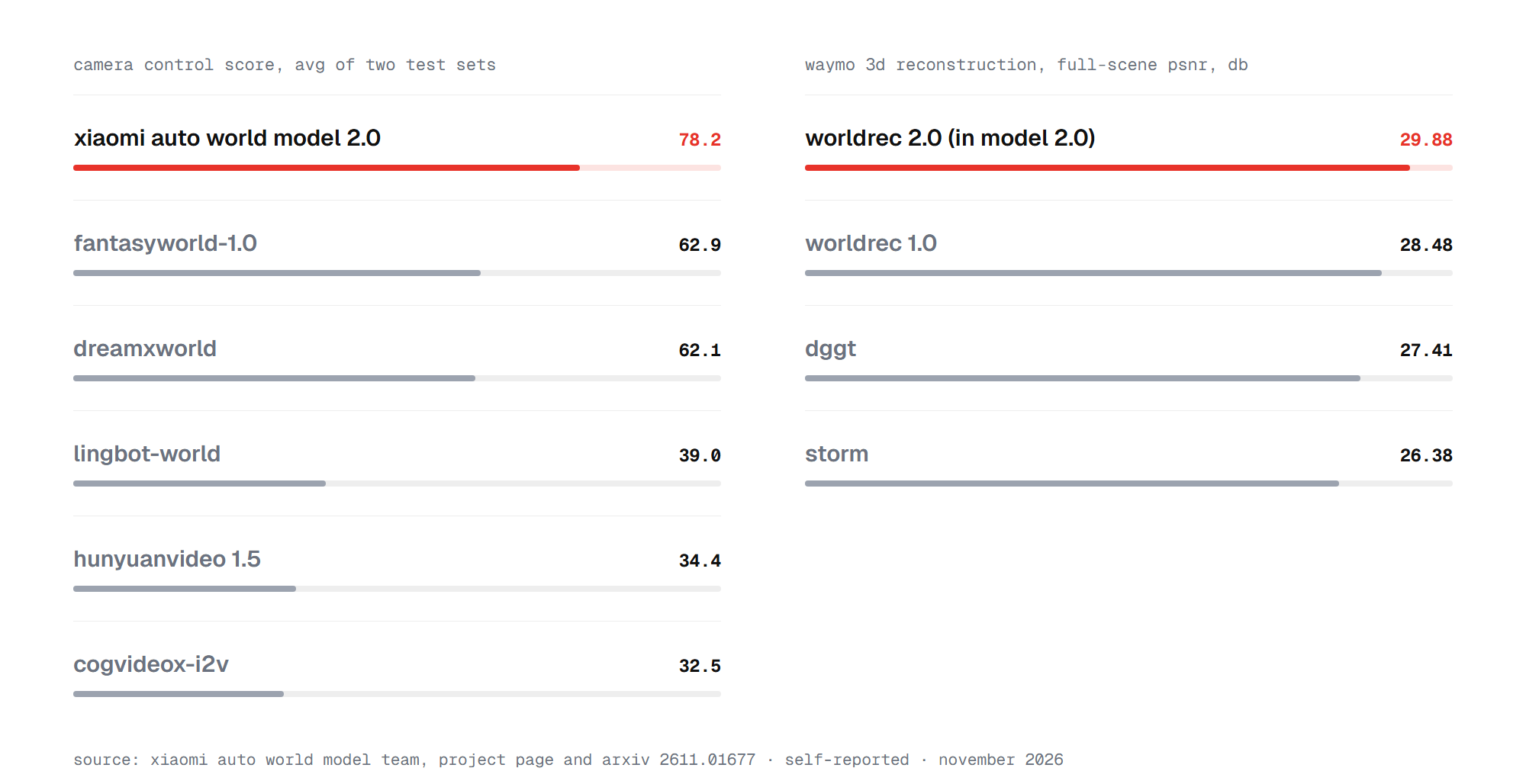
In camera control, it scored 78.2, ahead of FantasyWorld-1.0 at 62.9 and Tencent's HunyuanVideo 1.5 at 34.4. In 3D reconstruction on Waymo's driving data, WorldRec 2.0 reached 29.88 dB, up from 28.48 dB for the first version. Higher numbers mean a closer match to the real scene. It also estimated depth better than Nvidia's Cosmos models and other world models Xiaomi tested.
In other tests the picture is mixed:
- Video quality. On the PAI-Bench-G quality score, it scored 78.0 for driving and 77.1 for robot videos, a narrow lead over Alibaba's Wan 2.2 and HunyuanVideo 1.5.
- Short driving clips. Its image quality score, where lower is better, was 12.09 with one camera. That is worse than 6.90 for Vista, an older driving model.
- Robot world modeling. On TriWorldBench, it scored 64.79 and ranked below WoVR Plus and another model called CausalWM.
- Driving policy. Adding the world model to a driving planner raised its NAVSIM score by 0.4 points, to 95.3.
The planner result points to where Xiaomi wants to use the model.
How Xiaomi uses the world model
Xiaomi says the model "has been applied" to synthetic data generation and simulation at Xiaomi Auto. The paper describes three uses. The model tests driving software in a closed loop and trains it with reinforcement learning on generated futures. It also improves driving and robot control models.
In one test across 1,000 scenarios, a driving model trained with reinforcement learning inside the world model collided in 0.4% of cases. The comparison model collided in 1.2%. Xiaomi has not said which of its cars or driver assistance features use the results.
The company has also not released weights or code. Only the paper and the project page are public.
Xiaomi is one of many companies building world models for machines in the physical world. Nvidia offers its Cosmos models to carmakers and robot makers, and Google's Genie 4 generates interactive worlds. Most big labs are now building physical AI.
Is Xiaomi Auto World Model 2.0 a step forward?
For Xiaomi, yes. In six months the model went from a driving-only system with three cameras to one that handles seven cameras, robots and action control. Its strongest results are in camera control and 3D reconstruction, where it leads every model it was compared with. On video quality and robot tests it is close to rivals, and on some it trails. The bigger gains Xiaomi promises are in safer driving software, but they rest on a single internal test with no named car or feature. Until Xiaomi releases the model or shows it in its cars, version 2.0 is best seen as a strong research result.
Sources
- Xiaomi Auto World Model 2.0 announcement, Xiaomi on X – November 27, 2026
- Xiaomi Auto World Model 2.0 project page, Xiaomi Auto World Model Team – November 2026
- Xiaomi Auto World Model 2.0: causal world models for real-world driving and embodied intelligence, arXiv – November 1, 2026
- Xiaomi Auto World Model: a joint world model integrating reconstruction and generation for autonomous driving, arXiv – May 18, 2026