 Felix Laurent
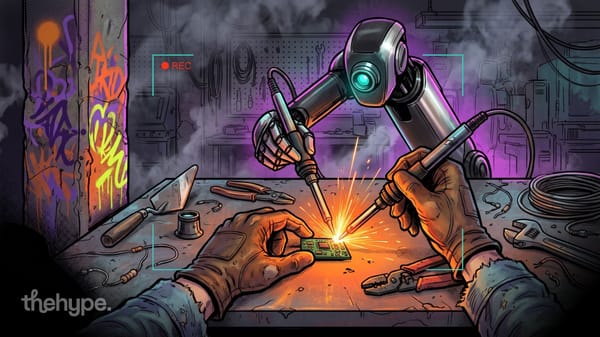
Hub, a startup that collects training data for robots, has released HubEgo-100K, an open dataset of first-person video of people doing skilled manual work. The first release went up on Hugging Face on November 16, 2026, with 10,124 hours recorded by 12,227 contributors. Hub plans to add the remaining 90,000 hours in batches over the coming weeks.
The data is free for research and commercial use under a CC BY 4.0 license. Hub's pitch is variety: thousands of real workplaces and homes, from building sites to watch repair benches.
What's inside HubEgo-100K
Egocentric video is footage filmed from the wearer's point of view, usually with a head-mounted camera. Robotics labs use it to teach robots how human hands handle tools and objects.
In HubEgo-100K, contributors filmed their own work with a head-mounted phone. Each one recorded a named task in their own workplace or home, with no staged sessions. The first release covers:
- 10,124 hours of video in 72,754 episodes, with a median length of 4.9 minutes;
- 12,227 contributors and 15,548 separate environments in 11 setting types;
- 62,000+ unique task descriptions across 56 task types, 30 work categories and 35 action families;
- 1080p video at 30 fps with motion sensor data (IMU) aligned to every frame;
- LeRobot v3 and MCAP formats, about 44.8TB in total.
Hub says 83% of the hours were filmed in workplaces such as building sites, workshops, salons, commercial kitchens, shops, warehouses and farms. The tasks run from bricklaying, wiring and plumbing to microsoldering phone boards and repairing watches. Hub labels 34% of the hours as hard and 47% as medium difficulty.
Every episode is centered on the wearer's hands. Hands are in frame more than 95% of the time, and 96.9% of episode time is spent on the task itself. Each episode also comes with a task description, a step-level instruction, an action family, a skill group, a difficulty level and the setting type.
Hub built the dataset around one idea from robotics research.
Why diversity matters for robot learning
Robot policies often work in the lab where they were trained and fail in a new room. Hub's thread points to a 2025 ICLR paper by Lin et al. on data scaling in imitation learning. It found that a robot's ability to generalize grows with the number of environments and objects it sees. The number of demonstrations matters much less.
HubEgo-100K is built on that finding. Every new contributor adds a new workplace or home, with its own tools, light and layout. Each task type was recorded by a median of 250 people, and no single contributor accounts for more than 0.22% of the hours. Hours are balanced across tasks, and no action family takes more than 10% of the total.
Hub also cites a 2026 study by Long et al. showing that human video helps robot policies most when clips show the hands and the camera moves steadily. That is why the dataset was filtered for hand visibility.
The bigger question is how this release compares with other open datasets.
How HubEgo-100K compares with other egocentric datasets
Hub published its own comparison of seven open egocentric datasets, using figures from each dataset's paper, card or site:
| Dataset | Video quality | Hours released | People | License | Commercial use |
|---|---|---|---|---|---|
| HubEgo-100K (Hub) | 1080p | 10,124 | 12,227 | CC BY 4.0 | Yes |
| Egocentric-100K (Build AI) | about 256p | 100,405 | 14,228 | Apache 2.0 | Yes |
| EgoSuite-Open100K (Lightwheel) | not published | 10,000 | no exact count | custom | training only |
| EgoVerse | mixed | 4,003 | 2,087 | not published | not stated |
| Ego4D | varies | 3,670 | 931 | signed license | limited |
| Ego-Exo4D | 1408x1408 | 221 egocentric | 740 | signed license | limited |
| EgoDex | 1080p | 829 | not published | CC BY-NC-ND | No |
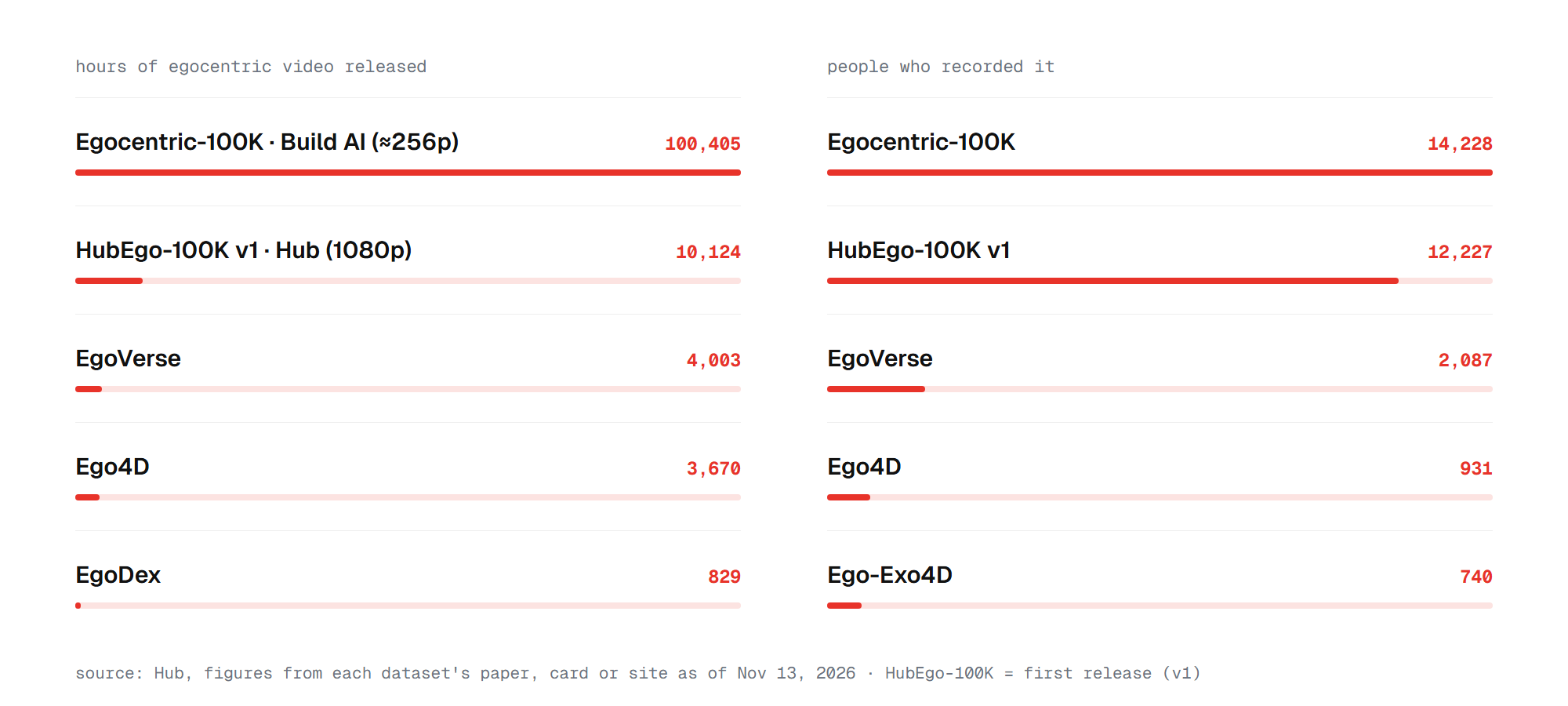
The table shows what Hub claims and what it does not. HubEgo-100K is not the largest open egocentric dataset today. Build AI's Egocentric-100K has ten times the hours, though at much lower resolution and from 238 factories. Hub's claim is "most diverse": more settings, full HD video and a license that allows commercial use. It will also match Egocentric-100K in hours once all 100,000 promised hours are out.
Who is Hub and what comes next
Hub runs an app through which contributors record first-person video, and it sells the data to AI labs and robotics companies. It is backed by Y Combinator. Startup databases list about $1.7 million in early funding, a figure Hub has not confirmed publicly.
Alongside the dataset, Hub announced Hub Labs, its own research unit. The company says it wants to become the largest open-source provider of physical AI data. It plans regular releases of human demonstrations, teleoperation data and on-policy rollouts from robots deployed in real workplaces. Open data for robots is now a crowded field, from human sensing datasets to the big labs' physical AI push.
Getting the data takes one step: users fill in a short form on Hugging Face with their name, organization, country and intended use. Access is then free.
Is HubEgo-100K useful for robotics teams
Yes, especially for teams that need commercial rights. Most well-known egocentric datasets, such as Ego4D and EgoDex, restrict commercial use or redistribution. HubEgo-100K allows both, in 1080p, with sensor data and LeRobot support out of the box. The spread of real workplaces fits what scaling research says matters most for robots that leave the lab.
There are caveats. All annotations come from a vision-language model and have not been checked by people. Video is mono and from phones, so it lacks depth data. The comparison table is Hub's own, and only a tenth of the promised hours is out. The full value of the dataset will be clearer once the remaining 90,000 hours arrive and teams publish results from training on it.
Sources
- HubEgo-100K dataset card, Hugging Face – November 16, 2026
- Hub on X – November 16, 2026
- Hub comparison of open egocentric datasets, DocSend – November 16, 2026
- Data Scaling Laws in Imitation Learning for Robotic Manipulation, Lin et al., ICLR 2025
- Hub, Y Combinator