Felix Laurent
Tencent has released Hy4 flash, a fast and cheap model for everyday office work. The Hunyuan team announced it on November 16, 2026. In Tencent's blind test, users rated it about as highly as Claude Haiku 5.5 on daily tasks, while each task cost about 18 times less.
The API price is $0.070 per million input tokens and $0.281 per million output tokens, with cached input at $0.003. That makes Hy4 flash one of the cheapest capable models on the market.
What Hy4 flash is
Hy4 flash is the smaller sibling of Tencent's Hy4, which left preview on November 4. Tencent promised a faster, cheaper version back then, and this is it. Like Hy4, it is natively multimodal and reads up to 1 million tokens of context.
The model has 224 billion parameters in total, including 64 billion so-called Engram parameters, but uses only 12 billion per token. Tencent says its hybrid attention, LatentMoE and Engram design shrinks the memory needed for long context to a sixth of Hy4's. Post-training distilled knowledge from Hy4 and used reinforcement learning to halve the average length of its answers.
Tencent also tuned it for speed. Custom kernels and 4-bit quantization push decoding past 150 tokens per second, according to Tencent. The real test is how it does on actual work.
Hy4 flash in Tencent's blind test
Tencent ran a blind test with 85 internal users of WorkBuddy, its AI office assistant. They worked through 259 tasks in 27 categories without knowing which model they used. Each answer was rated on a four-point scale.
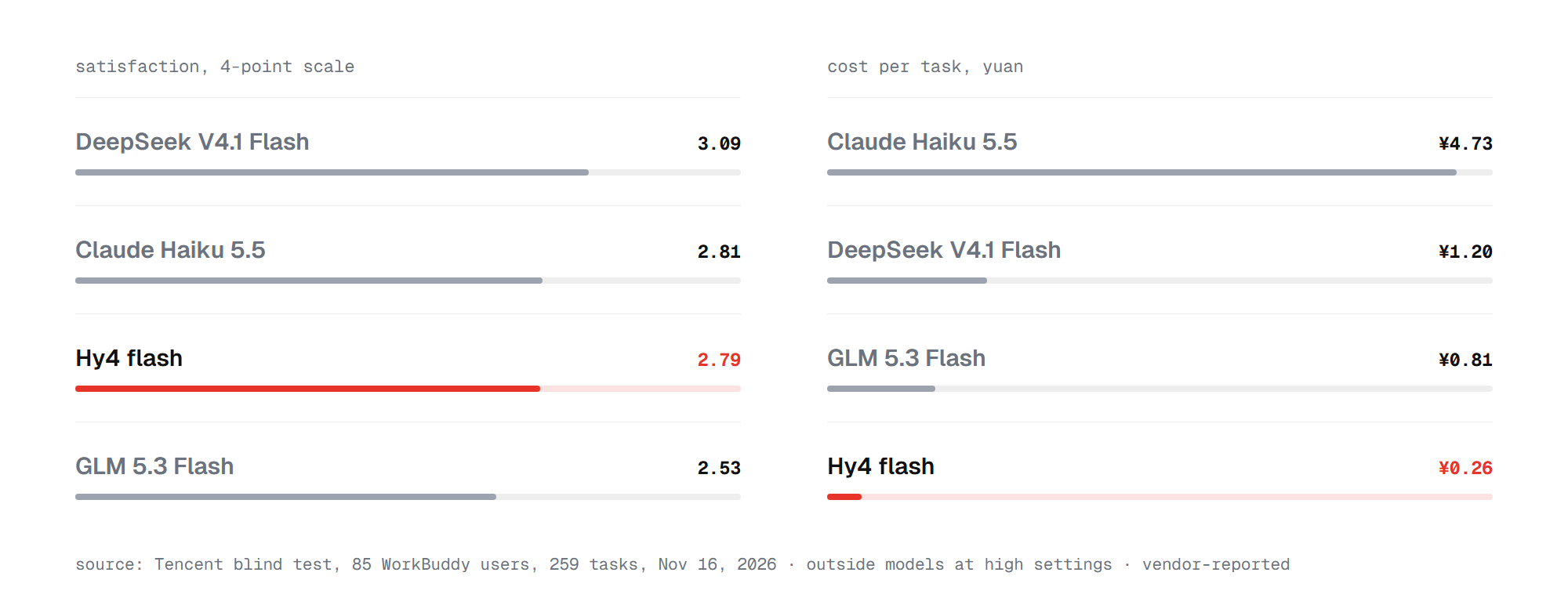
Hy4 flash scored 2.79, almost level with Claude Haiku 5.5 at 2.81. It finished tasks in a median 6.7 minutes, the fastest in the test, and cost ¥0.26 per task against ¥4.73 for Haiku. That gap is where the 18-times claim comes from.
DeepSeek V4.1 Flash, however, scored highest at 3.09. It took 10.3 minutes and cost ¥1.20 per task, more than four times Hy4 flash. GLM 5.3 Flash scored 2.53. Tencent notes that all outside models ran at their high settings.
One reply under the announcement pointed this out directly: Hy4 flash is the cheapest model in the test, not the most satisfying one. Tencent's other benchmarks show a similar pattern.
WorkIndex and open benchmarks
Tencent built its own benchmark, WorkIndex, around typical WorkBuddy jobs. Its eight test sets cover slide creation, document editing, spreadsheet repair, co-writing in Markdown, audio and video processing and visual understanding. It measures the quality of the finished work, the length of each answer and how long a task takes.
On WorkIndex, Hy4 flash scores 42.1, slightly above Hy4 preview at 39.7 and below the full Hy4 at 51.4. Its cost per task is ¥0.2, against ¥3.2 for Hy4 preview and ¥5.7 for Hy4. Tencent's chart puts it 13.8 times cheaper than the preview and 24.5 times cheaper than Hy4.
On a mix of open benchmarks, Tencent's chart places Hy4 flash at about 48. That is close to Qwen 3.8 Flash Next and GLM 5.3 Flash, above GPT-6 Luna and below DeepSeek V4.1 Flash. It costs far less per task than any of them, which is the point of the model.
Tencent's appendix lists the individual scores, and they show what the low price costs. Tencent ran every model itself at its highest reasoning setting.
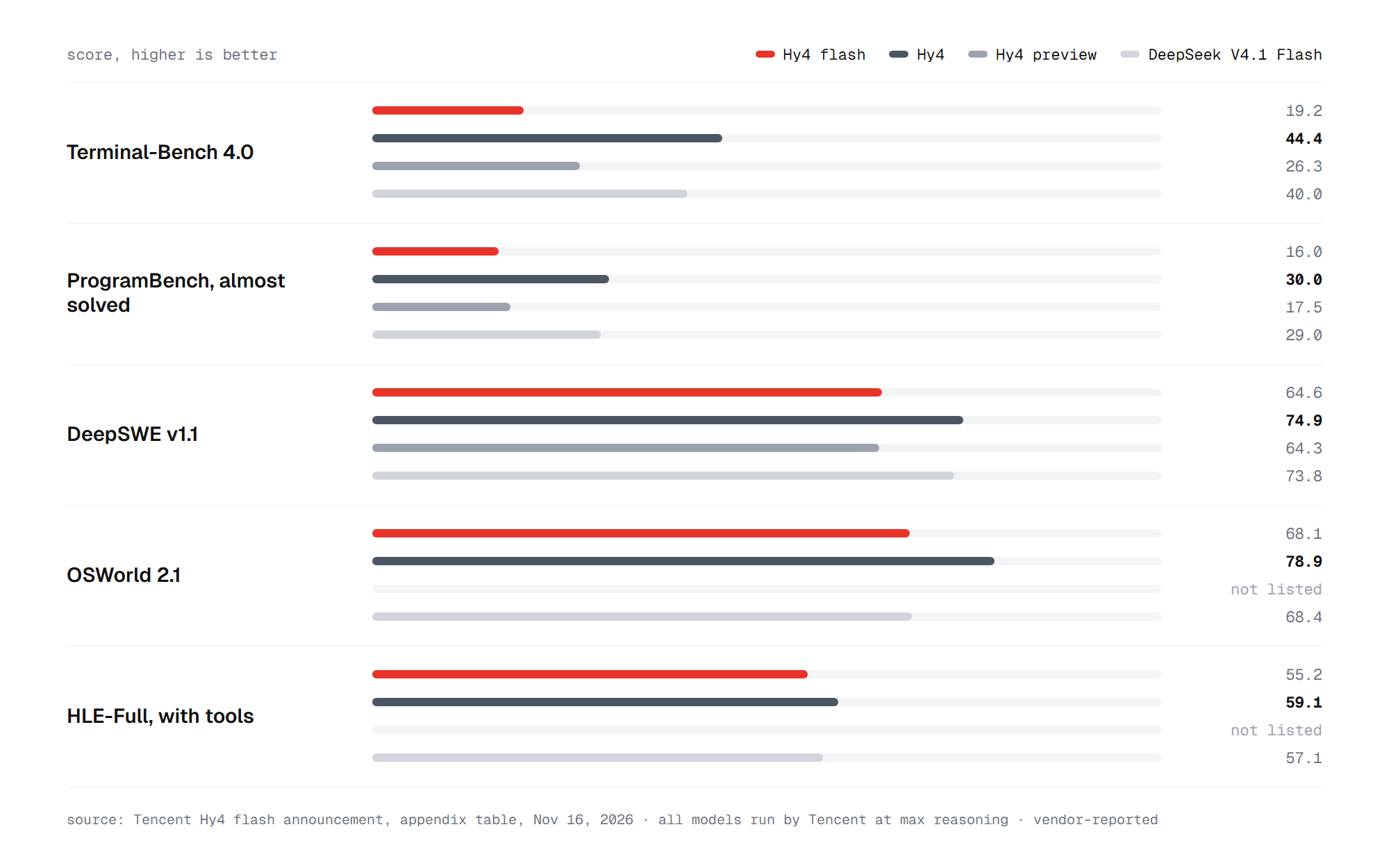
Agentic coding is the weak spot. On Terminal-Bench 4.0, run in the Claude Code harness, Hy4 flash scores 19.2 against 44.4 for Hy4 and 40.0 for DeepSeek V4.1 Flash. It also trails both on ProgramBench and DeepSWE, landing at about the level of Hy4 preview.
Computer use holds up much better. Its 68.1 on OSWorld 2.1 is level with DeepSeek's 68.4, and on Humanity's Last Exam with tools it is within two points. All of these numbers come from Tencent, and no outside lab has tested the model yet. The price is what has to make up for the coding gap.
Hy4 flash pricing and availability
The full Hy4 lists at $0.834 and $2.501 per million tokens. Hy4 flash costs about 92% less for input and 89% less for output. It is available through Tencent Cloud's TokenHub with the model ID hy4-flash. Input can run up to 960,000 tokens and output up to 64,000.
The API supports image understanding, reasoning, function calling, structured output and caching. It works with OpenAI's Chat Completions and Responses formats and Anthropic's Messages format, so existing tools can connect to it.
Inside Tencent's own products, Hy4 flash runs in WorkBuddy, the Yuanbao assistant, WeCom, QQ and other apps. WorkBuddy access is free until November 30, and TokenHub API calls are half price until noon Beijing time that day. Tencent also plans to list the model on OpenRouter.
Open weights are the open question. The Hy4 preview was released under Apache 2.0 in August, and many replies asked when Hy4 flash would follow. Tencent says it plans to release them but has not given a date or license. That leaves the claims to be checked by others.
Is Hy4 flash as good as Claude Haiku
On Tencent's numbers, Hy4 flash is close to Haiku 5.5 on everyday office work and much cheaper. For high-volume jobs such as document processing, slide drafts and deep search, the price matters most. At 7 cents per million input tokens, running agents all day gets much cheaper.
The evidence is still Tencent's own. The blind test used internal users, WorkIndex is an internal benchmark, and DeepSeek V4.1 Flash scored higher on satisfaction. Artificial Analysis had not scored Hy4 flash yet. Hy4 flash looks like the cheapest serious option for routine work, and it is worth testing on real tasks before switching from Haiku or DeepSeek.
Sources
- Hy4 flash announcement, Tencent Hunyuan on X – November 16, 2026
- Hy4 flash, Tencent Hunyuan research – November 16, 2026
- Tencent launches Hy4 flash as a lower-cost multimodal model, Unite.AI – November 16, 2026
- Tencent launches Hy4 flash, cutting AI task costs by 95% in internal tests, TechNode – November 16, 2026
- Hy4 flash at $0.070: fast, cheap, barely documented, OrcaRouter – November 2026