Felix Laurent

Nvidia has stopped shipping its US-approved H200 AI chips to China. Interim CEO Colette Kress said so on the company's earnings call on November 17, Reuters reported the next day. Nvidia sold $2.4 billion of these licensed Hopper chips to China in the quarter that ended October 25. Its forecast for the next quarter counts on none.
"We are no longer shipping licenced Hopper data centre products to China," Kress said. She did not say why the shipments stopped or whether the halt is permanent.
The halt puts in doubt a licensing deal that Washington and Beijing spent a year negotiating.
What Nvidia said on the earnings call
The remark came during Nvidia's first quarterly report since Jensen Huang resigned as CEO last week. Kress, who is also the CFO, now runs the company on an interim basis. Chair Harvey Jones opened the call by saying the board "does not intend to reinstate Jensen as CEO."
Kress's comments on China were short:
- Last quarter: Nvidia shipped $2.4 billion of licensed Hopper data center products to China.
- Guidance: the forecast for the fourth quarter does not include any licensed Hopper products.
- Now: Nvidia is no longer shipping them to China at all.
Nvidia's results release went further. The company said its fourth-quarter outlook assumes no data center compute revenue from China. That covers every data center chip, the H200 included.
That marks a sharp turn for a product Huang lobbied for over many months.
How the H200 deal with China worked
The US first restricted exports of advanced AI chips to China in 2022 and tightened the rules several times after that. The H200, a Hopper-generation processor used to train and run large AI models, was among the chips blocked.
After a summit with Chinese President Xi Jinping last year, President Donald Trump said he would allow H200 sales to approved Chinese customers. In January, the US eased its licensing policy, and each export application was reviewed individually under security conditions. The change followed months of lobbying from Huang.
The arrangement had several parts:
- Approved buyers. Washington cleared H200 sales to 10 Chinese companies, including Alibaba, Tencent and ByteDance, according to earlier Reuters reporting.
- A 25% tariff. TSMC makes the chips in Taiwan. They had to pass through the United States and pay a 25% tariff there before going on to China.
- Large orders. Several big Chinese internet companies each received about 10,000 H200 chips in recent months, Reuters reported.
The deal had already stalled on the Chinese side before Nvidia stopped shipping.
Beijing held back the imports
Beijing has restricted H200 imports as it tries to cut its dependence on US technology. That push continues even though Chinese companies need more computing power for AI.
Earlier this month, Reuters reported that about 600,000 H200 chips sat in storage in Hong Kong. They were waiting to ship to mainland China after Beijing withheld approval for large-scale imports.
So the halt may reflect pressure from both capitals. Kress gave no reason, and neither government has commented on Nvidia's decision so far. One reply under the Reuters post summed up a common reading: "China banned chips from Nvidia."
The timing adds a second layer. The allegations that led to Huang's exit include an affair with an alleged Chinese spy. After his exit, Nvidia's board formed a national security committee. Nvidia has not linked the China halt to that committee.
The financial hit is easier to measure than the reasons.
What China means for Nvidia's revenue
China still matters to Nvidia, even without the H200. Revenue from customers headquartered in China, including Hong Kong, reached $11.05 billion in the quarter. That compares with $2.97 billion a year earlier. Nvidia counts this figure by where the customer is based, so it includes gaming and other products and chips delivered outside China.
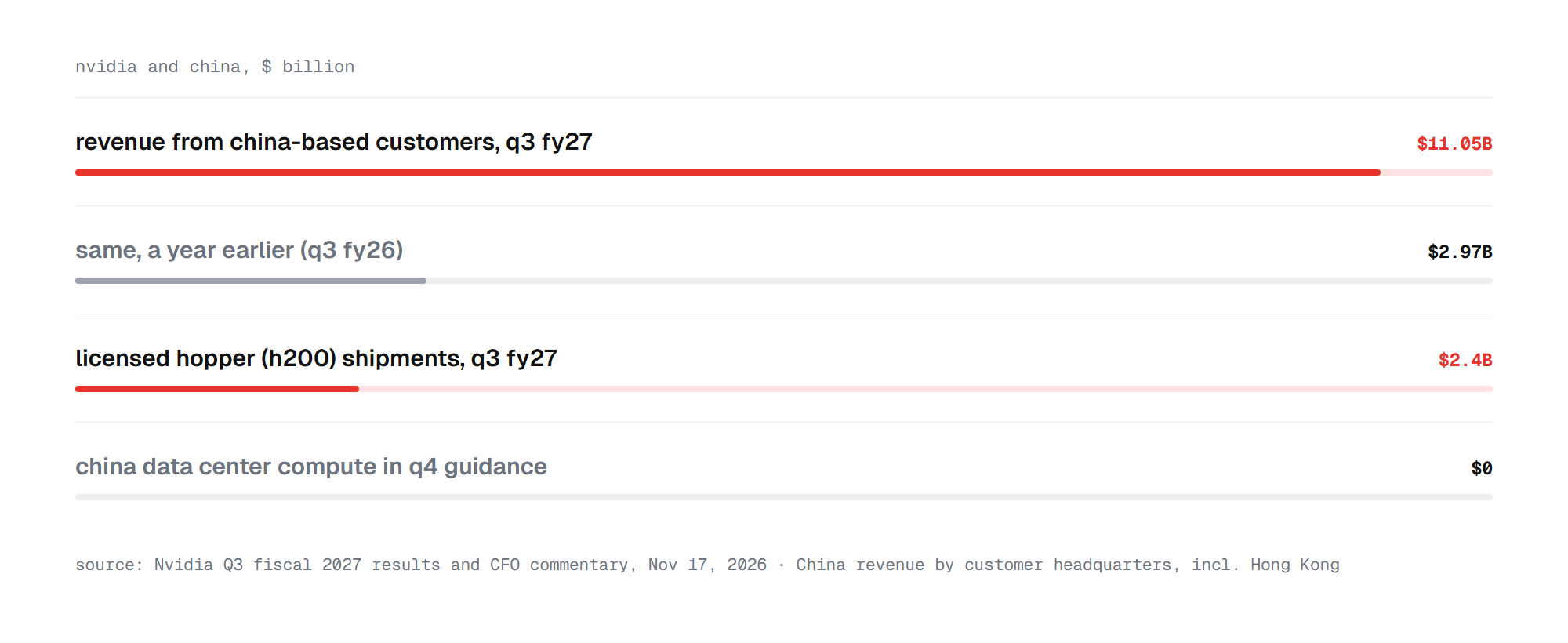
Against the whole company, the H200 business was small. Nvidia's total revenue was $115.8 billion, up 103% from a year earlier, and data center sales reached $107.6 billion. The licensed Hopper shipments made up about 2% of the total.
Investors focused on the forecast instead. Nvidia guided fourth-quarter revenue to $130 billion, plus or minus 3%, above the $125.1 billion analysts expected. That number already excludes China. Kress also raised the growth outlook for fiscal 2028 to about 75%, up from 70%. Nvidia shares rose about 3.6% after hours.
What the H200 halt means
The halt shows that Nvidia no longer plans on China for its AI data center business. The licensed H200 channel produced $2.4 billion last quarter and now produces nothing, and the company's forecast is built without it. For Nvidia's revenue, the loss is small next to the Vera Rubin ramp. For Washington's deal with Beijing, it may be the end, unless one side explains the halt and reopens the channel.
FAQ
Why did Nvidia stop shipping H200 chips to China?
Nvidia has not said why. Interim CEO Colette Kress only confirmed that shipments stopped. Beijing had already restricted H200 imports, and about 600,000 chips were stuck in Hong Kong awaiting approval.
Is the halt permanent?
Unknown. Kress did not say whether it is permanent, but Nvidia's forecast for the next quarter includes no data center compute revenue from China.
How much did Nvidia earn from H200 sales to China?
Nvidia shipped $2.4 billion of licensed Hopper data center products to China in the quarter that ended October 25, 2026. That is about 2% of its $115.8 billion revenue.
Which Chinese companies could buy the H200?
The US approved sales to 10 Chinese companies, including Alibaba, Tencent and ByteDance, according to Reuters.
Who is running Nvidia now?
Colette Kress, Nvidia's CFO, is interim CEO after Jensen Huang resigned. The board said it does not plan to reinstate Huang.
Sources
- Reuters on X – November 18, 2026
- Nvidia stops shipping US-approved AI chips to China, Reuters via Yahoo Finance – November 18, 2026
- Nvidia announces financial results for third quarter fiscal 2027, Nvidia – November 17, 2026
- Interim Nvidia CEO says it's no longer sending AI chips to China, Bloomberg – November 18, 2026
- Nvidia results live coverage, MLQ – November 17, 2026