Felix Laurent

Google AI Edge Gallery can now listen and talk without an internet connection. On November 10, Google added on-device speech recognition and text-to-speech to the app. It also launched XR Language Teacher, a voice tutor that explains whatever you point your phone camera at.
Everything runs locally on the phone. Google built the showcase with Gemma 4 and its coding agent Antigravity, the Gemma team said on X. The app is available for Android and iOS, and its code is open source on GitHub.
How XR Language Teacher works
Google designed the tutor for travelers who learn a language on the go. Wi-Fi and roaming data are often missing in underground stations, busy markets or abroad.
You point the camera at a street sign, a menu or an object and ask a question out loud. A typical question is "What is that, and how do I ask for one?". The speech recognition model streams your question in real time together with the camera frame to a small language model. On Android that model is Gemini Nano, and on other platforms it is Gemma 4.
The model explains the scene in your own language. It tags the foreign phrases separately, so the voice can switch accents mid-sentence and pronounce them like a local. A vocabulary card appears on screen at the same time.
The tutor is only one use of the new voice pipeline.
Voice comes to AI Chat in AI Edge Gallery
Google also added speech input and output to AI Chat, the main chat in the app. Gemini Nano and Gemma 4 now get a voice interface that works offline.
Users can dictate questions and hear the answers read aloud. A floating bar highlights each sentence as it is spoken, and tapping a sentence jumps to it. Speech models, voices and language packs are managed in one settings screen.
The open-source code also shows developers how to prepare chat replies for speech. It strips Markdown, skips code and tables, and plans synthesis sentence by sentence. That keeps speech from competing with the language model for memory and compute.
These features rest on several new speech models.
What runs under the hood
On Android, the app uses ML Kit's speech APIs. The speech models are built into the operating system through AICore, so they add 0 MB to an app's size. They also run on the phone's NPU when one is available.
For other platforms, Google prepared open-weight speech models in its LiteRT format. They work on iOS, macOS, Windows, Linux and the web through MediaPipe Tasks:
- Parakeet-TDT 0.6B: multilingual speech recognition;
- PocketTTS 100M: multilingual text-to-speech;
- Kokoro-82M: multilingual text-to-speech;
- Phonon 31M: a tiny English voice that starts speaking in under 100 ms on most devices.
Developers can also take other open models from the LiteRT community on Hugging Face, such as Whisper, Qwen3-ASR or Qwen3-TTS. Gemma 4 can process audio by itself, but Google keeps speech in separate small models. That cuts delays and lets developers swap parts.
The Android models are where Google published its speed numbers.
How fast the on-device speech models are
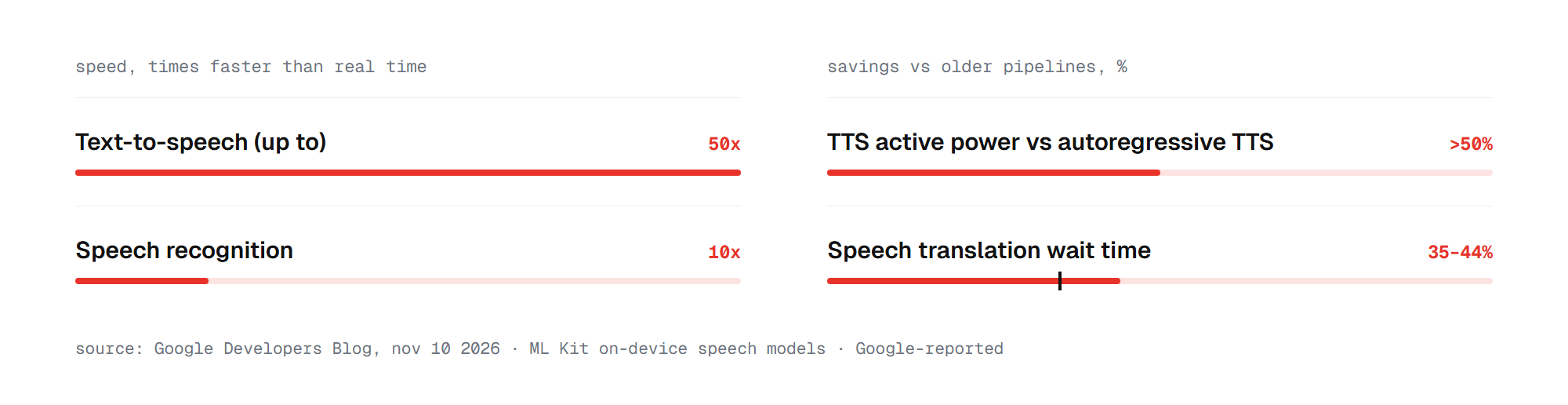
The new speech recognition model covers more than 100 languages. On the FLEURS test, its word error rate is 8% to 9%, Google says. It transcribes about 3 seconds of speech in roughly 300 ms. End-to-end speech translation now waits 35% to 44% less.
The text-to-speech model uses a few-step diffusion design. It starts speaking in about 100 ms and produces 24 kHz audio with 8 voices in 21 locales. A 27-second paragraph takes about 500 ms to generate. Compared with older autoregressive voices, it uses more than half less active power.
All these figures come from Google and have not been checked independently. Google also points to a device lab with more than 200 physical phones, where developers can test their own voice pipelines.
The same pipeline is meant to leave the phone screen as well.
From phones to smart glasses
The inference runs on the phone, so the same tutor can work through paired smart glasses. Google showed that version at Android Dev Summit, in a talk about audio-first apps for glasses with Gemini Nano.
That fits Google's wider push for small models. Gemma 4 already comes in tiny quantized versions that fit on phones. Our guide explains how to pick a local AI model for your phone.
Is an offline AI language tutor on your phone useful yet
For travelers, it already is. XR Language Teacher solves a real problem: translation apps often fail without a network, exactly where tourists need them most. Here the camera, the model and the voice all run on the phone, and the replies sound like a teacher instead of a dictionary.
It is still a showcase, though. Google calls it a demo of what developers can build, and the speed figures are its own. The bigger news is for app makers. They now get free, offline speech parts and open code to copy. Voice tutors and assistants without cloud costs should start appearing in other apps soon.