Felix Laurent
ElevenLabs released Scribe v3 and Scribe v3 Live on November 10, 2026. Scribe v3 transcribes recorded audio and makes 27% fewer word errors than Scribe v2 across 102 languages. Scribe v3 Live works in real time, makes 43% fewer errors than its predecessor by meaning-based scoring and can now tell speakers apart.
Both speech-to-text models are available through the ElevenAPI, at the same price as the versions they replace. ElevenLabs says they beat every rival it tested, though all the numbers come from its own evaluations.
What's new in Scribe v3
ElevenLabs says customers kept asking for the same five things. They wanted better speaker labels, smarter turn detection, a stronger real-time model, better Hindi and more control over the output. Scribe already handles hundreds of millions of hours of audio for meeting apps, contact centers and clinical tools.
The main changes split across the two models:
- Speaker labels. Scribe v3 makes 17% fewer diarization errors than Scribe v2 on recordings with three or more speakers. Diarization means labeling who said what.
- Real-time speaker labels. Scribe v3 Live adds diarization to live transcription for the first time.
- Turn detection. Scribe v3 Live uses the context of the conversation along with the audio. A caller who pauses halfway through a number is no longer cut off.
- Terminology. Keyterm prompting takes up to 1,000 terms. Scribe v3 Live adds a key term library of up to 10,000 terms, which the model checks only when it hears a likely match.
- Formatting. Transcript edits follow plain English rules, such as "write every date as YYYY-MM-DD," and numbers can come back as digits or words.
- Mixed languages. Scribe v3 Live has a multilingual mode for speakers who switch languages mid-sentence.
Those features matter only if the transcripts are accurate, so ElevenLabs published a long set of comparisons.
Scribe v3 benchmarks against rivals
ElevenLabs tested accuracy on an internal version of FLEURS, a benchmark of short, clean read speech in 102 languages. Across all of them, Scribe v3 has a word error rate of 12.4%, down from 17.0% for Scribe v2. Gemini 3.5 Transcribe scored 18.5% on the same set.
Other rivals support fewer languages, so each comparison uses only the languages both models cover. Scribe v3 scored 5.5% against 9.7% for GPT-Transcribe, and 5.8% against 15.2% for Deepgram Nova-3. The closest result was Microsoft's MAI-Transcribe-2, at 7.5% against 6.5% for Scribe v3.
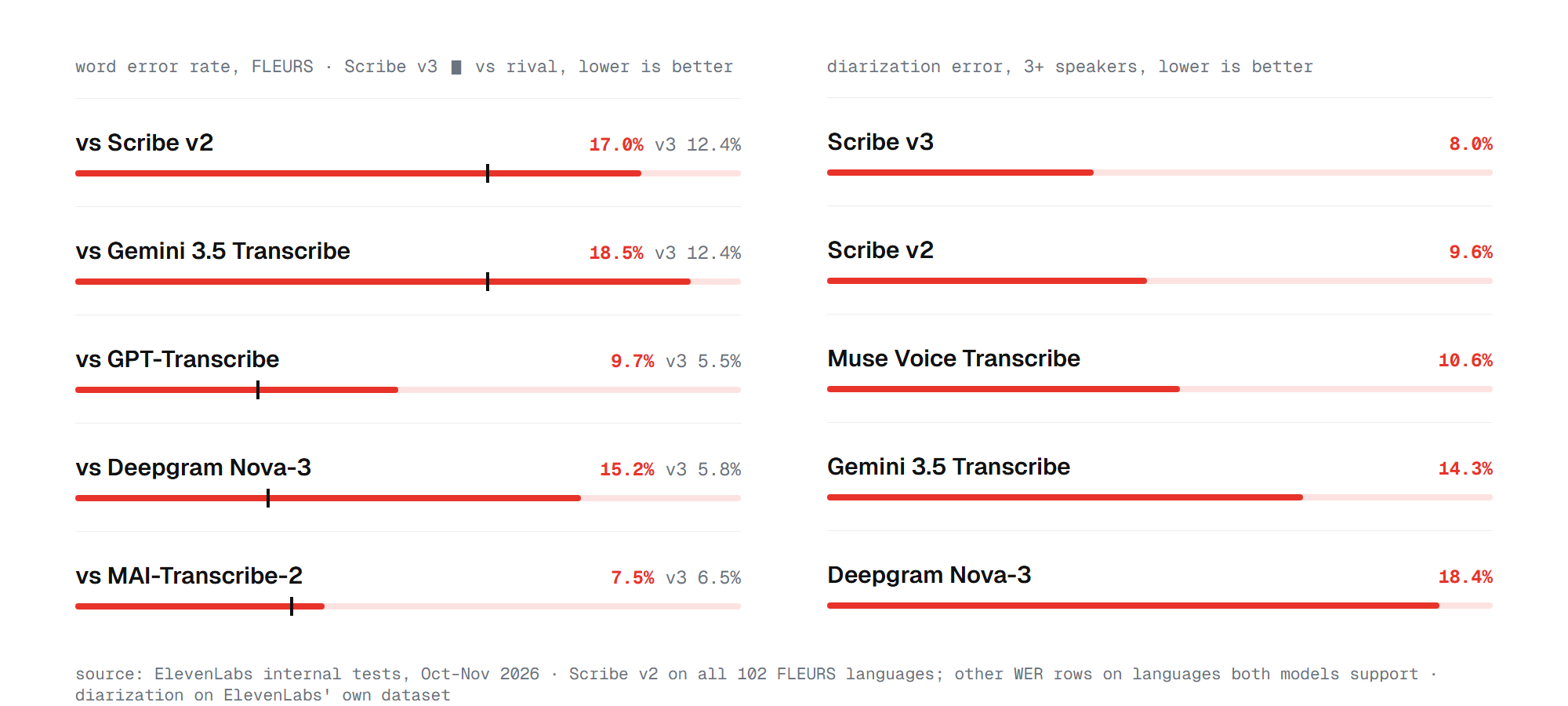
FLEURS has one speaker per clip, so it cannot measure diarization. For that, ElevenLabs built its own dataset of real meetings, agent calls and voice notes in 16 languages, which it plans to open source soon. Scribe v3 had a 5.6% diarization error rate overall and 8.0% with three or more speakers. Next came Scribe v2 at 9.6% and Muse Voice Transcribe at 10.6%.
Gains varied by language. German improved by 42%, Spanish by 35% and English by 23%. Swahili improved by 34%, Tamil by 29% and Thai by 28%.
Real-time transcription is a harder test, and it shows the biggest jump.
How Scribe v3 Live performs in real time
Scribe v3 Live has a word error rate of 18.2% across all 102 languages, down from 26.5% for Scribe v2 Realtime. ElevenLabs prefers semantic word error rate here, which counts an error only when the meaning changes. On that measure the model fell from 12.5% to 7.1%, a 43% cut.
It also led the other live models on the languages each one supports. Scribe v3 Live scored 8.8% against 13.7% for GPT-Live-Transcribe, and 6.0% against 8.4% for Grok Voice Transcribe 2.0. On English recordings, its diarization error rate was 3.1%, compared with 5.9% to 7.3% for the other real-time models.
The improvement is already visible in production. Dutch energy supplier Eneco tested Scribe v3 Live on its voice agent in real customer calls. The agent recognized postcodes correctly on the first try 40% more often, and house numbers 15% more often. A misheard digit can fail the identity check at the start of a call.
ElevenLabs offers a useful way to read these percentages. A one-hour meeting has about 9,000 words, so the gap between a 4% and a 2% error rate is 180 wrong words.
Scribe v3 pricing and availability
ElevenLabs' API pricing page lists Scribe v3 at $0.20 per hour and Scribe v3 Live at $0.22 per hour. Those match the listed prices for Scribe v2 and Scribe v2 Realtime. Developers upgrade by changing the model ID to scribe_v3 or scribe_v3_live.
Scribe v3 Live is also available in ElevenAgents, with a version tuned for medical conversations. Both models are the default in the ElevenLabs app.
For enterprises, the models run in the US by default, with isolated environments in the EU, India and Singapore. Zero Retention Mode deletes audio and text as soon as a request completes. Both are covered by SOC 2, ISO 27001 and PCI DSS Level 1 programs and are HIPAA-eligible with a Business Associate Agreement.
The comparisons still need outside confirmation.
Is Scribe v3 the best speech-to-text model
On ElevenLabs' numbers it is the strongest of the models tested, especially for meetings with several speakers and for live calls. For teams already on Scribe v2, the upgrade is an easy call: one line of code and no price increase.
The claim of being the most accurate has limits. All the tests were run by ElevenLabs, and the diarization dataset is not public yet. The list of rivals also leaves out recent releases such as Mistral's Voxtral 3 and Nvidia's Nemotron 3.5 Transcribe. Independent results, such as the Artificial Analysis leaderboard, will show whether Scribe v3 keeps its lead.
Sources
- Introducing Scribe v3 and v3 Live, ElevenLabs – November 10, 2026
- ElevenLabs on X – November 10, 2026
- ElevenLabs API pricing
- ElevenLabs models documentation