Felix Laurent

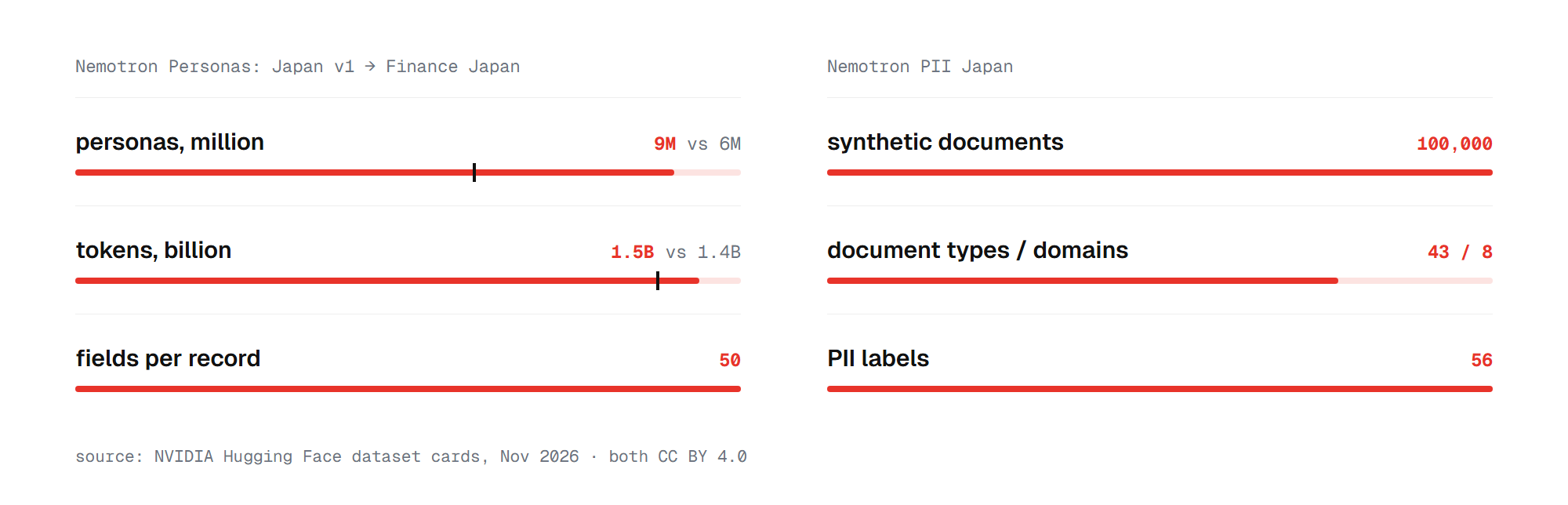
NVIDIA released two Japanese synthetic datasets on November 10, 2026, at its Agentic AI Day developer event in Tokyo. Nemotron Personas Finance Japan adds income, assets and other money details to 9 million fictional Japanese personas. Nemotron PII Japan contains 100,000 synthetic documents with labeled personal data for training privacy filters.
Both datasets are free on Hugging Face under the CC BY 4.0 license. They target a common problem for AI teams in Japan. Real customer data is hard to collect, use and share, especially in finance, healthcare and government.
What is Nemotron Personas Finance Japan
The new dataset extends Nemotron Personas Japan, which NVIDIA released in 2025. NVIDIA's Japanese account on X calls it Nemotron-Personas-Japan V2. That first version turned public population and labor statistics into 6 million synthetic personas, described in natural Japanese.
The finance version keeps those base traits and adds what a bank or insurer needs to know about a customer:
- 1 million records with 9 personas each, or 9 million personas in total;
- 50 fields, including 30 context fields based on official statistics;
- about 1.5 billion tokens, up from about 1.4 billion in the first version;
- about 950,000 unique names and more than 1,600 occupation categories.
New fields cover personal income, household financial assets and the types of assets a person holds, such as savings accounts or life insurance. Others describe family makeup and attitudes to health. The personas describe spending, saving and investing habits in plain language. No real person stands behind any record.
NVIDIA built the data with its NeMo Data Designer tool. It sampled traits from public statistics with probabilistic graphical models, then used Google's open Gemma 4 31B model to write the personas. Elith, an AI startup from the Matsuo Institute at the University of Tokyo, built the generation pipeline.
A sample record shows what these personas look like in practice.
What the synthetic personas are for
A persona is a detailed profile of a person who does not exist but could. The numbers match Japan's real statistics, and the text describes the person's life, habits and attitude to money. One record in the dataset describes a 20-year-old woman who lives alone in Usa, a small city in Oita Prefecture. She works part-time as a clerk at the city office and earns ¥1 million to ¥1.49 million a year. She keeps her savings in an ordinary bank account and turns down complex investment products at the bank counter. She is also putting money aside for her apartment's lease renewal fee.
A bank cannot simply feed real customers like her into an AI system. Japan's privacy law limits how companies use and share personal data, and real logs rarely cover every type of customer. Synthetic personas fill that gap in three main ways:
- Training data. An LLM role-plays thousands of personas to write realistic customer conversations in Japanese. These dialogues then teach a support bot or an advisory agent how real people talk about money.
- Testing agents. A simulated customer talks to the bank's AI agent before any real client does. Developers check whether the agent explains a mortgage clearly to a pensioner, or pushes a risky product on a cautious saver like the clerk above.
- Coverage and fairness. Because the personas follow census data, they include groups that are easy to miss, such as older people in rural areas or low-income single workers. That reduces bias and the drift that comes from training only on other models' outputs.
To make those uses realistic, NVIDIA took design input from the finance industry itself.
Japanese banks and insurers helped design it
Six financial players reviewed the dataset during development. They did not share customer data. They told NVIDIA which attributes they need and checked samples for realism:
- Sompo Japan on personas for buying, renewing and claiming insurance;
- Tokio Marine Holdings on marketing use cases;
- Bank of Fukuoka on traits needed to recommend financial products;
- Mizuho Financial Group on retail banking uses;
- Meiji Yasuda Life on life insurance needs and sales;
- Financial Data Utilization Association (FDUA) on wealth management simulations.
NVIDIA suggests three main uses. Banks can generate multi-turn customer conversations, simulate marketing and market research, and train sales staff against virtual clients. Some examples are a retiree in the countryside asking about passing on assets, or a working couple in a city reviewing a mortgage.
The dataset also works with NeMo User Sim, NVIDIA's framework for testing AI agents with simulated users. Developers can combine the personas with its existing finance probes to see how an agent handles different customers.
The second dataset deals with the documents those customers send in.
What is Nemotron PII Japan
Nemotron PII Japan contains 100,000 fully synthetic Japanese documents with personal data. They cover eight domains: healthcare, finance, government, employment, education, legal, IT and e-commerce. The 43 document types include medical certificates, loan applications and change-of-address forms.
Each document marks where personal data appears and what kind it is. The dataset uses 56 labels, from names and addresses to Japan's My Number ID and medical and bank identifiers. In total there are 810,703 labeled spans, or about eight per document. The full set is about 34.7 million tokens.
The use case is a filter that runs before an LLM sees a document. It detects names, addresses and ID numbers and masks them. NVIDIA stresses that it released a dataset, not a ready Japanese PII model.
NEC tested the dataset in early access. The head of NEC's AI platform services division said few public Japanese PII datasets exist. Extra training on Nemotron PII Japan raised precision and cut false positives in NEC's own model while keeping the detection rate high.
Why NVIDIA is building Japanese data
Both releases belong to Nemotron, NVIDIA's family of open models and datasets for AI agents. NVIDIA has pitched the family as a base for sovereign AI, meaning national models built on local language and data. Japan is one of its main markets for that idea. The first Japanese personas came out in 2025, and NVIDIA also offers a Japanese version of Nemotron Nano v2.
The datasets do not train a large model by themselves. They give Japanese companies material to fine-tune and test smaller models and agents on local rules and habits. Other recent open releases in the family include Nemotron 3.5 Super VL. There is also the Nemotron 3.5 Transcribe speech model.
Synthetic data has limits. The personas follow census distributions, so they reflect averages, not real customers' quirks. The PII labels focus on generated values and rules, and the card notes that not every piece of personal data in a text is marked. Companies still need to check results against their own documents and legal requirements.
Are NVIDIA's Japanese datasets worth using
For Japanese banks, insurers and AI startups, yes. Both datasets are free for commercial use with attribution, and they fill real gaps. Financial personas give agents realistic test customers without touching client records. Labeled Japanese documents for PII detection are rare, as NEC's comment shows.
The personas are most useful for testing and simulation, not as a substitute for real customer insight. The PII data is a strong starting point for a masking model, but teams will still need their own evaluation before trusting it in production.