Felix Laurent

There is no single best AI music generator. Suno writes the most convincing songs with vocals for $10 a month. ElevenLabs publishes the clearest rights table in the market. Stability AI and the open ACE-Step model cover the jobs where you need control over the pipeline. The choice depends on where the track will end up. Every vendor writes different rules for a TikTok clip, a Spotify release and a TV ad.
This guide walks through those destinations one by one, from free experiments to client work, and names the tool and the plan that fits each. Prices and terms were checked against the vendors' own pages on November 10, 2026.
Start with where the music will be used
Before comparing sound quality, answer one question: who will hear this track, and who will pay for it? The answer puts you in one of five groups, and each group has its own winner.
Rights decide what you can do with a track. How good it sounds is a separate question, and blind tests now put numbers on it.
What blind listening tests say about quality
Artificial Analysis runs a Music Arena with a panel of recruited evaluators. They compare two tracks made from the same prompt without knowing which model made either. Its v1.1 boards, relaunched in October 2026, cover 1,000 new prompts across 17 genres. Models are ranked by Elo, with MiniMax Music 3.0 fixed at 1000 as the reference point.
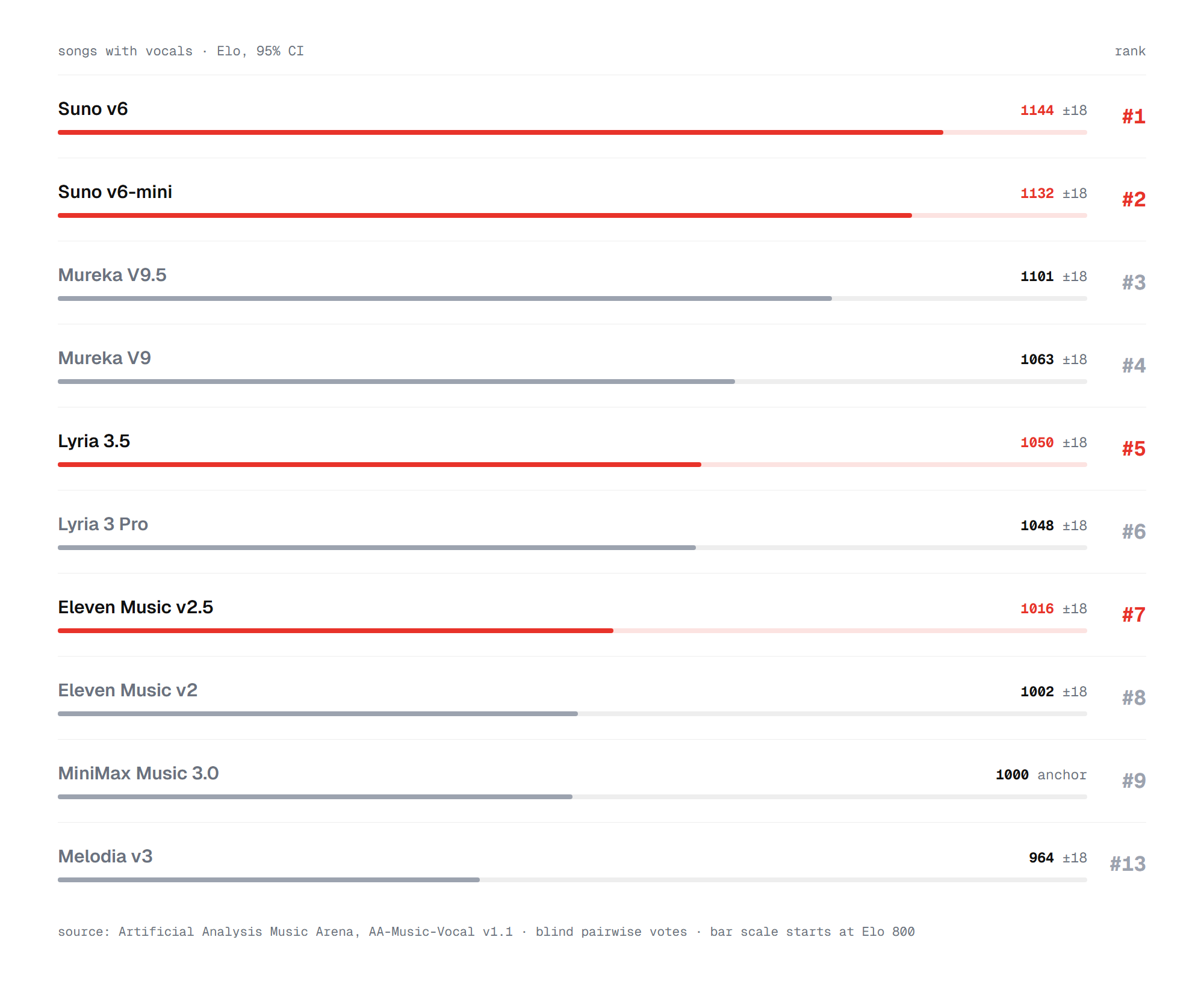
Suno v6 leads the vocal board at 1144, and v6-mini, the model on Suno's free plan, follows at 1132 within the margin of error. Mureka V9.5 is third at 1101. Google's Lyria 3.5 scores 1050, and Eleven Music v2.5, the best ElevenLabs model for vocals, scores 1016. By the Elo formula, a 128-point gap means listeners would pick Suno v6 over Eleven Music v2.5 in about two pairings out of three.
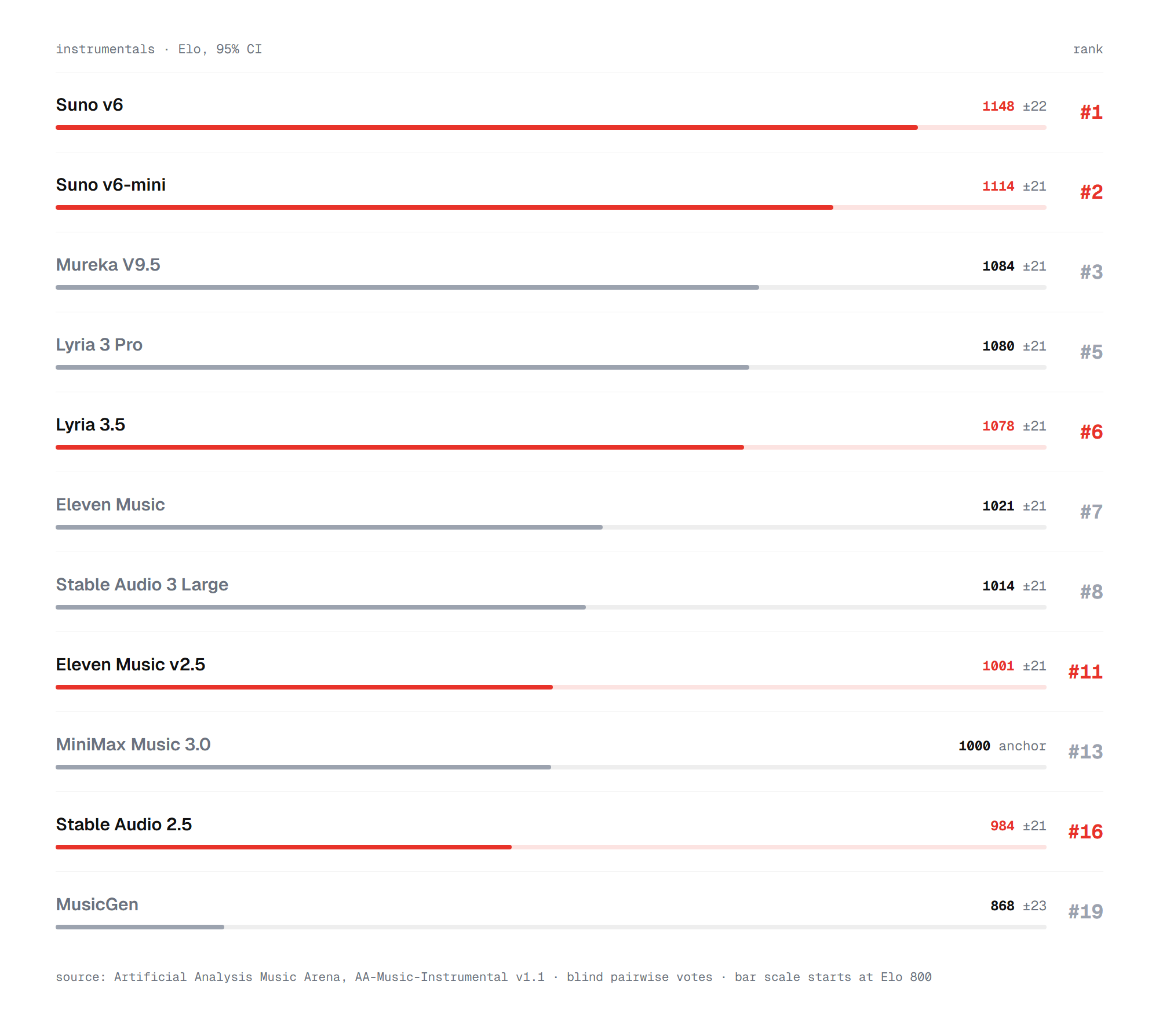
The instrumental board keeps Suno v6 on top at 1148. Mureka V9.5, Lyria 3 Pro and Lyria 3.5 sit between 1078 and 1084, a statistical tie. Eleven Music v2.5 scores 1001, slightly below the original Eleven Music at 1021. Stable Audio 2.5 ranks 16th of 19 at 984, behind Stability's own Stable Audio 3 Large at 1014. Udio and the open ACE-Step model are not on either board.
To hear the gap, we ran one vocal prompt through Suno's free v6-mini model, Lyria 3 Pro and ACE-Step 1.5. It asked for an indie pop song with female vocals and our own lyrics.
Suno's track came from the free plan, which allows sharing but not commercial use. Lyria's song cost $0.08 through OpenRouter. ACE-Step ran for free on a consumer RTX 5070 Ti and made two takes in about 25 seconds. We kept the first one.
Some models on both boards outscore the tools this guide recommends, and the reason they are left out is in their terms. Mureka V9.5 from Kunlun Tech ranks third on vocals and includes commercial rights from its Pro plan, $10 a month or $8 billed yearly. Kunlun says its models learned from "millions of tracks" but names no sources and no label deals.
In December 2025 a group of musicians sued Kunlun Tech and Skywork AI in a federal court in Illinois. They allege Mureka was trained on their recordings and voices without permission. The judge has not yet ruled on the motions to dismiss. Suno is being sued too, but it names the labels whose music trained v6, and Kunlun names none. For a track a client will pay for, that leaves the risk with the buyer.
MiniMax Music 3.0 is the board's reference model at 1000 and ships with open weights. Its community license allows commercial use only below $20 million in yearly revenue. Any product built on it must also show "MiniMax-Music3" in its interface. ACE-Step 1.5 has no ranking, but its MIT license carries neither condition. Stable Audio 3 Large scores 30 points above Stable Audio 2.5. Stability says all its audio models use licensed data, so teams that choose Stability should test the newer model first.
The tool with the best sound and the tool with the cleanest license are rarely the same one. Which matters more depends on what you are allowed to keep, starting with the free tiers.
For fun: free tiers and what you can keep
Free plans are good enough to hear what AI music sounds like in 2026, but none of them lets you sell the result. Suno's free plan gives 50 credits a day on v6-mini, the fast model the company opened to all users on September 9. It has no monthly downloads and no commercial rights. Suno says free songs are "only intended for personal, non-commercial use" and can be shared on the platform.
Google's Gemini app runs Lyria 3.5, which DeepMind says writes tracks of up to three minutes with improved vocals. Every Lyria track carries an inaudible SynthID watermark, and Gemini can check an uploaded file for it. ElevenLabs gives free users 11 minutes of music generation a month, with no downloads and a required "Eleven Music" credit when anything is shared.
Udio, once Suno's closest rival, is the odd case. Downloads have been switched off since its settlement with Universal Music Group in October 2025. The licensed "walled garden" platform the two companies announced for 2026 had not launched by late September 2026, according to coverage tracked by Loop.
Once a track has to leave the platform and earn money, even under a video, the free tiers stop working. The paid entry plans take over from there.
For YouTube, TikTok, podcasts and client videos
Background music for content is the most common commercial use, and two plans cover it for $10 a month or less. ElevenLabs Starter costs $6 and allows "all online and offline commercial use" with 30 minutes of downloads a month and no attribution. It does not allow distribution to streaming services, which does not matter for a soundtrack under a video.
Suno Pro costs $10 a month, or $8 billed yearly. It includes 20 song downloads a month, the full v6 and v6-wild models, and commercial rights. Suno's help center sets the key rule: songs downloaded while subscribed get commercial use rights. A subscription does not turn songs made earlier on the free plan into commercial ones.
For instrumental mood music, Beatoven sells a non-exclusive perpetual license on its paid plans. You get the right to use the track, while the same composition can, in theory, reach other buyers too.
ElevenLabs leans on licensed training data, and Suno leans on vocals. That difference starts to matter when a song goes out under your own name.
For releasing songs on Spotify and Apple Music
Releasing a track on streaming services is where plan tiers bite. On ElevenLabs, distribution to Spotify and similar services is "Prohibited" on the Free and Starter plans. It is permitted from Creator ($22 a month) up, per the music terms updated October 9, 2026. Full-quality WAV or 192 kbps MP3 downloads start only on Pro at $99.
Suno lets Pro and Premier subscribers distribute songs to Spotify and Apple Music. Premier costs $30 a month, or $24 billed yearly, for 60 downloads and adds Suno Studio and stem exports.
Suno v6 was trained on licensed music from Warner Music Group, BMG and Believe, TechCrunch reported. The company says it did not use the data behind earlier versions. Sony and Universal's lawsuits against Suno were still pending at launch. So was a suit by independent musicians filed in Illinois in October 2025. Suno also admitted training on YouTube videos the day before v6 shipped.
The streaming side has its own rules. Spotify launched an AI credits disclosure in April 2026, starting with DistroKid. Deezer tags fully AI-generated tracks, shows the tag to listeners and keeps them out of its algorithmic and editorial recommendations. Distribution guides also report that some distributors refuse AI-made music or block tracks from specific generators. Check your distributor's policy before you pay for a plan.
Ownership is the last part of a release. The US Copyright Office says a fully AI-generated work is not eligible for copyright, and prompts alone do not count as authorship. A Suno or ElevenLabs license gives you the right to use and sell a track. It does not stop someone else from reusing a song with no human contribution in it. Writing your own lyrics, melody or arrangement is what turns an output into a work you can register.
That gap between a license and real ownership grows wider when the buyer is a brand or a studio.
For ads, film, TV and games
Broadcast and game work sits outside most self-serve plans. ElevenLabs excludes film, TV, radio and studio games on every plan below Enterprise Music. It makes one exception for indie games, which qualify while the game earns under $500,000 and the developer under $1 million a year.
Stability AI built Stable Audio 2.5 for this market. The company says all Stable Audio models are "commercially safe and trained on a fully licensed dataset". It also says 2.5 renders three-minute tracks in under two seconds on a GPU. It also supports audio inpainting and on-premises deployment, which matters for agencies with strict data rules. Stability's claim about its dataset is a vendor statement, but it is the kind of provenance a legal team will ask for.
For orchestral and cinematic scores, AIVA takes a different route to rights. On its Pro plan, €33 a month billed yearly plus VAT, the copyright of compositions belongs to the subscriber, according to AIVA's pricing page. On the Free and Standard plans, AIVA keeps the copyright.
Studios that need hundreds of tracks or full control over the model eventually move from subscriptions to APIs and their own servers.
For music inside your own app or service
If music is a feature of your product, you need an API or open weights, and the license of the model itself starts to matter. ElevenLabs sells music through its API, and its self-serve plans ban model resale and building music libraries. Google offers Lyria through AI Studio and its enterprise agent platform, with the same SynthID watermark on every output.
ACE-Step 1.5 is the strongest open option for commercial work. Its model card lists an MIT license and says outputs can be used "for commercial purposes". The model runs locally on less than 4 GB of VRAM and writes a full song in under 10 seconds on an RTX 3090. It scales from short loops to 10-minute pieces. Its authors say it was trained on licensed, royalty-free and synthetic MIDI-to-audio data.
Other open models carry stricter terms, so read each repository's license before you ship. Some allow only non-commercial use of the weights.
Self-hosting removes the subscription and the download caps. It also removes the vendor's legal team, so the provenance of the training data becomes your problem.
So which AI music generator is best for commercial use?
For most commercial work, ElevenLabs on a paid plan is the safest choice. Its training data is licensed, its terms list every right per plan, and $6 a month already covers content soundtracks. Releases on Spotify need the $22 Creator plan, and broadcast work needs Enterprise Music.
Suno Pro at $10 a month is the better pick when the song itself is the product and vocals carry it. Its v6 models now rest on Warner, BMG and Believe catalogs, but the open lawsuits remain a risk to weigh. Stable Audio 2.5 fits brands and agencies that want licensed provenance and on-premises deployment. ACE-Step 1.5 is the answer for developers who want commercial rights with no subscription at all. Whatever you pick, download tracks while your plan is active and keep your prompts and project files. Add your own lyrics or melody if you want a song you can actually own.
FAQ
The questions below come up most often when people choose a music generator for paid work.
Can I use AI-generated music commercially for free?
Not on the hosted services. Suno, Mureka and ElevenLabs keep commercial rights for paid plans. ACE-Step 1.5 is the exception: its weights are free to run on your own hardware under an MIT license.
Can I upload AI songs to Spotify?
Yes, on the right plan. Suno allows it on Pro and Premier, and ElevenLabs from the $22 Creator plan up. Deezer tags fully AI-generated tracks, and some distributors refuse them.
Do I own the copyright to an AI-generated song?
In the US, not without a meaningful human contribution. The Copyright Office says prompts alone do not count as authorship. A paid plan gives you a license to use the track, and AIVA Pro assigns copyright to subscribers by contract.
Which AI music generator sounds best?
Suno v6 leads both Artificial Analysis Music Arena boards, with Elo 1144 for vocals and 1148 for instrumentals. Its free v6-mini model comes second on both.