Felix Laurent
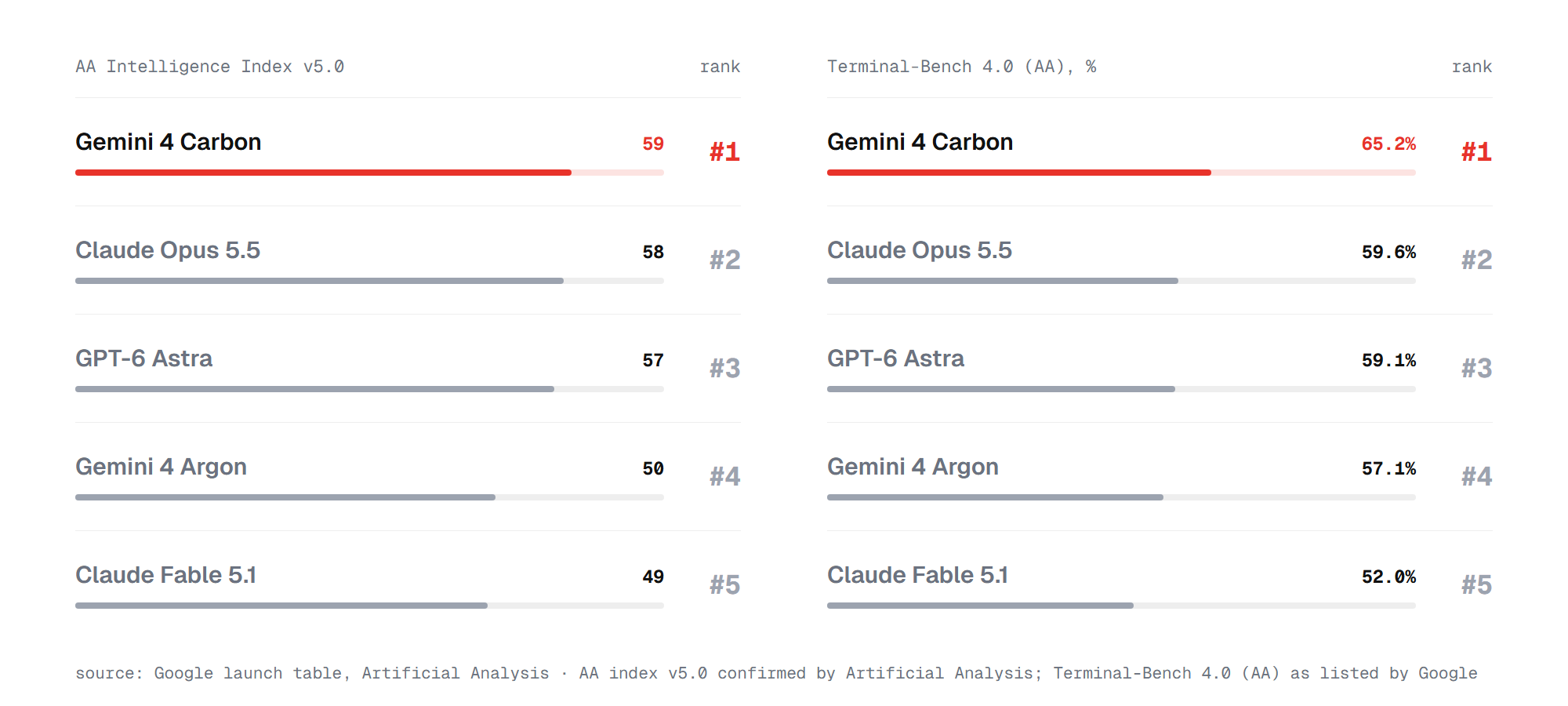
Google announced Gemini 4 Carbon on Oct 28 and calls it its strongest model. Google says it ranks #1 on the Artificial Analysis Intelligence Index v5.0 at 59, and Artificial Analysis lists the same score. The model is available first to a small group of trusted cyber defenders.
What Google announced
Google describes Carbon as a model with state-of-the-art cybersecurity and long-horizon capabilities. The post is signed by Koray Kavukcuoglu, Google's chief AI architect. It says internal teams have seen Carbon work for days on multi-step engineering tasks, pushing through dead ends.
Carbon builds on Gemini 4 Argon, which Google introduced on Sept 30. On WebDev Arena, Google says Carbon gained 89 Elo points to reach #4 at 1768. Google also published a 17-row comparison against Argon, GPT-6 Astra, Claude Opus 5.5 and Claude Fable 5.1. That table shows where the #1 claim holds and where it does not.
How it compares
Artificial Analysis lists Carbon at 59, ranked #1 of 52 models on its index. Google's table puts Claude Opus 5.5 at 58 and GPT-6 Astra at 57, so the lead is one point. Artificial Analysis also says running its index took Carbon 200 million output tokens, and it lists a 1 million token context window.
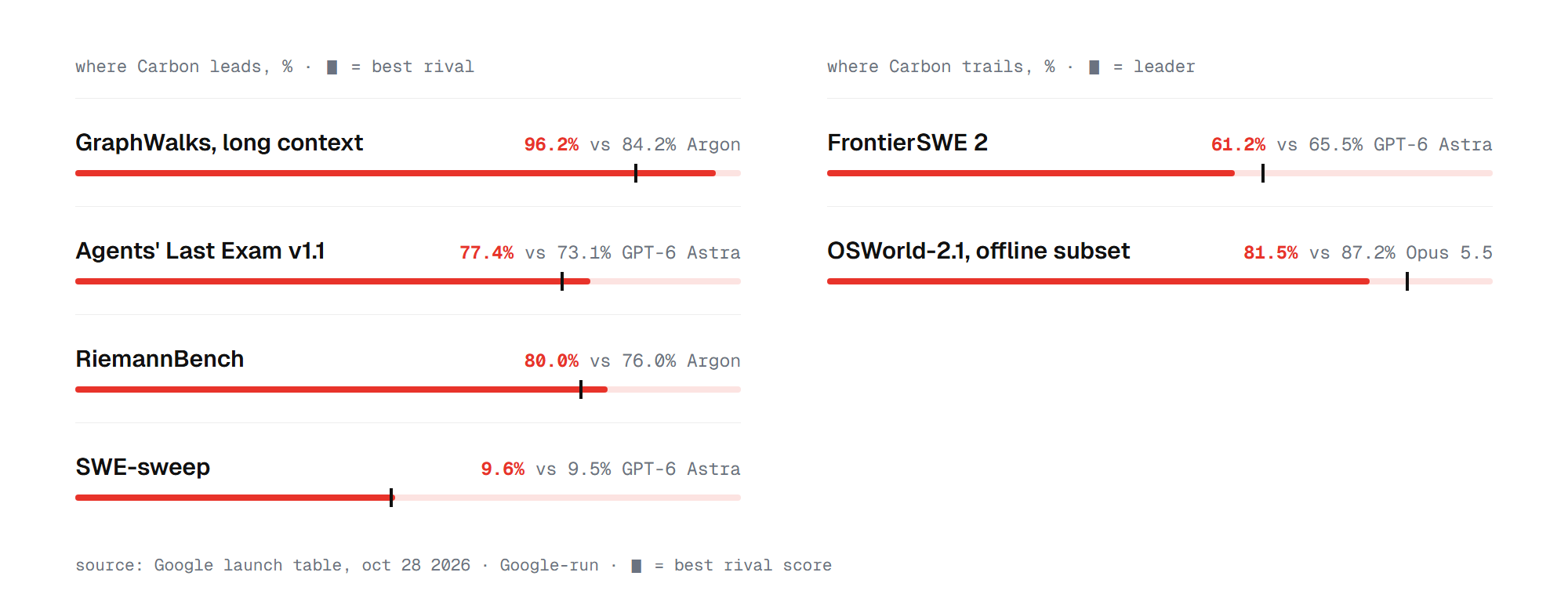
Carbon leads 15 of the 17 rows in Google's table. The widest margins over the next-best model are about 12 points each. Carbon scores 96.2% on the GraphWalks long-context test against 84.2% for Argon, and 54.8% on ExploitGym against 42.4% for GPT-6 Astra.
It trails in two rows. On FrontierSWE 2, GPT-6 Astra scores 65.5% to Carbon's 61.2%. On OSWorld-2.1, Opus 5.5 leads with 87.2% to Carbon's 81.5%. On SWE-sweep, Carbon's lead over Astra is 9.6% to 9.5%. The largest gains, though, are in the area Google is promoting most.
The cybersecurity numbers
Google says Carbon holds a firm lead on SEC-bench Pro at 88.2% for finding vulnerabilities, against 85.4% for GPT-6 Astra. On ExploitGym, which tests exploitation, it scores 54.8% with a 10-hour cap per task and 53.5% with a 6-hour cap. Claude Opus 5.5 scores 34.5% with a 6-hour cap.
On CWE-bench, which tests patching, Carbon scores 71.0%. Grok 4.7, Argon and GPT-6 Astra are tied at 68.0%. Google says these external benchmarks were run without guardrails.
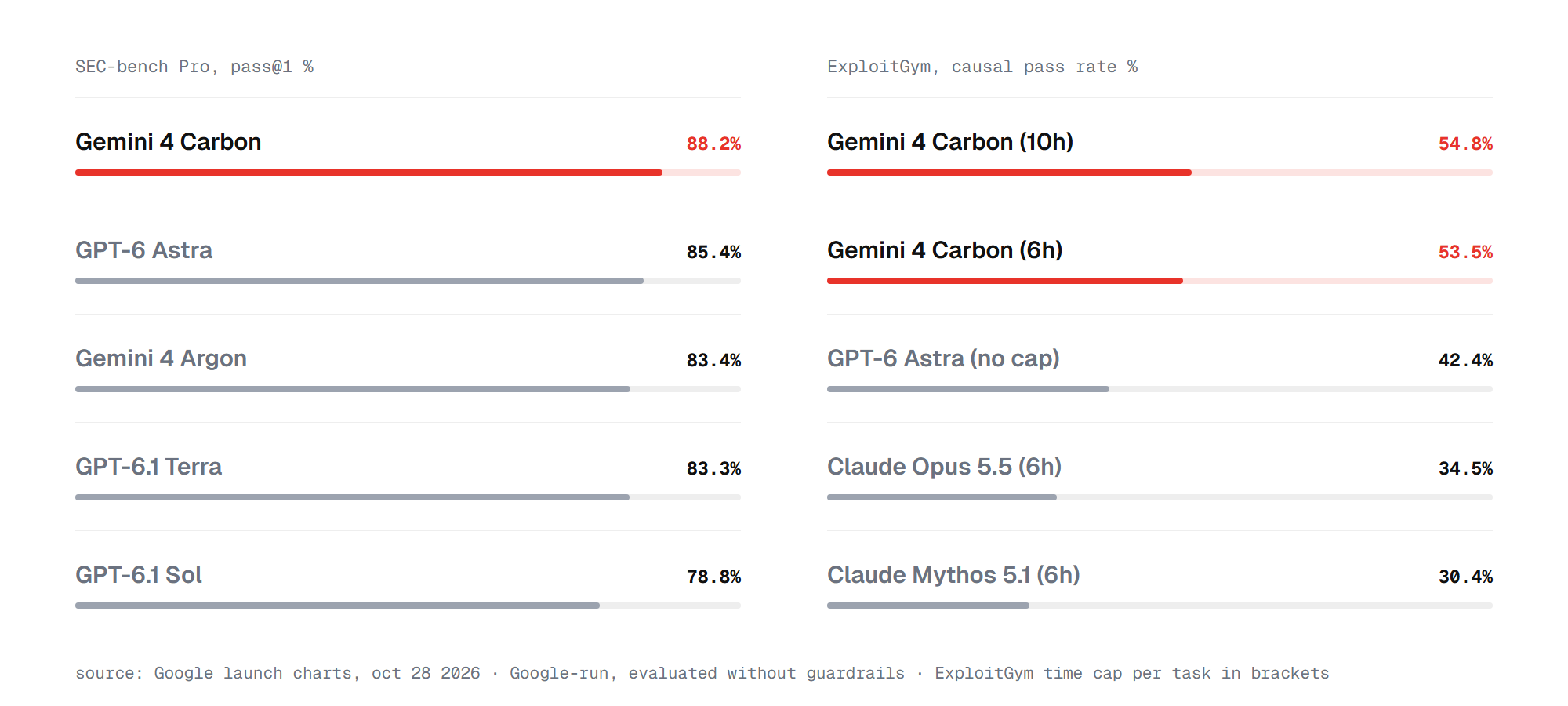
The other cyber claims are Google's own. It reports more than a 2x gain over Argon at writing secure code on internal tests. It says the Chrome team found Carbon more than 10x better than an unnamed lab's frontier model at producing quality patches. Wiz, the security company Google owns, says Carbon leads its web penetration testing benchmarks. Those capabilities explain who gets the model first.
Who gets access first
Google says Carbon is first available to a subset of trusted cyber defenders in its Fairwind program. Argon went through the same program first. Access starts this week and will phase in to more trusted partners.
Google says it is taking part in the US government's voluntary pre-release testing. It wants more feedback on guardrails before it opens Carbon to developers, businesses and consumers. It gives no date beyond "as soon as possible."
Pricing is already set. Carbon launches at Argon's introductory price of $2 per million input tokens and $10 per million output tokens. Cached input is 95% off. After the introductory period, the price doubles to $4 and $20, which is what Artificial Analysis lists. Google also made claims about safety.
What Google says about safety
Carbon uses the same safety stack as Argon: training, real-time misuse defenses, prompt-injection resilience and chain-of-thought monitoring. In internal testing, Google says Carbon cuts unsupported claims by about half compared with Argon. It says overreach fell 26% and under-service fell 29%.
On Gray Swan's indirect prompt injection benchmark, Google reports a 0.0% attack success rate, against 0.7% for Argon. It says cheating on Terminal-Bench 4.0 fell to 0.0%, and high-severity misalignment alerts in live coding dropped almost 80%. Before the launch, Carbon had already been circulating among testers.
What testers saw before launch
Business Insider reported on Oct 9 that Google employees were testing Carbon on an internal coding platform, according to retellings of that story. One employee reportedly said it felt comparable to Opus 5.5 but needed more testing. Google declined to comment at the time.
On Oct 23, TestingCatalog collected posts from early Arena testers. They called Carbon a clear step up from Argon, especially in 3D work, but said frontend output was still weak. One tester said it ran two to four times slower than Argon. TestingCatalog notes these were hand-picked matchups, not benchmarks.
What is verified and what is not
So does Carbon really lead? On the overall index, yes, and that part is checked. Artificial Analysis ran its own evaluation and lists Carbon at 59, ranked #1 of 52. The margin is one point, and Carbon still trails rivals on FrontierSWE 2 and OSWorld-2.1. The rest of Google's table, the cyber scores and every safety figure come from Google's own runs and published methodology. Few outsiders can test the model while access is limited to Fairwind. Until Carbon reaches the public API, the cyber lead remains Google's claim.
Sources
- Introducing Gemini 4 Carbon, Google blog
- Gemini 4 Carbon announcement, @GoogleAI on X
- Artificial Analysis, Gemini 4 Carbon model page
- 9to5Google, Google announces Gemini 4 Carbon
- Marktechpost report on Gemini 4 Carbon, a retelling of the launch
- TestingCatalog, Gemini 4 Carbon early test results
- Tech Insider, on the Business Insider leak report
- Google DeepMind, Fairwind program