Felix Laurent
Nvidia released Nemotron 3.5 Transcribe on October 28, an open-weight speech model that takes its instructions as text. One checkpoint transcribes 40 languages, translates 31 of them to or from English and labels up to eight speakers in 13 languages. Until now, the same job usually needed a chain of separate models.
In Nvidia's launch video, the model transcribes a newsroom scene from the 1940 film His Girl Friday. Everyone talks at once, and each line gets a speaker tag. The model is free to download from Hugging Face under the OpenMDW-1.1 license, which allows commercial use.
Nvidia's demo: Nemotron 3.5 Transcribe labels speakers S01–S04 in overlapping dialogue from His Girl Friday (1940).
One prompt instead of a pipeline
A typical transcription stack has three or four parts. One model turns speech into text, another works out who is speaking, a third translates, and a fourth cleans up names or personal data. Every handoff between them is a place where timing or speaker context can get lost, as AlphaSignal points out.
Nemotron 3.5 Transcribe folds those steps into one model and lets a text prompt pick the task. The same meeting recording can come back as a speaker-labeled transcript, an English translation or a summary of decisions. The prompt can also carry domain terms, such as drug names. Nvidia says the model should use them only when they really occur in the audio.
Other features are word-level timestamps, verbatim or clean transcripts, PII redaction and questions about the audio. Recordings can run up to one hour. The model works only on recorded audio and does not stream live speech.
That breadth raises an obvious question about cost, and the answer sits in how the model is built.
How a 30B model runs on one GPU
The model pairs a speech encoder with a hybrid Mamba–Transformer mixture-of-experts language model. Nvidia describes it as a 30B model with about 4B active parameters per token. The Hugging Face card counts the audio encoder too and lists about 34B total and 4.3B active.
The language part is based on Nemotron 3.5 Lightning 30B-A3B. A speaker encoder taken from Nemotron 3 Diarization feeds speaker cues into it, so labels are assigned while the transcript is being written. Weights ship in BF16, FP8 and NVFP4.
Nvidia recommends one H100 80GB for deployment. The card also lists A100, B200, RTX 5090, RTX PRO 6000, DGX Spark and Jetson Thor. On one RTX PRO 6000 Blackwell Server Edition with NVFP4, the model processed 100 hours of audio in under three minutes.
AlphaSignal adds two caveats. The 4B figure describes compute per token, while memory still depends on the full 30B. The speed figure is batch throughput, not the wait for a single file.
A small active footprint only matters if accuracy holds up, which is what the benchmark tables test.
Where it ranks on speech benchmarks
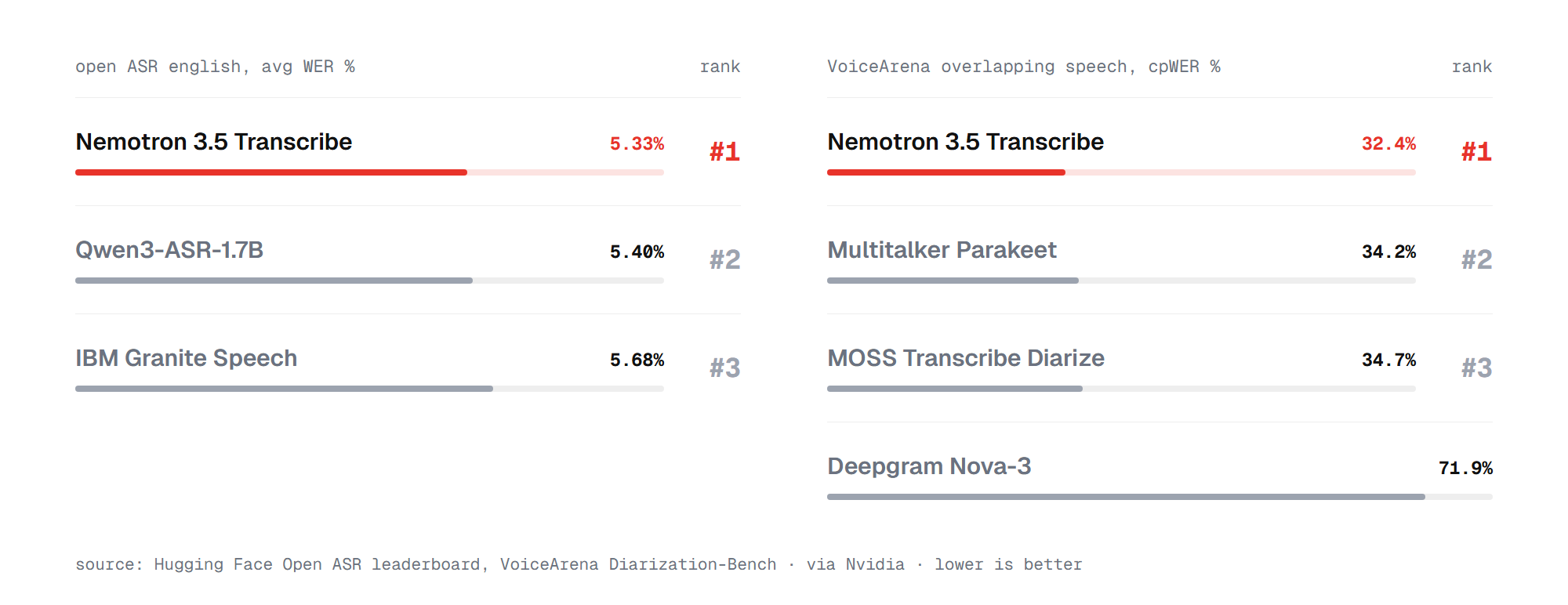
On the Hugging Face Open ASR leaderboard for English, the model posts a 5.33% average word error rate. That is first among open-weight models, ahead of Qwen3-ASR-1.7B at 5.4% and IBM Granite Speech at 5.68%. It also leads the seven-language track at 4.62% and the long-form track at 10.98%.
On Artificial Analysis, it scores 2.81% WER. Mistral's Voxtral Small sits at 2.77% while using roughly six times as many active parameters. On the AA-AgentTalk set, Nemotron reaches 1.8% against 2.3% for the next open model.
The strongest results come from conversations with overlapping speech. On VoiceArena's diarization benchmark of 14 systems, Nemotron scored 32.4% cpWER. Nvidia's Multitalker Parakeet followed at 34.2%, MOSS Transcribe Diarize at 34.7% and Deepgram Nova-3 at 71.9%.
On VoiceArena, the model dropped 8.32% of spoken words, while the median system dropped about 31%. On David AI's 21-language speaker-attribution test, it had the lowest error at 18.26%, just ahead of Nemotron 3 Diarization at 18.38%.
AlphaSignal warns that these rows are not directly comparable. Datasets, language mixes and scoring differ from table to table. The general picture is clearer when the model is pushed into a narrow field.
Fine-tuning for medical speech
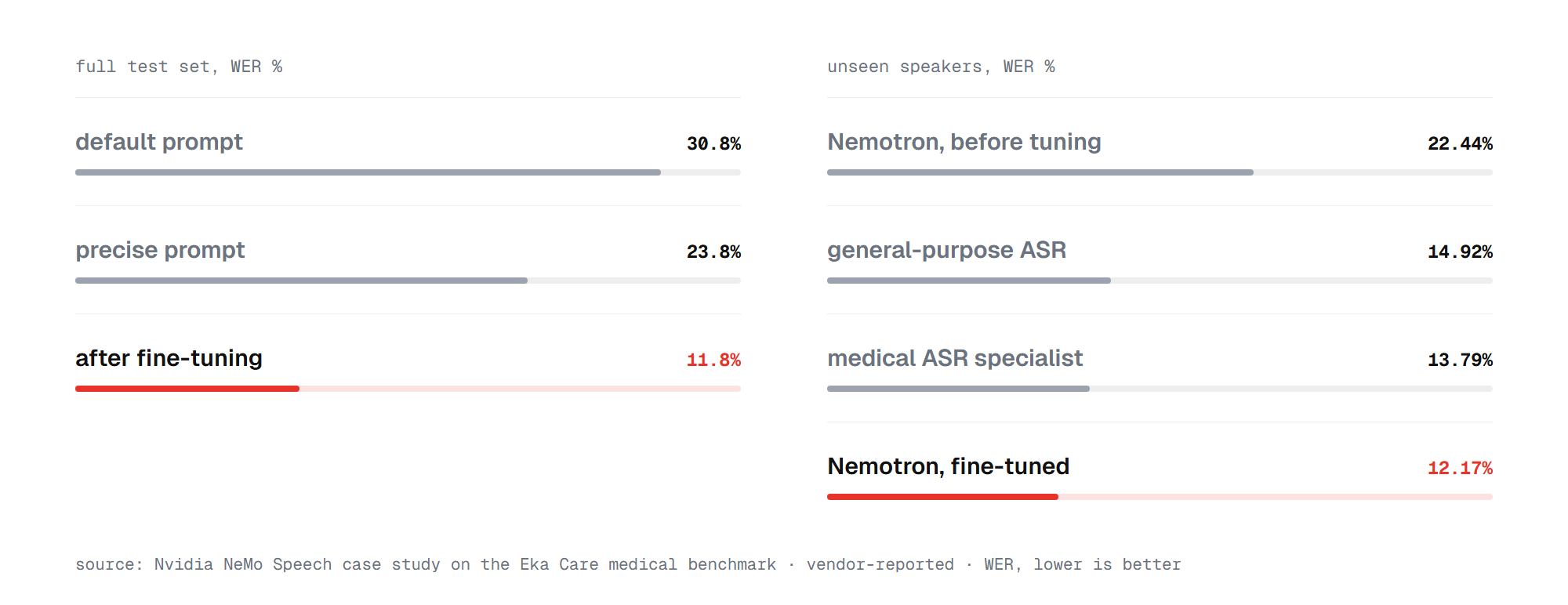
Nvidia tested adaptation on Eka Care's benchmark of Indian doctors and medical students. Out of the box, the model made errors on 30.8% of words. A more precise prompt cut that to 23.8%, and fine-tuning brought it to 11.8%.
On speakers the model had never heard, error fell from 22.44% to 12.17%, a 45.8% relative cut. That beat an open medical ASR specialist at 13.79% and a general-purpose model at 14.92%. Training used mostly synthetic speech and took about 14 GPU-hours on one GB300.
The adaptation has a price. Error on general English rose slightly, from 1.54% to 1.69% on LibriSpeech, and the specialist stayed better on brand-name drugs. Nvidia advises keeping at least 100 real, verified recordings aside for testing a custom version.
Nvidia also published recipes for this work. They cover new languages and code-switching, and come with a skill that lets an AI coding assistant run the training workflow. The data behind it is open as well.
Granary v2 and where to run it
Alongside the model, Nvidia released Granary v2, a public speech dataset of 463,062 hours in 48 languages. The first version covered 25 languages. Each clip has three transcript forms, from verbatim with filler words to a clean version with digits.
Nvidia also shares the curation pipeline, built on NeMo Curator. It says the public set does not fully match the model's own training mix.
The model runs today through vLLM and SGLang-Omni, with a demo on Hugging Face. Baseten, DeepInfra and Simplismart offer hosted endpoints. NeMo-Speech.cpp and quantized builds for DGX Spark and Jetson Thor are listed as coming soon.
A busy year for Nemotron speech
Transcribe is the third Nemotron speech release in 2026. In June, Nvidia shipped Nemotron 3.5 ASR Streaming, a 0.6B model for live captions that runs on a CPU. In September came Nemotron 3 Diarization, which tracks up to eight speakers but needed a separate model like Parakeet for the text.
The new model sits on top of both. It merges speaker tracking and transcription, then adds translation and audio understanding. The same family also covers vision, as in Nemotron 3.5 Super VL.
Mistral's Voxtral line also mixes transcription with audio understanding. Its newer Voxtral 3 is aimed at real-time voice agents, which leaves recorded audio to models like this one.
The limits are real. Audio Q&A and spoken instructions were tested only in English, and feature coverage varies by language. The card mentions rare generation loops, and the open vLLM build runs about twice as slow as Nvidia's NIM version. Nvidia itself advises spot-checks on names, speaker changes and answers.
So does one open model replace the transcription pipeline? For recorded meetings, calls and lectures in the 13 languages with speaker labels, it largely can. It matches or beats larger open models and costs about 4B active parameters per token. For live speech, Asian languages outside its list or strict medical vocabulary, separate tools still have the edge.