
 Felix Laurent

Tencent open-sourced WeVisOne-VL, a 2B and 4B vision-language model under Apache 2.0. One set of weights covers detection, counting, OCR, masks and alpha mattes. Its main selling point is a skill most grounding models lack: when asked for an object that is not in the image, it answers that the object is not there. Tencent says the 4B rejects 96.4% of such queries on its own WeRef bench.
What Tencent released
The release includes 2B and 4B weights, an inference package, three cookbooks, an evaluation pipeline and two demos on Hugging Face, under Apache 2.0. The model comes from WeChat Vision, a team at Tencent, and the name stands for WeChat Vision All-in-One. Tencent says the model replaces five jobs that used to mean five models.
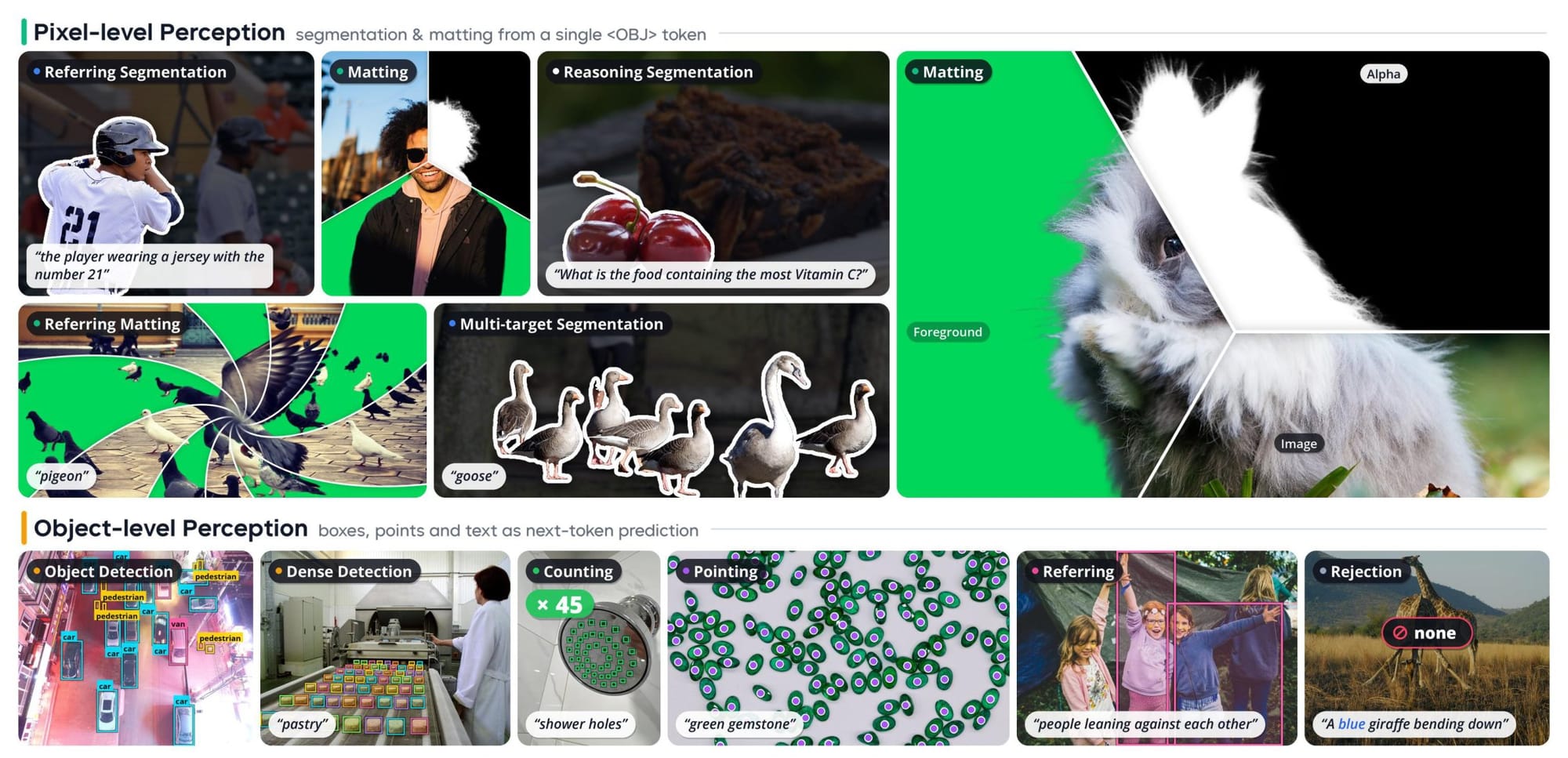
Tencent announced the model on X on Nov 3, but the release is older. The technical report went up on arXiv on Oct 22, and the README's news log dates the weights to October. The 4B model was downloaded about 9,800 times in the past month, according to its Hugging Face page. How one model handles so many tasks comes down to its design.
How it works
WeVisOne-VL is built on Alibaba's Qwen3-VL. It writes boxes and points as text, using coordinate tokens from 0 to 1,000, and answers None when the target is absent. For masks and mattes, it adds a special OBJ token after each box. A small pixel decoder then turns that token into a mask or a full-resolution alpha matte.
Tencent says alpha mattes come from a 9.6M-parameter decoder. The Hugging Face page lists a mask_decoder.pt of 9,609,764 parameters as a required core component. Tencent also says there is no SAM, Meta's segmentation model, in the pipeline. The model was trained in three stages of supervised fine-tuning, followed by reinforcement learning on mixed tasks.
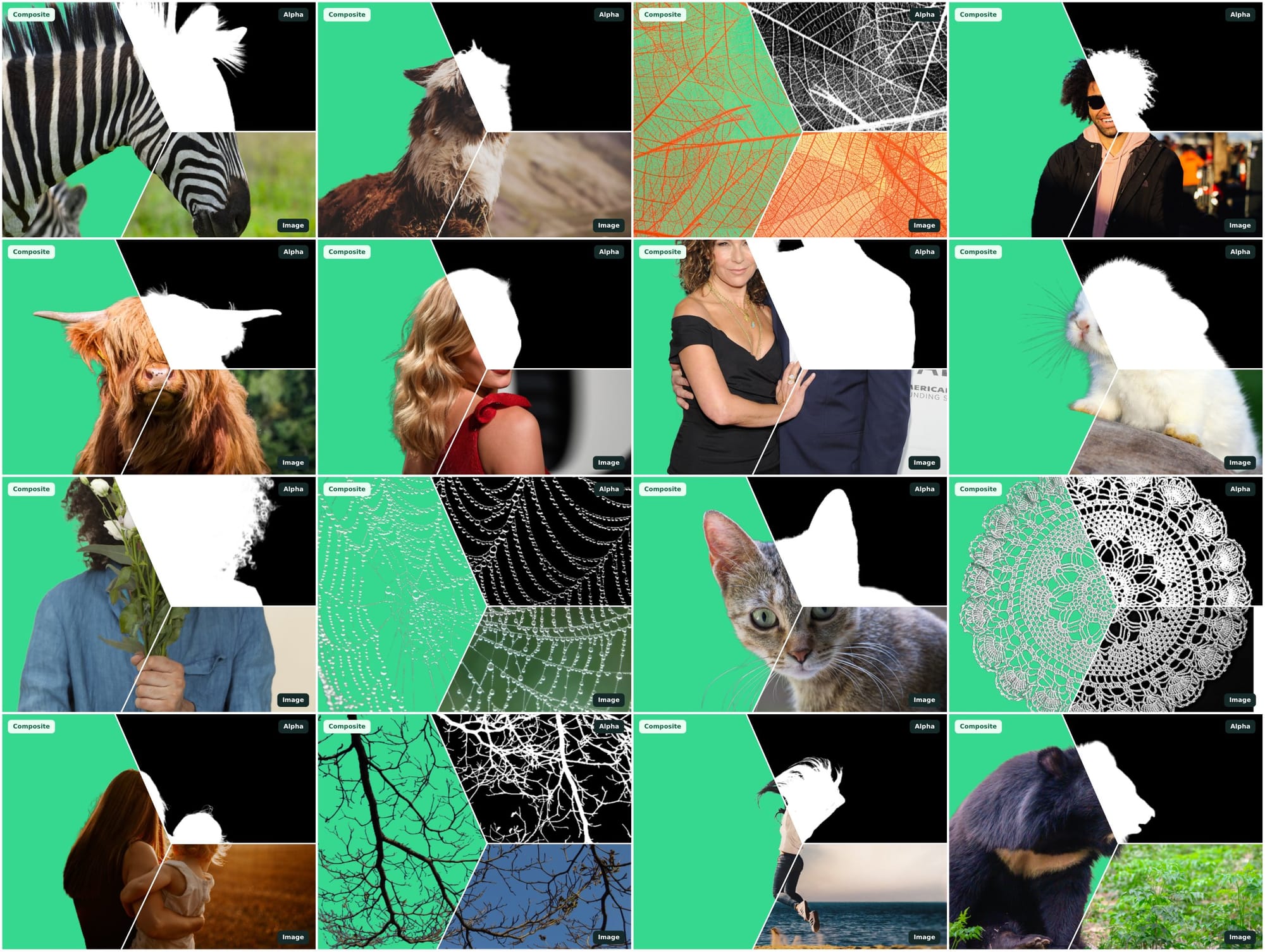
The training data comes from an automated engine that uses a knowledge graph to label images. Tencent says more than 100M images were annotated this way, with checked boxes extended to masks and mattes. It has also open-sourced Mask2Alpha, the tool that turns masks into mattes. The main thing this data teaches is when to say no.
The absent-object claim
Ask most grounding models for an object that is not in the image, and they still draw a box. That is a common failure: the model assumes the object exists because the question mentions it. WeVisOne-VL returns None instead.
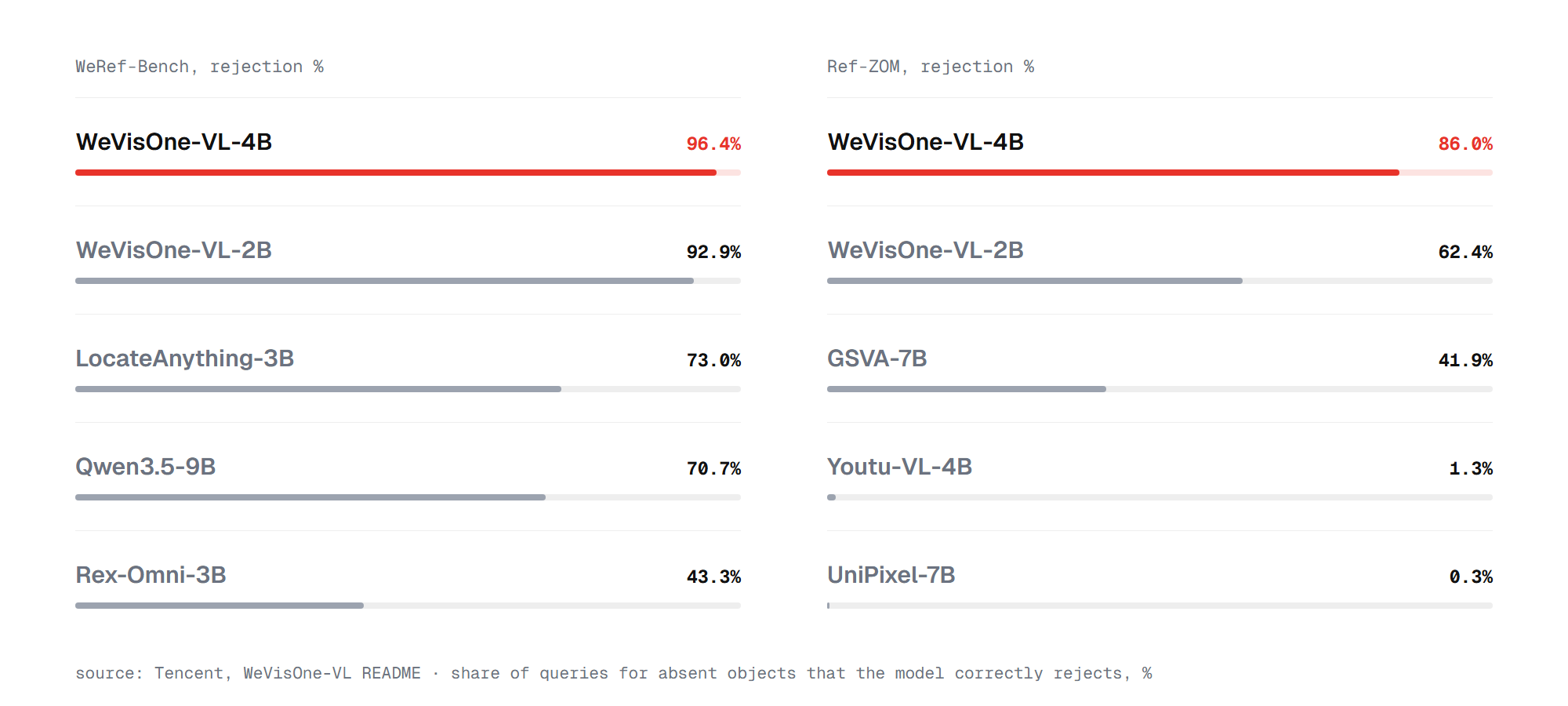
On Tencent's own WeRef bench, the 4B rejects 96.4% of such queries and the 2B 92.9%. The best baseline in Tencent's table, LocateAnything-3B, rejects 73.0%, and Rex-Omni-3B from IDEA Research 43.3%. On Ref-ZOM, a public benchmark built for the same failure mode, the 4B rejects 86.0%. Most segmentation models in the table almost never refuse: UniPixel-7B rejects 0.3% and Youtu-VL-4B 1.3%.
The two figures come from different benchmarks, so they are not a like-for-like comparison, and WeRef is Tencent's own test. Both are Tencent's reported results. Rejection is the headline, but Tencent reports wins on other tasks too.
Detection and counting
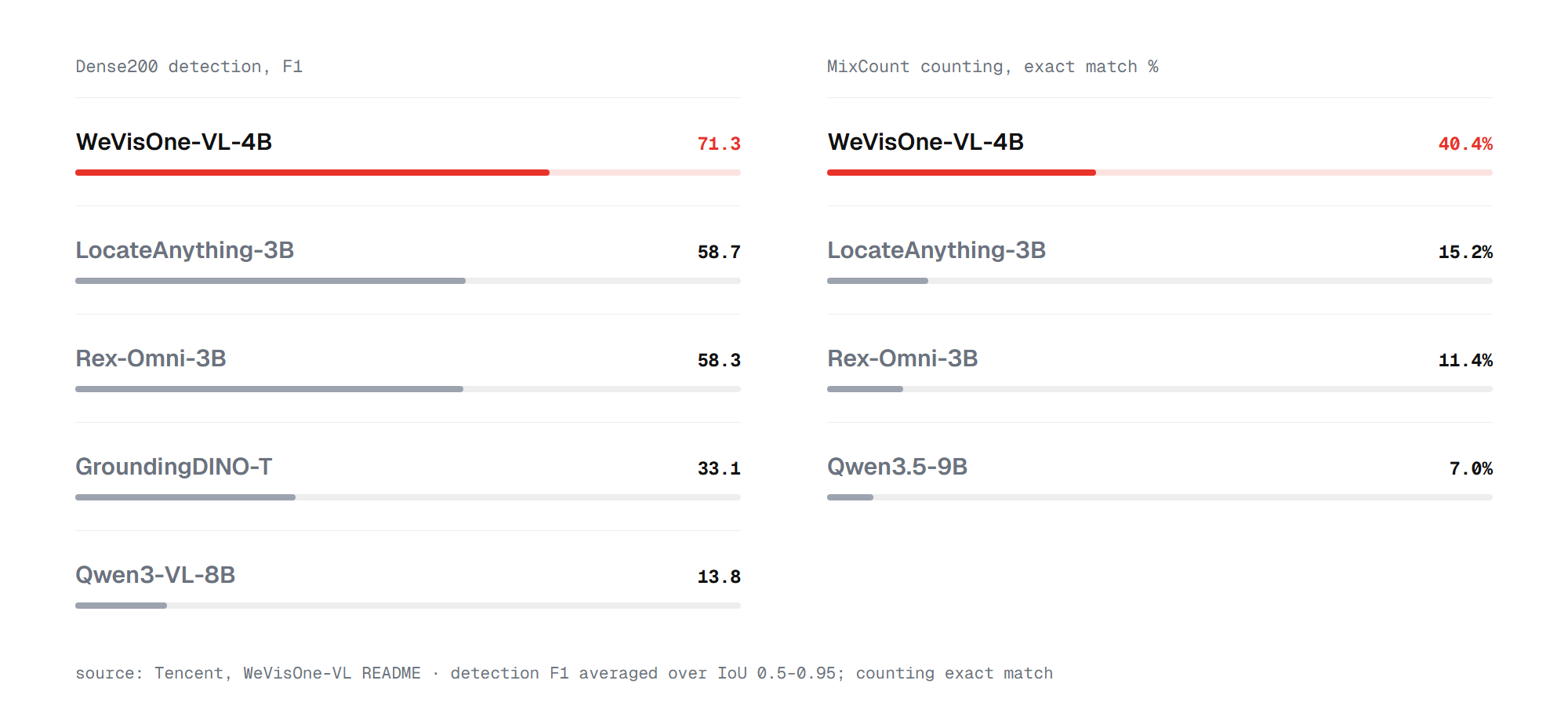
In Tencent's tables, detection and referring scores are F1 averaged over strict box overlap thresholds. On Dense200, a test with many small objects packed together, the 4B scores 71.3, against 58.7 for LocateAnything-3B and 13.8 for Qwen3-VL-8B, the larger general model. On COCO the gap is small: 57.1 for the 4B against 56.6 for GroundingDINO-T, which beats the 2B there.
Counting is the biggest jump. On MixCount, the 4B counts exactly right 40.4% of the time, against 15.2% for the best baseline. On PixMo-Count it reaches 89.6%. On TotalText, a test of curved and rotated text, it scores 52.0 against 43.3 for the best baseline and 25.7 for PP-OCRv5, a dedicated OCR model. The pixel tasks show the same pattern.
Masks and mattes
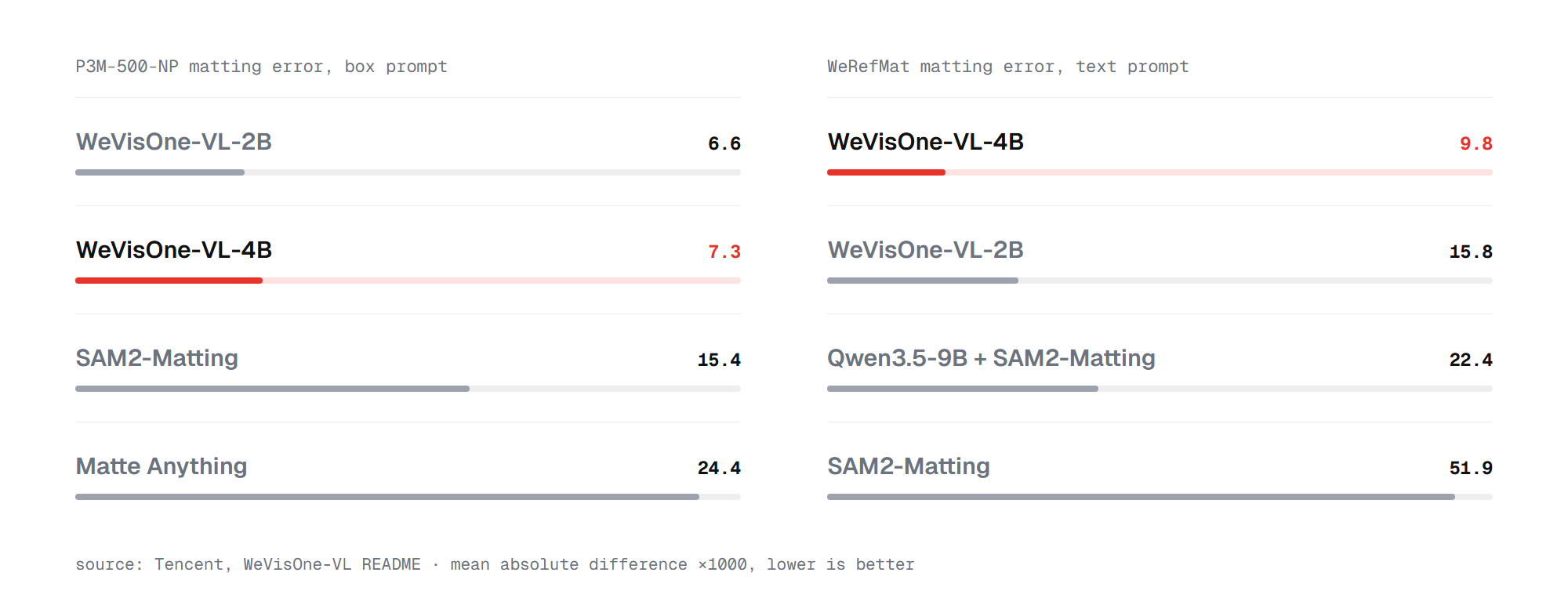
Matting means cutting an object out with soft edges, such as hair or fur, and it is measured as an error, so lower is better. On P3M-500-NP with a box prompt, the 4B's error is 7.3, half that of SAM2-Matting at 15.4. The 2B does slightly better still, at 6.6. When the object is described in words on Tencent's WeRefMat test, the 4B's error is 9.8, against 22.4 for Qwen3.5-9B paired with SAM2-Matting.
On referring segmentation, the 4B scores 84.5 on RefCOCO and 71.2 on ReasonSeg, which asks for objects described by reasoning, such as "the food with the most vitamin C". The tables do not show it winning everywhere. LocateAnything edges it on Dense200 pointing, 87.6 against 87.0, and the 2B beats the 4B on some tests. All of these numbers come with caveats.
What is not verified
Tencent says the scores can be rerun with the repo's evaluation scripts, and the paper claims leading results across more than 30 benchmarks. A third-party blog, orcarouter, notes that every figure comes from Tencent's paper or README and none has been reproduced independently. Several of the key tests, WeRef and WeRefMat, are Tencent's own.
Some details do not line up. The Hugging Face metadata lists the 4B model at 5B parameters, a gap the page does not explain. The README gives no speed or hardware figures, only that the model runs with transformers or vLLM on GPU, NPU or CPU. Fine-tuning code is still listed as a to-do. The limits are clearer than the speed.
Limits
The model handles images only. The Hugging Face page says it targets single-turn image perception and rejects video grids. It does no step-by-step reasoning, and its fine edges depend on resolution, occlusion, transparency and how the prompt is phrased. Tencent says it is meant for research and not for identifying people or making high-impact decisions on its own.
So is WeVisOne-VL the vision model that knows when to say no? On Tencent's numbers, yes: the 4B rejects absent objects far more often than any model it compares against, and it leads most of the detection, counting, OCR and matting tables at a small size. But the strongest results come on Tencent's own benchmarks, nobody has reproduced them, and it works on single images only. For developers who need one small, open model for boxes, counts and cutouts, it is worth testing on their own images before trusting the tables.
Sources
- Tencent AI announcement post on X, Nov 3
- WeVisOne-VL repository and README, GitHub – benchmark tables
- WeVisOne-VL-4B model page, Hugging Face – limits and files
- WeVisOne-VL technical report, arXiv – Oct 22
- WeVisOne-VL-4B demo
- Report by orcarouter, retelling Tencent's paper and README
- Rex-Omni model page – a baseline in Tencent's tables