Felix Laurent

In October 2026, Nvidia's two fastest gaming cards disappeared from its own store, and Intel began moving laptop chip capacity to server processors. Those were not sudden decisions. They were the latest step in a shortage that started with memory more than a year earlier.
The cause is the same at every stage: AI data centers pay more for the same factories, wafers and chips. This explainer traces how the PC parts shortage moved from RAM to graphics cards to processors. It also compares it with the last GPU crisis and looks at when it might end.
How the PC parts shortage started with memory
The first signs came in 2025. In September, the research firm TrendForce looked at where the big DRAM makers put their advanced capacity. The answer: "primarily to high-end server DRAM and HBM," it wrote. HBM is the stacked memory used in AI accelerators. Every wafer spent on it is one less for PC and phone memory.
In December 2025, Micron made the shift official for consumers. On December 3, it announced it would exit the Crucial consumer business, citing AI-driven demand for data center memory and storage. Crucial RAM and SSDs would ship only until February 2026.
Prices followed. In February 2026, TrendForce raised its forecast for conventional DRAM contract prices in the first quarter to 90-95% above the previous quarter. For PC DRAM, it expected prices to more than double.
The real numbers came in even higher. Conventional DRAM contract prices rose about 93-98% in the first quarter, TrendForce reported in June. It expected another 58-63% increase in the second quarter, as new supply went first to memory for AI servers.
Graphics cards depend on memory too, so they were next.
Memory shortages reached graphics cards
In December 2025, the Taiwanese site Benchlife reported that Nvidia would ship 30-40% fewer RTX 50 cards in early 2026. The first models affected were the RTX 5070 Ti and RTX 5060 Ti 16GB, and the reason was a shortage of GDDR7 memory.
Nvidia did not confirm the figure. In January 2026, it said that "memory supply is constrained" but that it would keep shipping all GeForce models. The same month, Board Channels reported that Nvidia had told partners not to expect the RTX 50 Super refresh soon. Spare memory was going to AI products instead.
By then, buyers faced fewer new cards and rising prices on the ones left. The next cut hit the top of the lineup.
The RTX 5090 and RTX 5080 left Nvidia's store
The RTX 5090 launched on January 30, 2025, at $1,999. On October 10, 2026, Tom's Hardware reported a leaked factory notice. According to it, Nvidia would stop supplying the GB202 chip for RTX 5090 cards and use it only in data center and professional products.
Nvidia pushed back a week later. Production "has not been discontinued," senior vice president Jeff Fisher told the Taiwanese site 4Gamers. But by October 17, the card was gone from Nvidia's store and Micro Center, and resellers asked about $8,500 on Amazon.
On October 30, the RTX 5080 also disappeared from Nvidia's store. The cheapest one in stock cost $2,199.99, 2.2 times its $999 launch price.
The economics explain the choice. The RTX Pro 5500 uses the same chip with the same 21,760 CUDA cores, but with 84GB of memory instead of 32GB. In the quarter that ended in July 2026, Nvidia's data center business made $89.0 billion of its $96.2 billion revenue, about 92.5%. Gaming no longer even has its own line in Nvidia's results: it sits inside the Edge Computing segment.
Processors were the last part of the PC to feel the shift, and Intel made it official.
Intel moves capacity from PC chips to Xeon
In late October, Notebookcheck reported that Intel was moving capacity from consumer processors to server CPUs. In Oregon, Intel is converting part of its 18A line, built for Panther Lake laptop chips. It will make Xeon data center chips on the Intel 3 process instead.
The demand is clear in Intel's numbers. Its Data Center and AI unit earned $7.3 billion in the third quarter of 2026, according to its quarterly filing. That is nearly 80% more than a year earlier.
Buyers already pay more. Consumer CPU prices rose 5-10% between March and April 2026, Tom's Hardware reported, citing Taiwan's Commercial Times. Analysts expect another 8-10% increase in the second half of the year.
It is "one of the most significant supply shortages in history," CEO Lip-Bu Tan said. Intel expects the shortage to stay severe in the first half of 2027 and to ease in the second half.
The timeline below shows how the squeeze spread from part to part.
| Date | Event | What it meant for PC buyers |
|---|---|---|
| September 2025 | DRAM makers prioritize server DRAM and HBM | Less capacity for PC memory |
| December 3, 2025 | Micron announces exit from Crucial consumer business | One major RAM and SSD brand leaves retail |
| December 2025 | Benchlife reports 30-40% fewer RTX 50 cards in 1H 2026 | Fewer new graphics cards |
| January 2026 | RTX 50 Super reportedly put on hold | No refresh with more memory |
| 1Q 2026 | DRAM contract prices rise about 93-98% | RAM costs nearly double |
| October 10-30, 2026 | RTX 5090, then RTX 5080 leave Nvidia's store | High-end GPUs at over twice their launch prices |
| Late October 2026 | Intel moves Oregon capacity to Xeon | Fewer consumer processors |
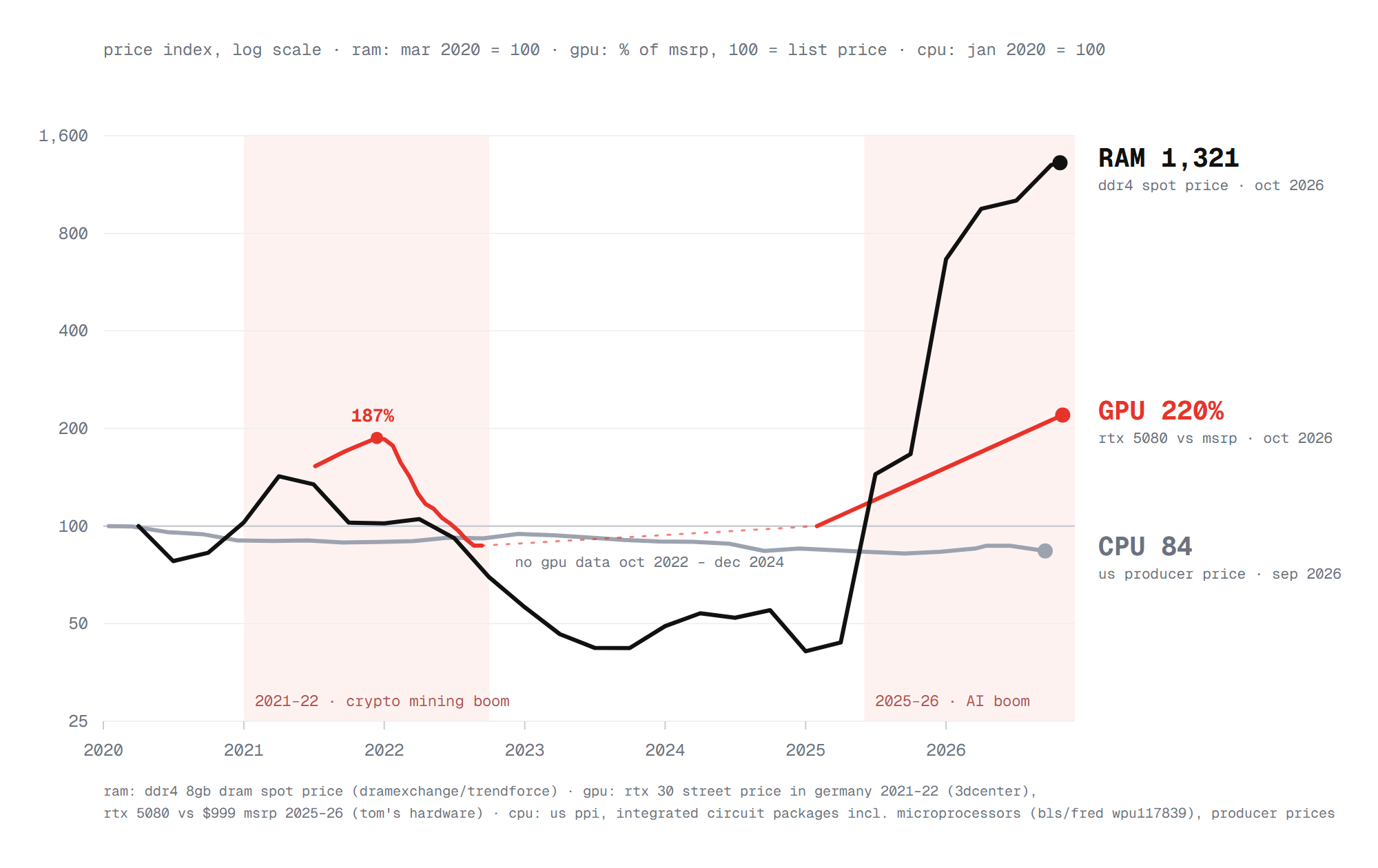
Seen since 2020, the jump stands out even more. DDR4 memory chips cost about 13 times more in October 2026 than in March 2020, after falling to less than half that level in 2023. Graphics cards had a spike in the 2021 mining boom and are now above list price again. Producer prices for processors have barely moved, so the CPU squeeze shows up mostly as supply cuts and retail price hikes.
Shortages of PC parts have happened before, but the last one worked differently.
How this compares with the 2020–2022 GPU shortage
The previous GPU crisis was driven by crypto miners and the wider chip shortage. In January 2022, The Register reported that third-party RTX 3090 cards sold for about three times their $1,499 price on some sites. Nvidia's chief financial officer Colette Kress expected to be "in great shape in terms of supply" later that year.
That shortage ended when demand fell and supply caught up. This one is different. The buyers are chipmakers' biggest and most profitable customers, and the companies are choosing to serve them first. The squeeze also covers memory, graphics cards and processors at the same time.
Forecasters expect it to last. In March 2026, IDC cut its forecast for 2026 PC shipments to an 11.3% decline, citing memory shortages. "Memory shortages will persist well into 2027," IDC analyst Jitesh Ubrani said. IDC does not expect PC prices to return to 2025 levels, with easing only from 2028.
When will PC parts get cheaper
Not before late 2027, and maybe not until 2028. Intel puts relief in the second half of 2027, and IDC expects prices to start easing only after that. Nvidia's next gaming generation is not expected before late 2027 either.
The bigger change is permanent. A year ago, PC buyers competed with other PC buyers. Now they compete with AI data centers for the same memory, chips and factory lines, and data centers pay more.
OpenAI CEO Sam Altman has made that case openly. On the Cheeky Pint podcast, he called it "quite terrible" for people to keep DRAM in their own computers. In his estimate, that memory is used only 5% of the time, while the cloud can run it at maximum utilization.
PC Gamer noted that Altman was talking about running AI models locally, not about gaming PCs. Still, his company is one of the biggest buyers of that memory, and his argument describes where it is already going. Until AI demand slows or new fabs come online, gamers and PC builders will get what is left after the AI orders are filled.
Sources
- Micron announces exit from Crucial consumer business, Micron – December 3, 2025
- 1Q26 memory price outlook sharply upgraded, TrendForce – February 2, 2026
- 1Q26 DRAM industry revenue, TrendForce – June 1, 2026
- Nvidia financial results for the second quarter of fiscal 2027, Nvidia – August 26, 2026
- Nvidia reportedly halts GeForce RTX 5090 production, Tom's Hardware – October 10, 2026
- CPU requirements for AI workloads are multiplying, driving shortages and price hikes, Tom's Hardware – April 24, 2026
- Sam Altman argues that it's bad you want DRAM in your computer and not a data center, PC Gamer – October 30, 2026
- IDC cuts 2026 PC outlook to -11.3% as memory shortages persist into 2027, IDC – March 12, 2026