Felix Laurent
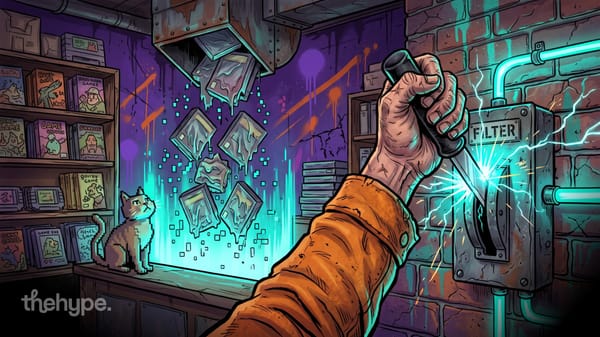
Itch.io, the indie game store, deleted "a couple terabytes of AI slop" on November 3, 2026. The store announced the cleanup on Bluesky two days after it reported that new game pages had doubled in two months. It also expanded its AI disclosure rules and added a filter that hides AI content.
It is not a ban on itch.io AI games. The store says it is enforcing a rule against AI spam that has been in its guidelines for over two years. The flood of uploads shows how cheap generative AI has made it to fill an open store.
What itch.io deleted and why
"The number of game pages being created per-day has doubled in the past 2 months," itch.io posted on November 1. Techtroduce put the daily count at about 3,000 in early August and over 6,000 by late October. Itch.io told users that downloads and purchases did not double with it.
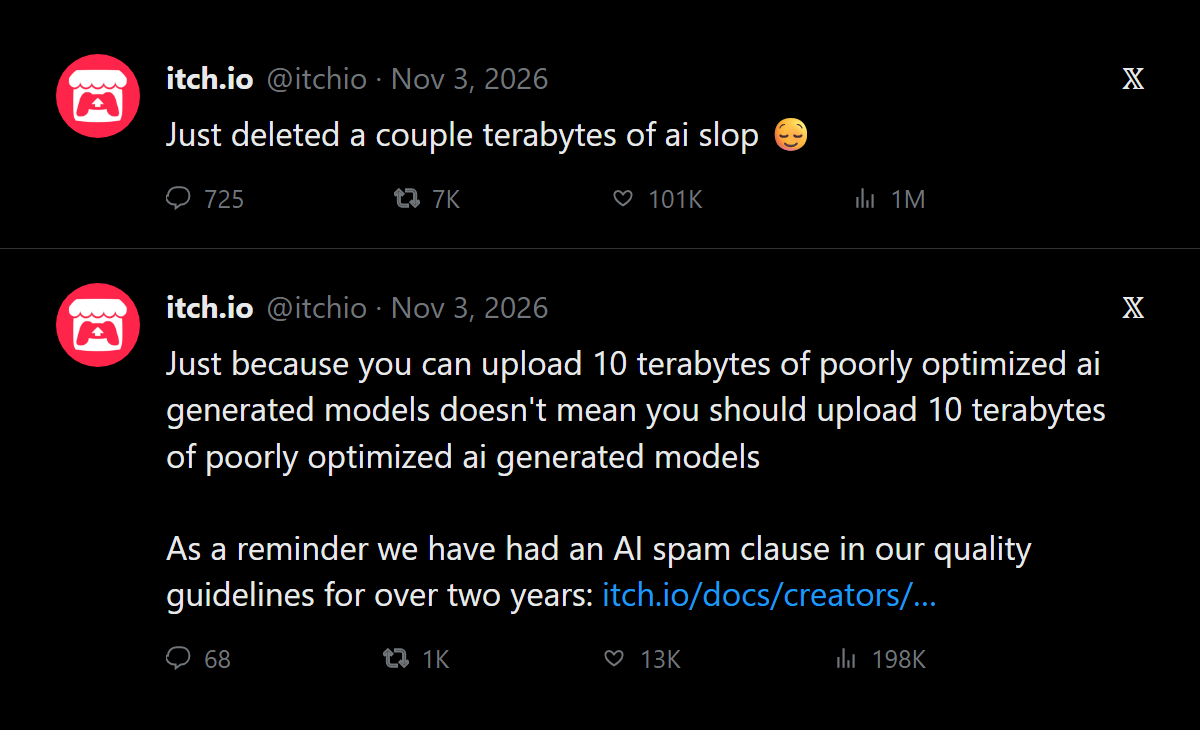
"Just deleted a couple terabytes of ai slop," the store wrote two days later. When users asked whether this meant a no-AI policy, the store pointed to its quality guidelines instead.
Its reply was blunt. Just because you can upload "10 terabytes of poorly optimized ai generated models," it wrote, does not mean you should. Itch.io added that an AI spam clause has been in its creator quality guidelines for more than two years.
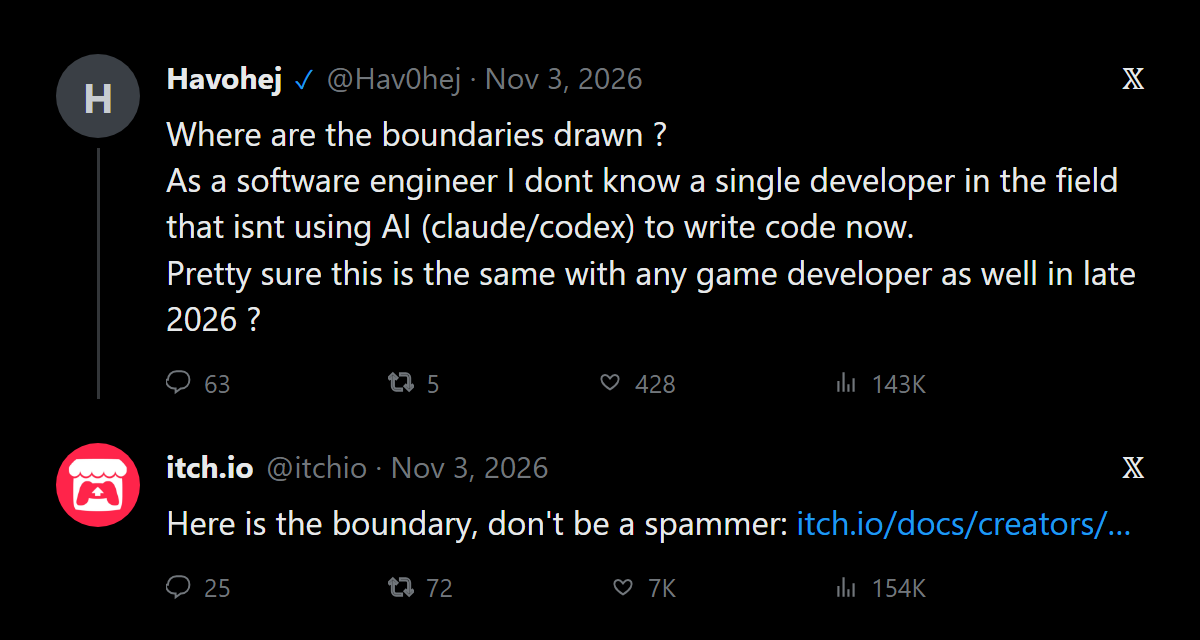
So the target is volume, not the technology. That leaves open how buyers can avoid AI content they do not want.
How the new AI disclosure filter works
Itch.io's generative AI disclosure started in late 2024 as a field on project pages. Creators mark whether a project uses AI for graphics, sound, text or code. For asset packs, the disclosure is strictly enforced, and untagged AI assets do not appear on browse pages.
The November update extends AI notices beyond video games to tabletop games, books, comics and soundtracks. Itch.io is also adding AI disclosure filtering to more parts of the site, including search results. In its own words, filtering was "critically lacking" in those places.
The filter shows the scale of the change. GamingOnLinux searched itch.io for Linux games: 153,734 results without the filter, and 43,057 with AI-notice content hidden. Techtroduce warns that the gap is not a clean count of AI games, since the filter can also hide pages for other reasons.
Users on Bluesky were split on whether disclosure is enough. Many asked for an outright ban. Others argued that a ban would only push creators to lie, since AI content is hard to detect and itch.io is a small team.
That debate is not unique to itch.io. Steam faces the same flood with a different set of rules.
How Steam handles AI games
Steam has asked developers to disclose AI-generated content since January 2024. An analysis by Totally Human Media counted about 1,000 games with such disclosures in 2024. By July 2025, the number had grown to nearly 8,000, Notebookcheck reported.
Like itch.io, Steam relies on self-reporting. Neither store bans AI games outright, and both sort content through labels and filters rather than removals. The difference is that itch.io is now deleting bulk uploads it considers spam.
The table compares the two stores' approaches.
| Itch.io | Steam | |
|---|---|---|
| AI ban | No | No |
| Disclosure | Field on project pages; strictly enforced for assets | AI section in the content survey since January 2024 |
| Filtering | New AI filter, now in search results | Disclosure shown on store pages |
| Removals | Deleted bulk AI spam under its quality guidelines | No mass AI removals reported |
Both stores bet on the same idea: let buyers see the label and decide.
Can disclosure keep AI slop out of indie stores
Only partly. Itch.io's numbers show the problem is real: page creation doubled in two months, while downloads and purchases did not follow. The terabytes it deleted were bulk uploads, the easiest kind of AI content to spot.
The new filter helps buyers who want to avoid AI, but it works only when creators tell the truth. As uploads keep growing, the AI spam clause will matter more than the label. Itch.io has chosen to police volume and leave the rest to disclosure. Whether that holds depends on how fast its small team can delete what slips through.
Sources
- itch.io on new game pages per day, Bluesky – November 1, 2026
- itch.io on deleting AI content, Bluesky – November 3, 2026
- Game store itch.io is getting flooded with AI slop, GamingOnLinux – November 3, 2026
- itch.io removes terabytes of AI content as game uploads double, Techtroduce – November 3, 2026
- Nearly 8,000 games on Steam have AI generated content, Notebookcheck – July 17, 2025, citing Totally Human Media