Felix Laurent

Together AI has open-sourced Hurdle, the framework it uses internally to run agent evals. Hurdle tests how well Claude Code and Codex can use a company's API, docs, MCP server and skills on real developer tasks. It runs each task many times across models and setups, then shows the pass rate for every combination.
Together announced the release on X on November 25. Hurdle is an npm library under the MIT license. The team says it spent six months building it after running evals by hand became too tedious. The release follows a November 16 post in which Together described what these evals had already turned up on its own platform. Here is how Hurdle works and what it found.
What Hurdle does
More and more developers reach an API through a coding agent instead of reading the docs themselves. Together calls this agent experience. If an agent cannot find the right endpoint or misreads a sample, the developer behind it hits the same wall. Hurdle is meant to show where that happens before users notice it.
A test in Hurdle starts with a task, which is simply a prompt a developer might give an agent. Hurdle launches the agent, records the whole session and scores the result. A suite file picks the tasks, agents and models to run. It also sets the conditions to test and how many times to repeat each run. Repeats matter because agents rarely behave the same way twice, so one lucky run says little.
Conditions are where the tool gets useful. A team can run the same task on a fresh agent with and without its MCP server or skill package installed. The difference in pass rates shows whether the extra context actually helps.
The next question is how Hurdle decides whether a run passed.
How Hurdle scores a run
Teams can score each run with one of three methods or mix them:
- Code checks. Assertions about the run, such as which API requests the agent must make or which files it should produce.
- Guards. Rules that block actions the agent must not take. Hurdle stops the request, and any attempt counts as a failure.
- LLM judge. A model reads the recorded session and grades it against a rubric written in plain English.
Together's own example task asks an agent to find the cheapest GPU cluster. The agent must print the command to reserve it for an hour without actually reserving it. A code check confirms that the agent called the live regions endpoint. A guard blocks any request that would create a paid cluster. A judge then checks whether the agent found the official prices and wrote a valid command. In Together's sample suite, this one task runs on two models under two conditions, 15 times each, for 60 runs in total.
Results open in a local viewer. It shows the pass rate, average duration and cost per run, plus a grid by task and condition. Each run can be opened to see the full transcript, the agent's tool calls and API requests, and the verdict of every check.
Guards and request checks only work in one of Hurdle's two run modes.
Sandboxed runs keep keys away from the agent
In a local run, Hurdle starts the claude or codex CLI on the user's machine in a temporary workspace with a clean config. It is quick, but Hurdle cannot see or block the agent's API requests there. The agent also runs as the user, so it can read local files and use real keys. Together recommends local runs only for tasks you trust.
Sandboxed runs use the Together Sandbox API instead. Each run gets a fresh, isolated sandbox with no network access of its own. All traffic goes through a single socket back to Guardian, a local proxy on the user's machine that allows or rejects each request. The agent only sees random stand-ins for API keys, and Guardian swaps in the real key on the way out. That routing is what lets Hurdle record every request and answer a blocked one with a 403 error.
There are limits. Guardian runs only on macOS and Linux for now. It also swaps keys only in the Authorization header, so APIs that take keys another way will not authenticate. The sandbox does not limit which endpoints the agent can call. Together advises using a dedicated low-balance key for evals and adding guards for anything risky.
Together's own numbers show why it went to this trouble.
What Together found with its own evals
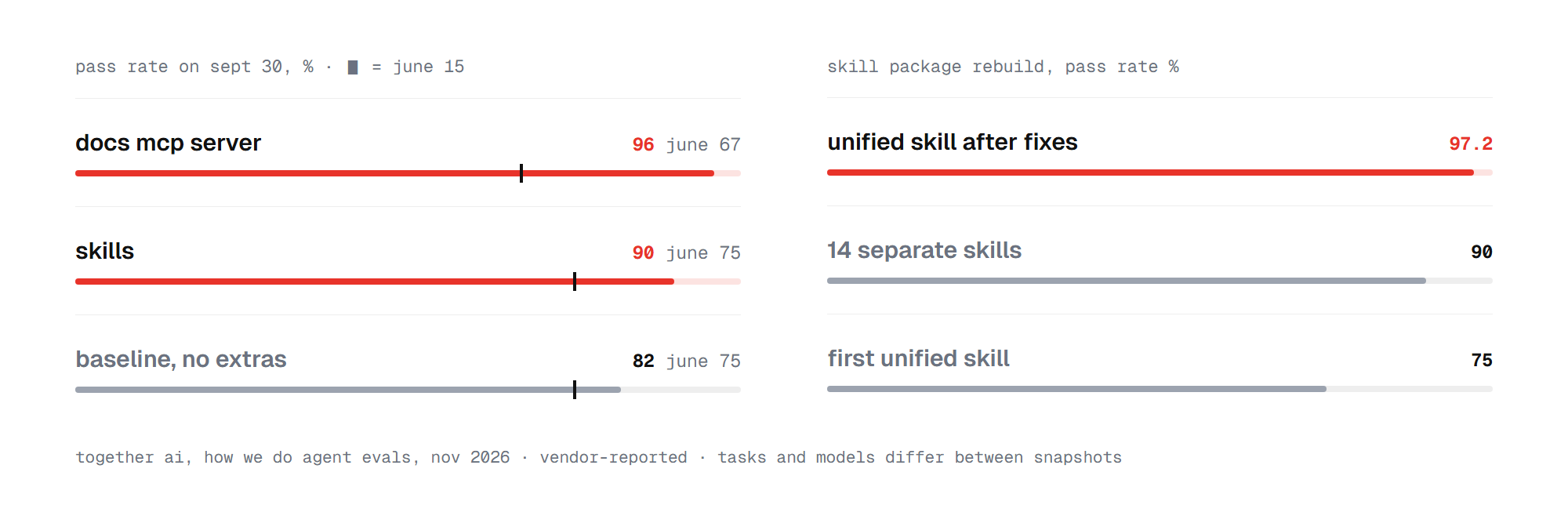
In its November 16 post, Together said evals pushed agent success on its platform far higher with mostly small fixes. On June 15, running Opus 4.8, the baseline setup passed 75% of runs. Neither the docs MCP server (67%) nor the skill package (75%) helped at all. By September 30, across three models, the MCP setup reached 96% and skills reached 90%, while the baseline rose only to 82%.
The GPU cluster task explains part of the jump. Sonnet 4.6 passed it only 4 times out of 15, even with skills enabled, while Opus 4.8 passed 13 of 14. Transcripts showed Sonnet treating a sample output in the CLI reference as the live inventory. Its skill file also linked to a marketing page instead of the pricing table. Two new sentences in the skill fixed it, and the task then passed every time for all tested models.
The evals also caught a bug in Together's API. An error message pointed agents to a route that did not exist, so even a correct retry failed. Together says it fixed both the message and the routing bug behind it.
The skill package went through the same loop. Together merged 14 separate skills into one, and the first version passed only 75% of runs at more than twice the cost. After the team cut the router file, updated stale models and fixed broken sample code, it reached 97.2%. Together admits these snapshots used different models and tasks, so they are not a controlled comparison.
Teams that want to run the same kind of tests can start in a few commands.
How to try Hurdle
The tool needs Node.js 22.18 or later and the Claude Code or Codex CLI. Running npx hurdle init creates a starter suite, and npx hurdle run --view runs it and opens the viewer. Claude Code works with an Anthropic API key or a subscription token from claude setup-token. Codex needs an OpenAI API key, since a ChatGPT login is not supported. Starter suites use Opus 5.5 and GPT-6.1 Sol by default.
A bundled example runs against the Together API inside a sandbox. Together says its side of each run should cost a fraction of a cent, but agent usage is billed separately. To test their own product, teams add their API key and host to the suite and write tasks their users already give to agents. Together suggests running each task on the best available model and on one a tier below. Weaker models expose gaps that strong ones quietly work around.
Is Hurdle worth trying
For companies that sell APIs or developer tools, yes. Hurdle turns a vague question, whether agents can use your product, into pass rates that change as you edit docs, skills or error messages. Its sandbox design is careful with keys, and the guards make it safe to test tasks that could cost money. Together's own results show how cheap the fixes can be once a team sees the transcripts.
The tool is still early. It covers only Claude Code and Codex, sandboxed runs depend on Together's infrastructure, and the repository had just a handful of stars on launch day. Teams that already build skills or MCP servers for their product have the clearest reason to try it. Claude can now load skills straight from MCP servers, so that work matters more than before. They can finally measure whether that extra context helps agents or just fills their context window.
Sources
- Together AI on X – November 25, 2026
- Introducing Hurdle: Run agent evals on your API, skills, and docs, Together AI – November 25, 2026
- How we do agent evals at Together AI – November 16, 2026
- Hurdle on GitHub
- Together Sandbox docs