
 Felix Laurent

Anthropic shipped a busy run of Claude updates for developers between November 23 and 25. The biggest is "Install as app", which turns Claude artifacts into desktop apps for Mac and Windows. Its announcement on the ClaudeDevs account passed 8.5 million views in a day.
Anthropic also marked two years of the Model Context Protocol with Skills over MCP and Tasks, and launched Claude Ship for pull requests. Around these launches, it published a guide to /ship and a security guide for coding agents. It also released a talk on how it rebuilt Claude Managed Agents and a post on moving the Messages API to Rust. Smaller updates landed in Claude Code and the Claude API. Here is a quick overview:
| Update | Date | What it does | Availability |
|---|---|---|---|
| Install as app | Nov 24 | Turns artifacts into Mac and Windows apps | Beta, all plans |
| Skills over MCP | Nov 24 | MCP servers ship skills with their tools | Public beta |
| Tasks and Elicitation | Nov 24 | Long-running jobs and mid-call questions for MCP servers | Generally available |
| Claude Ship | Nov 23 | Reviews, fixes and approves pull requests | Team and Enterprise, GitHub |
| ZDR with Enterprise Frontier Safeguards | Nov 23 | Misuse detection without data retention | Public beta |
| Guide to securing coding agents | Nov 23 | Security framework for Claude Code at scale | Guide |
| Managed Agents talk | Nov 24 | How Anthropic rebuilt its agent platform | Video |
| Messages API on Rust | Nov 25 | About 70% less CPU per request | Live since September |
| Claude Code 2.1.331 and 2.1.332 | Nov 23–25 | MCP skills in the / menu, Code Mode on cloud platforms | Released |
| Opus 4.5 deprecation | Nov 23 | Leaves the Claude API on January 22, 2027 | Claude API |
Install as app drew the most attention, so it comes first.
Claude artifacts become desktop apps
Artifacts started as things Claude makes for you to share, like a chart or a webpage. With Install as app, an artifact can now get its own icon and window. It opens like any other program on Mac or Windows. Anthropic says people already use artifacts as daily tools. Examples include a meeting prep page that pulls from a calendar and email. Another is a tracker for orders that need to ship that day.
Each installed app can use Claude and the user's connectors, and it updates itself when the artifact changes. Users do not need to package or sign it or set up an API key, since it runs on their Claude account. Requests the app makes to Claude count toward the plan's usage limits.
Apps get access to the computer in three levels:
- Default. The app can do only what it could do in a browser.
- App permissions. It can ask for features Claude controls tightly, such as notifications, always-on-top windows or global shortcuts.
- Full computer access. It can run programs and read, change or delete files without asking each time. Only apps you made, or on Team and Enterprise apps from your organization, can get it.
Permissions cover only the current version, so Claude asks again after every update. Anthropic does not review apps before people install them. Its staff built examples such as Linnet, a layered image editor, and Tern, a terminal with Claude beside it. Vitals is a menu bar and tray app for checking system performance.
Install as app is rolling out in beta on all plans in Claude for Mac and Windows. It is on by default for Team, with full access off, while on Enterprise an owner must turn it on first. It does not work for HIPAA-ready organizations or hybrid deployments, and Claude Docs, Slides and Sheets cannot be installed.
Replies split between excitement and worry. "Half the 'simple app' startups just got a lot harder to sell," one user wrote. Others asked about Linux support and whether apps keep working without a Claude account. They do not: users must be online and signed in to open them.
The same day, Anthropic gave MCP servers new abilities.
Skills over MCP and Tasks for MCP's second birthday
Anthropic launched the Model Context Protocol two years ago as a standard for connecting AI apps to tools and data. It now counts over 700 million monthly SDK downloads and more than 10,000 MCP connectors for Claude. For the anniversary, it added three features that let Claude work with a server more like another agent.
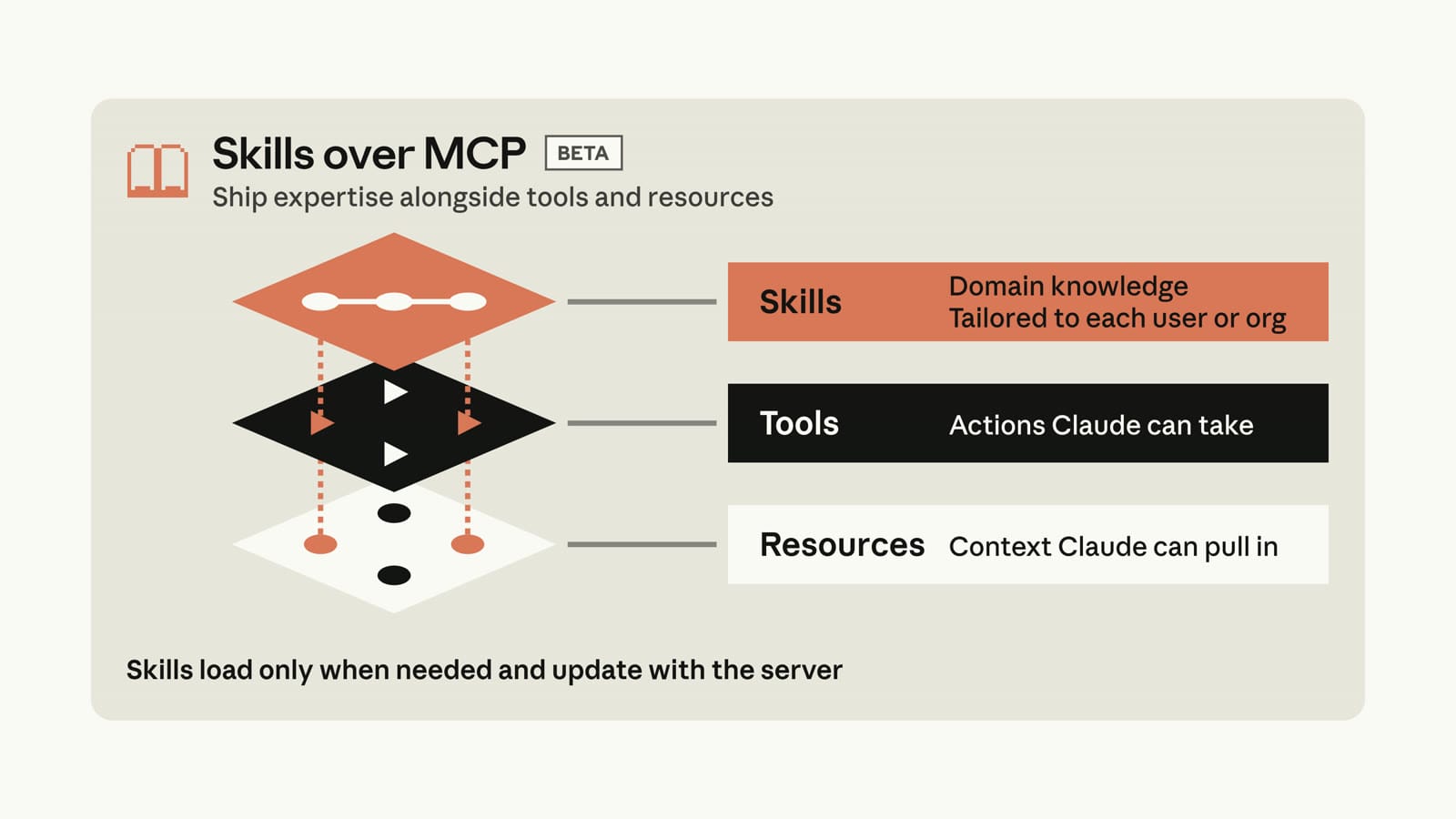
Skills over MCP, in public beta, lets a server publish skills next to its tools. Tool names tell Claude what a server can do, while skills explain how to handle specific jobs. Claude loads a skill only when it needs it, and skills update with the server, so users have nothing extra to install. Shopify uses them to help Claude build a merchant's online store, HubSpot to onboard customers and Atlassian to pull in company context. Carta's skill for issuing equity is coming soon.
Tasks, now generally available, lets a server run long operations or full agent loops in the background while Claude keeps working. ZoomInfo uses it for deeper account and contact research.
Elicitation, also generally available, lets a server pause and ask the user for input. Supabase uses it to confirm costs before creating a paid project, and GitHub asks users to type a repository's name before an agent deletes it.
A fourth feature, File Uploads, is rolling out soon. It will let Claude send PDFs, spreadsheets and images to a server without passing them through the context window.
Skills over MCP is on by default for Pro, Max and Ultra plans. On Team, an admin needs to switch it on, and Enterprise support is coming soon. Tasks and Elicitation work in Claude and Claude Code on the same plans and are rolling out to Team and Enterprise. All of them are part of the open MCP spec, so any compatible client can support them.
The other launches of the week focused on code.
Claude Ship and a practical guide to /ship
On November 23, Anthropic introduced Claude Ship, a set of three agents for the work after a pull request opens. Code Review finds bugs, and PR Steward fixes failing checks, conflicts and review comments. Claude Approvals decides whether a change can merge under a team's policy. Code Review is generally available, and the other two are in beta.
A day later, Anthropic's Addy Osmani published a practical guide to using it without admin rights. It covers three commands in Claude Code:
| Command | What it does |
|---|---|
| /code-review | Reviews your branch for bugs before you push, at effort levels from low to max |
| /ship | Commits, pushes, opens the pull request, reviews it and watches it for up to seven days |
| /steward | Watches a pull request you already opened and works on what comes back |
The guide also lists the catches. /ship commits pending changes as if you ran git add -A, so Osmani suggests checking git status first. The watch runs on your machine and quota, stops when the laptop closes and does not start on Windows. It can run tests after merging the base branch, so anyone who can land code there can run commands on your machine. Claude is told never to merge, and the watch skips files that set rules, such as CLAUDE.md and .github/.
Security for agents like these got its own guide.
Enterprise guide to securing coding agents
Anthropic's new guide is written for security leaders whose teams run Claude Code at scale. It opens with Salesforce's results after it standardized on Claude Code: 79% more pull requests merged per developer and 5% fewer total incidents.
The guide gives six questions to ask about any coding agent, from "Does the model refuse when it should?" to "Can you reconstruct an incident?". It then walks through four risks: leaked credentials and privilege abuse, unvetted dependencies and extensions, data exfiltration and prompt injection. For each one, it shows the matching controls in Claude Code. Examples include sandboxing that admins can require and deny rules in managed settings that users cannot override.
"A CISO's responsibility in the age of agentic AI is not to achieve zero risk," Anthropic's deputy CISO Jason Clinton writes in the guide. The goal, he says, is to make agentic risk "legible and bounded."
The guide also points to Enterprise Frontier Safeguards, which entered public beta on November 23. It lets companies on zero data retention keep inputs and outputs in their own cloud storage, encrypted with their own keys. Anthropic's automated monitoring checks that data for misuse without keeping a copy.
The last update looks at how Anthropic builds agents itself.
How Anthropic rebuilt Claude Managed Agents
Claude Managed Agents is Anthropic's platform for running agents in the cloud. In a new 16-minute talk, product manager Jess Yan and engineers Michael Cohen and Lance Martin tell its story. Anthropic built the infrastructure three times before opening it to customers.
The key change was separating the "brain", the harness that runs the model, from the "hands", the environment where the agent's code runs. The team also covers dynamic workflows, which coordinate work across many agents, and dreaming, which tidies what agents store in memory between sessions. Managed Agents and dynamic workflows are in beta, and dreaming is a research preview.
Smaller changes landed in Claude Code and the API over the same days.
Smaller Claude Code and API updates
These changes are minor, but some of them affect developers who run Claude Code on cloud platforms or still use older models:
- Claude Code 2.1.332 (November 25). Skills from MCP servers appear in the / menu as server:skill, in beta. On Google Cloud's Agent Platform and Microsoft Foundry, the sonnet alias now points to Sonnet 5.5, and Foundry's opus alias moves to Opus 5.5.
- Claude Code 2.1.331 (November 23). Code Mode lets Claude write JavaScript to run its tools. It now works in terminal sessions on Amazon Bedrock, Google Cloud, Microsoft Foundry and Claude Platform on AWS. The VS Code extension adds a "Fix with Claude Code" quick fix for errors and failed tests and a "Resolve Merge Conflicts" button.
- Opus 4.5 deprecation (November 23). Claude Opus 4.5 will be retired from the Claude API on January 22, 2027. Anthropic recommends moving to Opus 5.5.
- Storage webhooks (November 23). Organization webhooks, in beta, now send an alert when a customer-owned storage bucket fails Anthropic's daily check and another when it recovers.
The skills update in Claude Code is the same Skills over MCP feature. Servers that ship skills now work in the terminal as well as in the Claude apps. Teams still on Opus 4.5 have about two months to switch.
What these Claude updates mean for developers
Together, they move Claude from a chat window toward a platform that other software runs on. Install as app is the update most people will feel. Anyone on any plan can now turn a prompt into a desktop tool without an app store or an API key. For developers, Skills over MCP matters more, because a server can now ship its own instructions and Claude learns how to use it properly. Teams on GitHub should try /ship on a test repository first, and read the security guide before they let agents run on shared code. The Rust migration shows the same approach at work inside Anthropic, with agents doing the porting and engineers checking the result.
Sources
- ClaudeDevs on X – November 23–25, 2026
- Turn artifacts into Mac and Windows apps, Anthropic – November 24, 2026
- MCP servers can now ship skills, run tasks, and more with Claude, Anthropic – November 24, 2026
- Introducing Claude Ship, Anthropic – November 23, 2026
- A practical guide to shipping with Claude Code, Addy Osmani, claude.dev – November 24, 2026
- The enterprise guide to securing coding agents, Anthropic – November 23, 2026
- Zero data retention with Enterprise Frontier Safeguards is now in beta, Anthropic – November 23, 2026
- Lessons from building agents on the Claude Platform, YouTube – November 24, 2026
- Migrating our Messages API to Rust, Anthropic – November 25, 2026
- Claude Code changelog – versions 2.1.331 and 2.1.332
- Claude Platform release notes – November 23, 2026