Felix Laurent

OpenAI has opened healthcare model configurations to all developers on its API. These are versions of its GPT-6 models set up for clinical questions. When web search is on, they look up answers in a dedicated index of medical sources instead of the open web. OpenAI added them to its API changelog and help center on November 24, 2026.
Four model IDs are available, including gpt-6.2-astra-healthcare. Any API organization can use them, with no ChatGPT for Healthcare or Enterprise contract. OpenAI says developers can build apps that answer clinical questions, compare findings across studies and summarize medical evidence with citations.
What OpenAI's healthcare configurations are
A configuration is not a new model. Select models get "a harness tailored to clinical questions," OpenAI says. In practice, that means healthcare-specific instructions plus what OpenAI calls trusted clinical search.
Developers call the configurations through the Responses API, the same way they call any other model. Web search has to be enabled, because the medical index is reached through the search tool. Without it, the model answers from its own knowledge.
The four IDs are:
- gpt-6.2-astra-healthcare, built on GPT-6.2 Astra, OpenAI's top reasoning model, released on November 17.
- gpt-6.2-sol-healthcare, built on the cheaper GPT-6.2 Sol.
- gpt-6-astra-healthcare and gpt-6.1-sol-healthcare, versions on the older models.
OpenAI's help page adds a warning. Developers should review answers and cited sources before relying on them, because the configurations "do not replace professional medical judgment."
OpenAI first announced the configurations about a week before they reached the changelog.
Where the healthcare API comes from
At the HLTH health conference in mid-November, OpenAI presented updates to ChatGPT for Healthcare, its product for hospitals. They included computer-use agents for clinical software, more than 20 new plugins and better clinical search. It also announced a healthcare configuration in the Responses API that lets developers build the same search into their own apps.
The company also shared test results. On HealthBench Professional, OpenAI's set of 525 physician-written tasks, GPT-6.2 Astra with the healthcare configuration scored 74.4%. That is 6.3 points ahead of the best rival, Anthropic's Claude Fable 5.2 with web search.
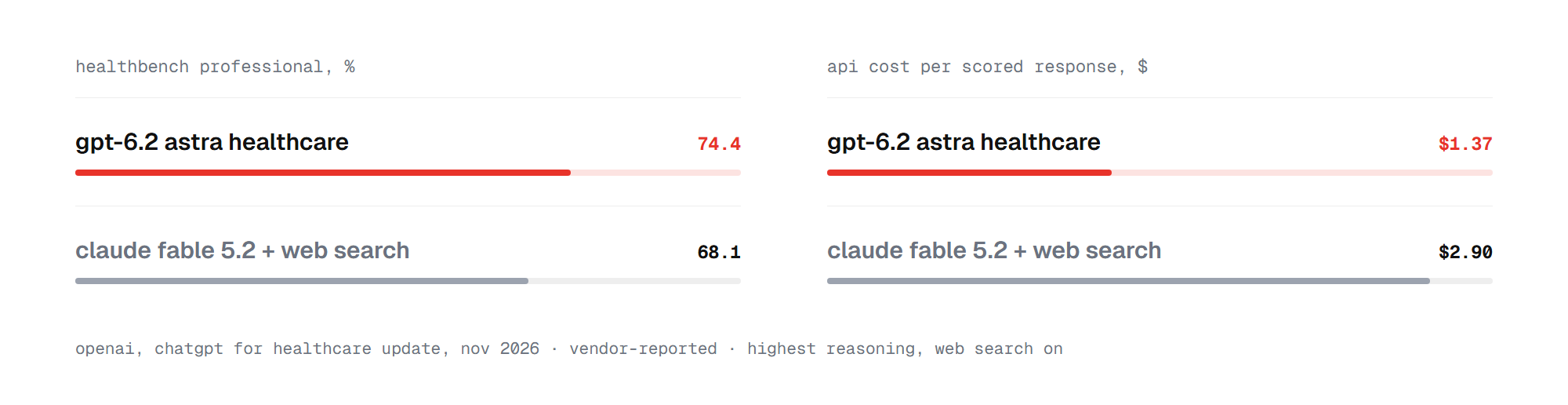
Speed and cost improved too, according to OpenAI. The healthcare setup answered in 23 seconds on average. The same model with general web search took nearly three minutes. Each scored response cost $1.37, against $2.90 for Claude Fable 5.2.
These are OpenAI's own numbers on OpenAI's own benchmark. No outside lab has tested the configurations yet.
The price is where the offer gets interesting.
How much the healthcare models cost
The healthcare configurations cost the same as the base models. OpenAI calls this promotional pricing, valid "at least through December 31, 2026." Prices per million tokens for standard prompts:
| Model | Input | Cached input | Output |
|---|---|---|---|
| gpt-6.2-astra-healthcare | $8.00 | $0.40 | $40.00 |
| gpt-6.2-sol-healthcare | $2.00 | $0.10 | $10.00 |
| gpt-6-astra-healthcare | $10.00 | $1.00 | $50.00 |
| gpt-6.1-sol-healthcare | $2.00 | $0.10 | $10.00 |
Fast mode costs twice as much, and data residency endpoints add 10%. OpenAI does not list a separate fee for the medical search index. Regular web search costs $10 per 1,000 calls plus the search content tokens, and it is unclear whether the same rate applies.
What happens after December 31 is open. OpenAI has not said whether the healthcare models will then cost more than the base versions.
Price is only one question for hospitals. Patient data is the bigger one.
What about patient data and HIPAA
Access to the configurations does not allow developers to process protected health information. For that, an organization needs a Business Associate Agreement with OpenAI, the contract US law requires before a vendor handles patient records. It must also meet OpenAI's account and tool requirements.
Organizations with an established history of API usage can sign it themselves on the API platform, without an enterprise contract. Its list of HIPAA-eligible services includes the Responses API. The list does not mention the healthcare configurations or the medical index by name, though. Developers working with patient records will need to confirm coverage with OpenAI first.
The other gap is the index itself. OpenAI describes it only as "a dedicated index of medical sources." Its ChatGPT pages speak of peer-reviewed studies, clinical guidelines and public health sources. The company has not published a full list, so developers cannot check which journals or guidelines the model actually cites.
OpenAI has also done the same for another profession.
OpenAI's push into professional AI
The healthcare models sit next to legal configurations in OpenAI's price list, such as gpt-6.2-astra-law, at the same prices as the base models. There are also gated models for cybersecurity and life sciences. OpenAI is packaging its general models for specific industries, with a tuned harness and its own search.
Health is the biggest of these bets. In January 2026, OpenAI launched ChatGPT Health for consumers and ChatGPT for Healthcare for hospitals. It also bought Torch, a startup that combines medical records. In April came ChatGPT for Clinicians, a free tool for doctors, along with HealthBench Professional.
Rivals are moving the same way. Anthropic launched Claude for Healthcare in January. OpenEvidence, a medical search app popular with doctors, was valued at $12 billion in a January funding round. Unlike OpenEvidence, OpenAI now sells its clinical search to any developer.
So far, the launch has drawn little attention. OpenAI posted no blog or X announcement for the November 24 release. Tracker accounts on X spotted the change in the changelog, and developers began adding the new IDs to their tools within hours.
Should developers use OpenAI's healthcare API
For teams building clinical research and evidence tools, it is worth testing now. The configurations cost nothing extra until the end of the year, and they need no enterprise contract. According to OpenAI, they are faster and more accurate than its own models with general search.
The open questions matter more for patient-facing products. OpenAI has not published what the medical index contains or confirmed that the agreement covers it. All test results come from OpenAI's own benchmark. For now, the healthcare API is a cheap way to add cited medical search to an app. Hospitals will want more transparency before they trust it with patient care.
Sources
- Healthcare model configurations in the OpenAI API, OpenAI Help Center – November 24, 2026
- OpenAI API changelog – November 24, 2026
- OpenAI API pricing – accessed November 25, 2026
- More ways to move care forward with ChatGPT for Healthcare, OpenAI – November 2026
- TestingCatalog on X – November 24, 2026