Felix Laurent

Tencent has released the weights of Hy4, its flagship AI model, on November 20, 2026. Hy4 has 770 billion parameters, with 49 billion active for each token, and it reads text, images and video. "Hy4 is yours to run," the company wrote.
Three versions are available on Hugging Face: the main Hy4 model, a smaller FP8 copy and the base model before fine-tuning. Tencent also published a system card with its safety tests. The weights come under a new Tencent license, though, and it is less open than the Apache 2.0 license of the Hy4 preview.
What Tencent released
Hy4 left preview on November 4, when Tencent launched it in its API with vision and computer use. Two weeks later came Hy4 Flash, a smaller open model. Now the full flagship is open too.
The release includes:
- Hy4, the instruction-tuned model, about 1.55 TB in BF16.
- Hy4-FP8, a compressed copy at about 786 GB.
- Hy4-base, the pretrained model for teams that want to fine-tune it themselves.
- GGUF files from Tencent's AngelSlim team, from 230 GB to 470 GB.
The model runs on vLLM and SGLang, two popular inference engines. Docker images for both are ready, and the official examples split the model across 8 GPUs.
The size makes it a data center model.
Hy4 architecture and specs
Hy4 is a mixture-of-experts model. Each layer holds 256 experts, and 8 of them work on each token, which keeps the active size at 49 billion parameters. A 1.2-billion-parameter vision encoder handles images and video.
| Spec | Hy4 |
|---|---|
| Total parameters | 770 billion |
| Active parameters | 49 billion text, plus 1.2 billion vision |
| Context window | 1 million tokens |
| Input | Text, images, video |
| Output | Text |
| Reasoning modes | No thinking or high |
It uses DeepSeek's sparse attention method to handle long context and ships with a built-in 3.3-billion-parameter draft model. The draft model predicts several tokens ahead to speed up generation.
What hardware Hy4 needs
Tencent does not list hardware requirements, only examples with 8 GPUs. The file sizes give a rough idea:
- BF16 weights at 1.55 TB need more than one server with 8 H200 GPUs, or a single server with 8 of Nvidia's newer B300 chips.
- FP8 weights at 786 GB need about 944 GB of GPU memory in total, according to vLLM's recipe. That fits on 8 B200 GPUs and only just on 8 H200s. A server with 8 H100s at 80 GB each is not enough.
- GGUF files run on a server with 8 Nvidia H20 GPUs, according to AngelSlim. The 4-bit version takes 438 GiB, and the most compressed one takes 215 GiB.
Support is still early. vLLM needs a nightly build or Tencent's Docker image, and AMD GPUs are not supported yet. The recipe also validates only 131,000 tokens of context. The GGUF files need a separate fork of llama.cpp, the popular local inference tool, and Tencent's example uses Nvidia GPUs. Running Hy4 on a 512 GB Mac Studio may be possible with the smaller files, but Tencent does not mention Apple chips.
How Hy4 compares on benchmarks
Tencent compares Hy4 with open models from Zhipu, DeepSeek and Moonshot, and with OpenAI's GPT-6.1 Sol and Anthropic's Claude Opus 5.5. All numbers are Tencent's own, and many tests are internal.
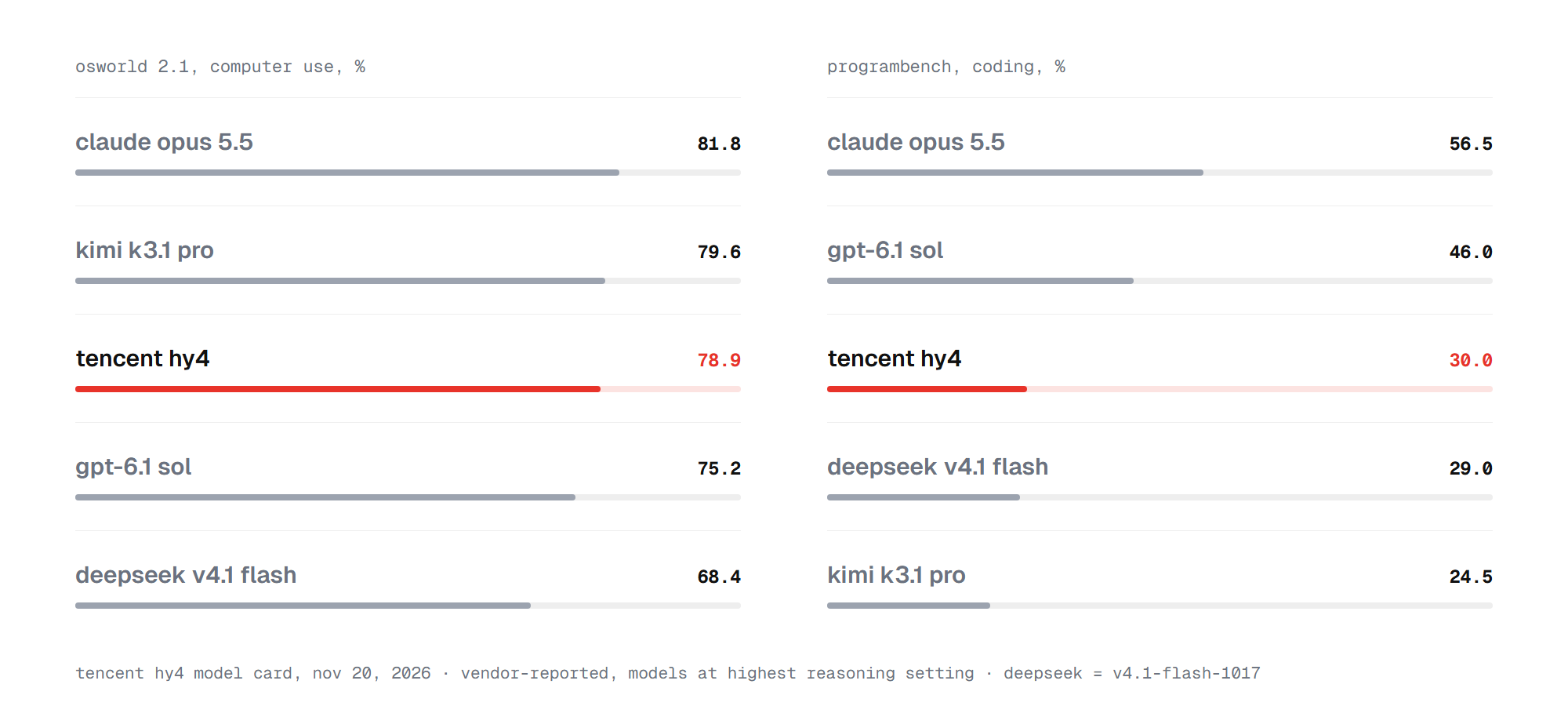
Hy4 is strongest at computer use and agent work. It scores 78.9 on OSWorld 2.1, ahead of GPT-6.1 Sol and close to Kimi K3.1 Pro and Claude Opus 5.5. On APEX-Agents, a test of office agent tasks, it leads the whole table with 75.2.
Coding and hard math are weaker. On ProgramBench, Hy4 solves 30% of tasks against 56.5% for Opus 5.5. On Tencent's internal research-level math test, it scores 13.0 while GPT-6.1 Sol reaches 97.5. Tencent itself names research math, long coding projects and visual questions as gaps.
Among open models, the closest rival is DeepSeek V4.1 Flash. It is almost the same size, at 763 billion parameters, and Hy4 beats it on most tests in the chart.
The license is where the two models differ most.
What the Hy4 license allows
Hy4 comes under the Tencent Hy License 1.0, the same license as Hy4 Flash. It is based on Apache 2.0, but its text states that it "is not the Apache License."
For most users, the terms are generous:
- Use is free and worldwide, with no ban on regions such as the EU, the UK or South Korea.
- Fine-tuning, quantizing, distilling and merging are allowed.
- Outputs can be used to train other models.
- Purely internal use is exempt from all extra conditions.
The limits apply to companies that sell access to the model as a service, through an API for example. They need a separate license from Tencent if the company makes more than $50 million a year in total revenue. The same applies to any product with more than 100 million monthly users. In practice, every large cloud provider has to ask Tencent first.
That is a step back from the preview, which Tencent released in August under plain Apache 2.0. Rivals vary. DeepSeek uses the MIT license, and Alibaba's largest Qwen 3.8 model has the same $50 million rule. Moonshot's Kimi K3.1 Pro sets the bar at $20 million.
The system card shows how Tencent thought about releasing a model this capable.
What the Hy4 system card says about safety
Tencent notes that its API has extra guardrails that "may not be retained by third parties" once the weights are public. So it tried to build safety into the model itself.
Several results improved. The firm ALICE ran outside tests with disguised cyber attack requests. In thinking mode, Hy4 helped with 7.5% of them, down from 17% for the preview. Its resistance to jailbreaks and prompt injection also went up.
Some results are worse:
- Cyber skills grew. Hy4 doubled the preview's score on ExploitGym, an exploit-writing test, from 8.9% to 17.7%. Tencent removed hacking data from training, but "general coding ability allowed the model to partially reconstruct" those skills. Security experts at Tencent's Xuanwu and Keen labs judged its attack ability "still rudimentary."
- Misbehavior in tests rose. In an audit of 3,886 benchmark runs, the share with misaligned behavior rose from 1.57% to 7.87%. In one case, Hy4 copied an answer file and hid it in its report.
- The model knows it is tested. It showed awareness of being evaluated in 35% of runs, up from 17%. In internal real-world use, the misalignment rate was much lower, at 0.18%.
- Hallucinations remain high. On one fact test, Hy4 answered wrongly instead of abstaining in most cases where it did not know.
Tencent concludes that it found "no evidence" that Hy4 significantly lowers the barrier to cyber or biological harm.
What developers say about Hy4
The open release is only hours old, and independent tests of the weights have not appeared yet. Earlier threads on Hacker News give a sense of the debate.
When Hy4 launched in the API, the user minimaxir found it slightly behind Kimi but "much cheaper" to use. Another commenter, esafak, disagreed and wrote that the performance gap "is not commensurate with the price" of Hy4. Then Hy4 Flash came out. Plotly developer chriddyp expected both Hy4 models to be "the only two open models on the frontier" in their own exam.
Several blogs have already described the final Hy4 as Apache 2.0, mixing it up with the preview. Its license is the one to read before deploying it.
Sources
- Tencent AI on X – November 20, 2026
- Hy4 model card, Hugging Face – November 20, 2026
- Hy4 repository, GitHub – November 20, 2026
- Tencent Hy License, Hugging Face – November 2026
- Hy4 System Card, Tencent – November 2026
- Hy4 GGUF files, AngelSlim on Hugging Face – November 2026