Felix Laurent

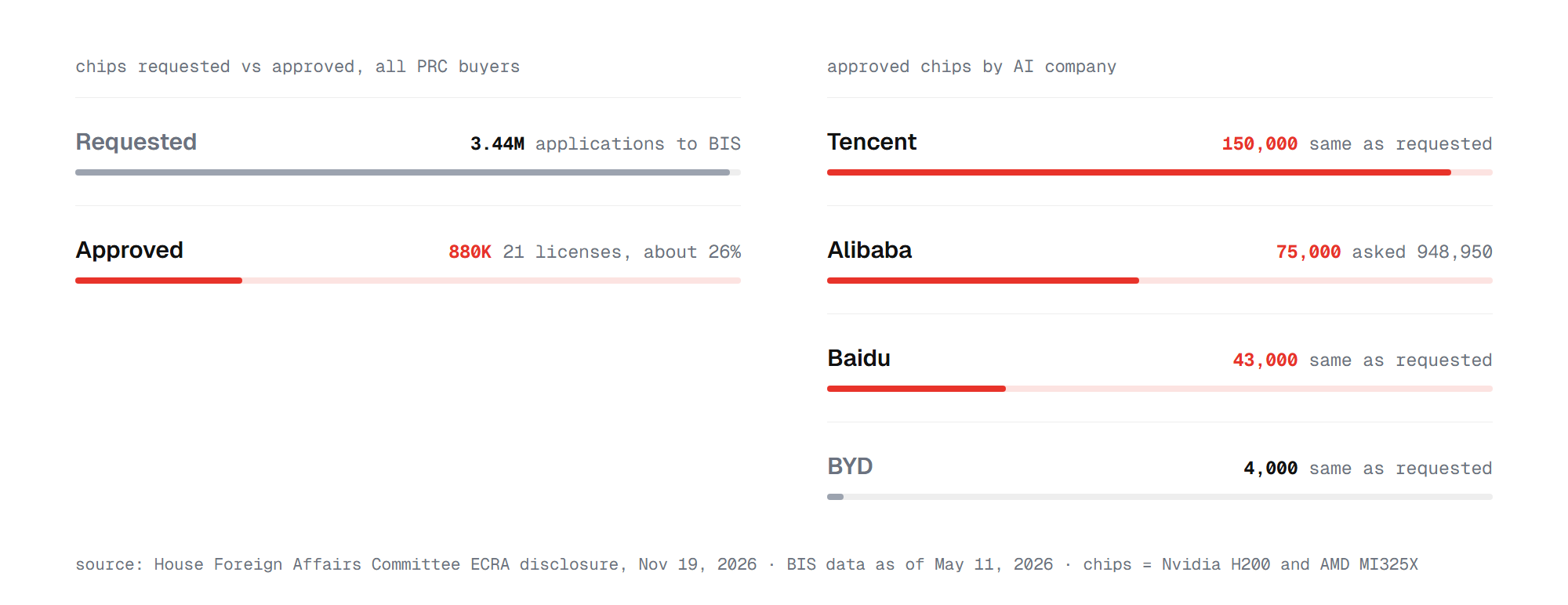
The US Commerce Department approved licenses to sell 879,868 Nvidia and AMD AI chips for China. These are the chips labs use to train and run large AI models. The figure comes from documents a House committee released on November 19, 2026. Companies had asked to sell more than 3.4 million. The approved buyers include Alibaba, Tencent and Baidu, which build some of China's leading AI models.
House Foreign Affairs Committee chair Brian Mast used his powers under the Export Control Reform Act to make the data public. He called it "the most detailed public disclosure in the history" of the law. The files also show Nvidia listing two suspected smuggling fronts on its license applications.
What the House committee released
The committee published a two-page summary and a redacted table of license applications. The numbers come from a summary that the Commerce Department's Bureau of Industry and Security (BIS) gave the committee on May 11, 2026. The chips in question are Nvidia's H200 and AMD's MI325X.
As of that date, BIS had received applications to sell 3,444,160 of these chips to Chinese companies. It approved 879,868 across 21 license applications, about one in four. Bernstein analyst Stacy Rasgon told CNBC that the ratio does not suggest BIS was "approving everything they got willy nilly."
The summary is not the full picture. The committee says it also holds applications that the May summary did not fully reflect. One example is a December 19, 2025, Nvidia request to export 445,000 H200s to Tencent. The list of buyers explains why the numbers matter for AI.
What the chips mean for China's AI labs
The H200 is the chip AI labs use to train and run large language models. It belongs to Nvidia's Hopper generation, a step behind the Blackwell and Vera Rubin chips that cannot be sold to China at all. For Chinese developers locked out of newer hardware, it was among the best US AI chips they could legally buy, alongside AMD's MI325X.
The approved buyers are among China's biggest AI developers. Alibaba builds the Qwen models, Tencent the Hunyuan models and Baidu the Ernie models. BIS refused Nvidia's request to sell 508,000 chips to ByteDance, the maker of Doubao, The Register reports. It also turned down an Nvidia request for 610,000 chips for Alibaba.
Beijing has pushed the other way. It held back large H200 imports, Reuters reported in November. Beijing wants Alibaba, ByteDance, Tencent and DeepSeek to rely on Chinese chips, especially for running models. Several big firms got only about 10,000 H200s each into the mainland.
A new US rule makes computing power tighter still. Since November 16, Chinese firms can no longer freely rent advanced US chips in data centers abroad. Tencent president Martin Lau said on November 18 that the new restrictions could slow its next-generation models in the short term. Alibaba CEO Eddie Wu said its long-term target of 20 gigawatts of data center capacity may be lowered. Moonshot AI, the maker of Kimi, cancelled a $150 million lease of Nvidia B300 chips in Indonesia, The Information reported.
The approvals by company show who got to the front of the line.
Which AI companies got the chips
BIS approved 150,000 chips for Tencent and its subsidiaries, 43,000 for Baidu and 4,000 for carmaker BYD. In each case that matched the full amount in the May summary. Alibaba asked for 948,950 chips for itself and its subsidiaries and got 75,000. CNBC reports that license requests also named ByteDance and Tesla's Shanghai unit.
The committee stressed that all four approved companies are on the Pentagon's 1260H list of Chinese military companies. Together they received 272,000 chips, almost a third of the total. Only Tencent was on that list for the whole licensing period, though. Alibaba, Baidu and BYD were added on June 8, and the list itself does not ban exports.
"The Bureau of Industry and Security has failed to enforce the rules," said Rep. Gregory Meeks, the committee's top Democrat. He added that the public "has the right to know how these decisions were made." The middlemen on Nvidia's paperwork drew even more attention.
Suspected smuggling fronts on Nvidia's applications
All but two Nvidia applications listed the same companies as possible installers of the systems in Chinese data centers. They are Maginfra, Beijing New Matrix Information Technologies, ZTE Kangxun Telecom and Lenovo or its subsidiaries. Other names on multiple applications include Aivres Systems, XFusion, Cloudnine and SmoothCompute.
Mast called Maginfra and New Matrix suspected "smuggling fronts." "Both are fake companies," he said at the committee meeting. He cited New York Times reporting that both had empty offices and ties to companies on the US Entity List. Firms on that list cannot receive US technology without a special license. Some of the same companies also appeared on AMD applications. Every Nvidia and AMD application rated the risk of diversion as "low."
The questions land on a company already under scrutiny over chips reaching China. Jensen Huang was tied to a suspected Chinese spy at Megaspeed, a Singapore firm that US investigators suspect diverted Nvidia chips. Huang resigned as Nvidia's CEO on November 12. Mast wrote to the Commerce Department about Megaspeed on November 17.
How Nvidia, AMD and Commerce responded
Nvidia says it followed the rules in force at the time. "Despite receiving some licenses, we have since stopped shipping H200s to China," spokesperson John Rizzo told CNBC. Nvidia halted H200 shipments to China earlier this month. AMD said it complies with US export laws.
A BIS spokesperson said the agency gave Congress data on denials as well as approvals. "Licensing decisions are the product of deliberation and consultation among multiple U.S. Government agencies," the spokesperson said. Maginfra and New Matrix did not reply to CNBC.
H200 sales to China became possible in December 2025, when President Trump allowed them if the US government received a 25% cut. Actual shipments stayed limited because Beijing did not approve large imports. Nvidia reported $2.4 billion in quarterly revenue from H200 and related sales in China on November 17.
What happens next
The disclosure sets up a busy few weeks in Congress. Huang is due for a closed-door, transcribed interview with the House Foreign Affairs Committee and two other panels on December 1. Nvidia general counsel Tim Teter is scheduled for December 2. Senate Banking chair Tim Scott said Commerce Secretary Howard Lutnick has also agreed to testify.
Commerce is tightening rules at the same time. On November 16, it closed a loophole that let Chinese companies rent Nvidia computing power from data centers in other countries. Meanwhile, AMD shares fell on November 19 after a report from short seller Hunterbrook. It alleged that a Chinese server maker on the Entity List kept getting newer AMD firmware.
What the chip licenses mean for AI in China
For China's AI labs, the licenses opened a narrow door. Alibaba, Tencent and Baidu won approval for H200-class chips, the best US hardware they could legally buy for training and running models. BIS cleared about one in four of the chips requested and turned down the biggest orders from Alibaba and ByteDance.
Approval also did not mean delivery. Beijing held back imports and pushed its tech giants toward Chinese chips. Reuters reported in early November that about 600,000 H200s were stuck in Hong Kong. Now Nvidia has stopped shipping them altogether.
What the files do show is how the checks worked. Every Nvidia and AMD application called the diversion risk "low" in its filing. Yet nearly all Nvidia applications named firms with empty offices and links to Entity List companies as installers. Chris McGuire, a former NSC official now at the Council on Foreign Relations, questioned "whether Commerce conducted any serious national security review" at all. That is the real finding here, more than the chip count.
Washington is already tightening. Besides the November 16 rule, lawmakers are pushing again for bills that would track where exported chips end up, such as the Chip Security Act. The December interviews with Huang and Teter should show how much Nvidia knew about the middlemen on its paperwork.
For Nvidia, China sales of top chips are close to over for now. For Chinese AI labs, the next Qwen, Hunyuan and Ernie models will likely train on fewer US chips and more domestic ones. For US policy, the debate is shifting from whether to sell chips to China to whether anyone checks where they end up. The answers in December will decide how strict the next round of rules gets.
Sources
- License information on AI chips sent to China released by US House committee, Reuters – November 19, 2026
- Chairman Brian Mast exercises legislative authority to publicly release AI chip license information for China, House Foreign Affairs Committee – November 19, 2026
- Commerce approved sales of more than 879,000 AI chips to Chinese companies, Rep. Mast says, CNBC – November 19, 2026
- Chairman Mast sends letter to Commerce Department on Megaspeed, House Foreign Affairs Committee – November 17, 2026
- House panel says BIS cleared 879,000-plus AI chips for China, Briefs – November 19, 2026
- US let Nvidia and AMD sell bucketloads of chips to military-linked Chinese companies, The Register – November 20, 2026
- US approved exports of nearly 879,000 advanced AI chips to Chinese firms, Korea JoongAng Daily (Reuters) – November 20, 2026
- Nvidia H200 chips sit in Hong Kong awaiting China import approval, The Next Web – November 2026
- Pentagon adds 65 new entities to the 1260H list of Chinese military companies, WilmerHale – June 11, 2026
- BIS targets remote access to advanced chips through overseas data centers, Nixon Peabody – November 16, 2026
- Jensen Huang and NVIDIA agree to appear before Congress, House Select Committee on the CCP – November 17, 2026